The AI ecosystem in 2025 is evolving faster than ever. From agentic AI workflows to quantum enhanced machine learning, organizations now have access to powerful platforms designed to automate operations, boost productivity, and unlock entirely new scientific capabilities.
Below is a deep-dive into some of the most transformative tools shaping the next era of artificial intelligence.
1. LangChain 2.0 – Agentic AI Orchestration
Key Feature: Agentic AI workflow orchestration
Primary Use Case: Workflow automation
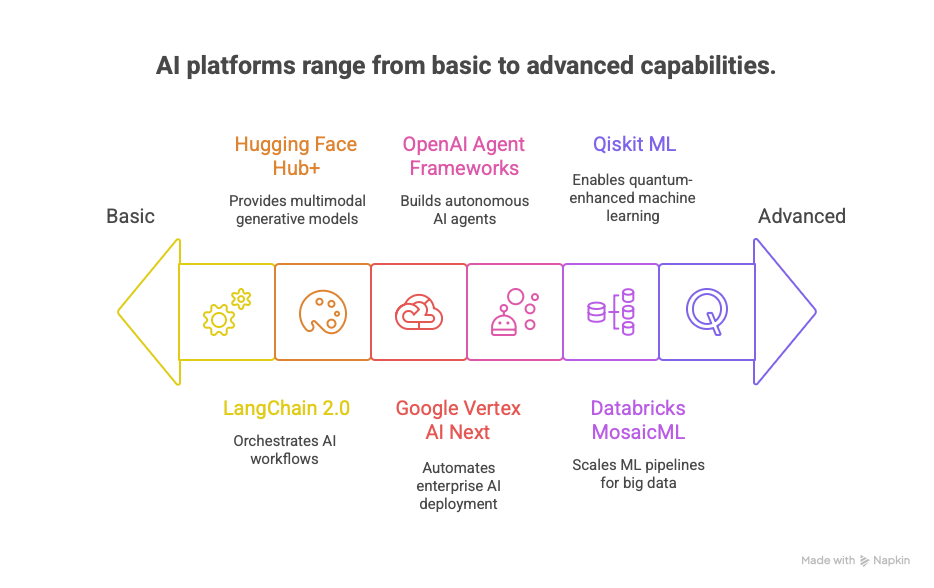
LangChain 2.0 represents the next generation of AI systems capable of reasoning, planning, and taking multi-step actions. It integrates LLMs with tools, APIs, and memory to automate complex workflows everything from data processing to customer operations.With improved agent reliability and native function-calling support, LangChain 2.0 is quickly becoming the backbone for building AI-driven applications that behave more like autonomous digital employees than traditional chatbots.
2. Hugging Face Hub+ Multimodal Generative AI
Key Feature: Multimodal (text, vision, audio) generative models
Primary Use Case: NLP + computer vision tasks
Hugging Face Hub+ expands the standard HF model hub with enterprise-ready features and cutting-edge multimodal models. Developers can now run powerful text-to-image, text-to-video, and audio generation models in a unified environment.
For teams building AI products that require language + visual reasoning like content generation, product tagging, or video summarization, Hub+ is becoming the go-to platform.
3. Google Vertex AI Next AutoML 2.0 for the Enterprise
Key Feature: AutoML 2.0 with end-to-end lifecycle tools
Primary Use Case: Enterprise AI deployment at scale
Vertex AI Next upgrades Google’s enterprise AI stack with a new generation of AutoML tools that dramatically simplify model building. It offers automated data prep, hyper-parameter tuning, model evaluation, and deployment pipelines all inside a secure, compliant ecosystem.
Enterprises adopting Vertex AI Next gain the advantage of faster experimentation cycles and seamless migration from prototypes to fully deployed production systems.
4. OpenAI Agent Frameworks Autonomous AI Agents
Key Feature: Fully programmable autonomous agents
Primary Use Case: Customer support automation
OpenAI’s Agent Frameworks enable developers to build autonomous agents capable of retrieving information, performing actions, handling conversations, and integrating with business systems.
These agents can operate across support desks, internal knowledge systems, and IT workflows handling repetitive tickets, resolving inquiries, and generating dynamic responses with minimal human supervision.
It’s the next evolution of AI-driven customer interactions.
5. Qiskit ML Quantum-Enhanced Machine Learning
Key Feature: Hybrid quantum ML algorithms
Primary Use Case: Drug discovery, materials science, optimization
Qiskit ML brings quantum computing into the machine learning world through hybrid algorithms that combine classical and quantum processors.
While still early, the biggest opportunities lie in scientific domains that require exploring massive molecular or combinatorial spaces such as discovering new drugs, designing proteins, and modeling materials at the atomic level.
Quantum-enhanced ML is opening doors to breakthroughs previously impossible with classical hardware alone.
6. Databricks MosaicML Scalable ML Pipelines for Big Data
Key Feature: Fully scalable, modular ML pipelines
Primary Use Case: Big data analytics + enterprise LLM training
MosaicML, now part of Databricks, provides a highly optimized environment for training custom machine learning and LLM models on enterprise-scale datasets.
Its Composer and MPT (Mosaic Pretrained Transformer) frameworks allow companies to build private, secure, and fully customizable AI systems without depending on off-the-shelf black-box models.
For organizations dealing with petabyte-scale data, MosaicML is one of the most cost-efficient ways to operationalize large-scale AI.
The AI landscape is shifting from standalone models to integrated platforms that orchestrate data, tools, and autonomous behavior. Whether you are a startup building multimodal apps or a global enterprise exploring quantum-enhanced ML, these platforms represent the forefront of innovation in 2025.