Introduction, Why Semantic Segmentation Is Becoming Mission Critical
Artificial Intelligence has reached a stage where recognizing objects is no longer enough. Modern intelligent systems must understand scenes with precision, context, and spatial awareness. This is where Semantic Segmentation plays a transformative role.
Semantic Segmentation is a computer vision technique that assigns a class label to every pixel in an image. Instead of identifying objects as whole entities, it creates a dense, pixel level map of the scene. Roads, vehicles, people, buildings, vegetation, medical tissues, and industrial components are all identified at the most granular level possible.
For executive leaders and AI architects, Semantic Segmentation is not just a technical enhancement. It is a strategic capability that enables safer automation, higher accuracy decision making, and deeper situational awareness. As organizations move toward autonomous systems, digital twins, and real time AI driven operations, pixel level intelligence becomes a necessity rather than a luxury.
In my earlier article on Object Detection in Deep Learning and Intelligent Vision Systems, I explained how bounding box based detection unlocked the next wave of visual intelligence. Semantic Segmentation takes that evolution further by removing ambiguity and enabling machines to truly understand visual environments.
What Is Semantic Segmentation in Simple Terms
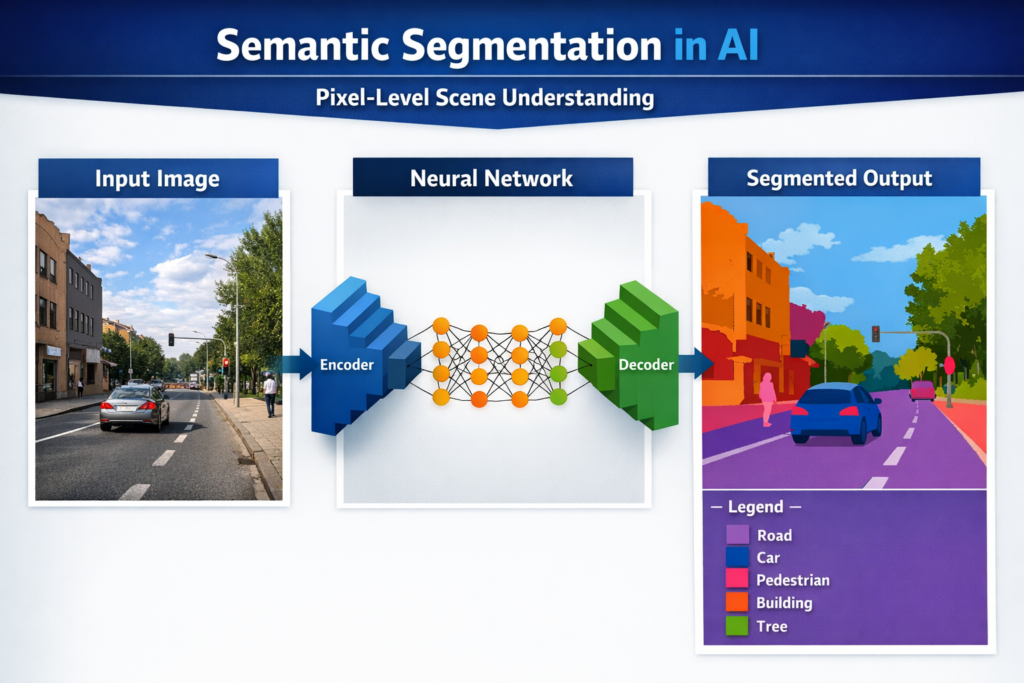
Semantic Segmentation is the process of classifying every pixel in an image into a predefined category. If an image contains a road, cars, pedestrians, trees, and buildings, each pixel is labeled accordingly.
This approach differs fundamentally from image classification and object detection. Image classification assigns a single label to an entire image. Object detection draws bounding boxes around objects. Semantic Segmentation paints the entire image with meaning.
From a business perspective, this means AI systems can measure areas, detect boundaries, understand surfaces, and analyze spatial relationships with high accuracy. This capability is essential for applications where precision matters more than object count.
Image below is a Semantic Segmentation example showing pixel level labeling of road, vehicles, pedestrians, and buildings using AI
Semantic Segmentation Versus Object Detection
Understanding the distinction between Semantic Segmentation and Object Detection helps leaders choose the right approach.
Object Detection identifies objects and their approximate locations. It is ideal for counting, tracking, and alerting scenarios. Semantic Segmentation goes deeper by identifying exact shapes, edges, and regions.
In autonomous driving, Object Detection identifies a pedestrian. Semantic Segmentation defines the pedestrian’s exact outline and the drivable road surface around them. In medical imaging, Object Detection highlights a tumor. Semantic Segmentation outlines its precise boundary, enabling accurate measurement and treatment planning.
These techniques are often used together in production systems. Object Detection provides speed and context, while Semantic Segmentation delivers precision and safety.
How Semantic Segmentation Works at a High Level
Semantic Segmentation models are typically built using deep convolutional neural networks designed for dense prediction tasks. Instead of producing a single output label, these networks generate a prediction for every pixel.
The process begins with annotated datasets where each pixel is labeled. This annotation process is intensive and requires domain expertise, especially in healthcare and industrial applications.
During training, the model learns spatial patterns, textures, edges, and contextual cues that differentiate classes. During inference, the model processes new images and outputs a segmentation map that aligns with the original image resolution.
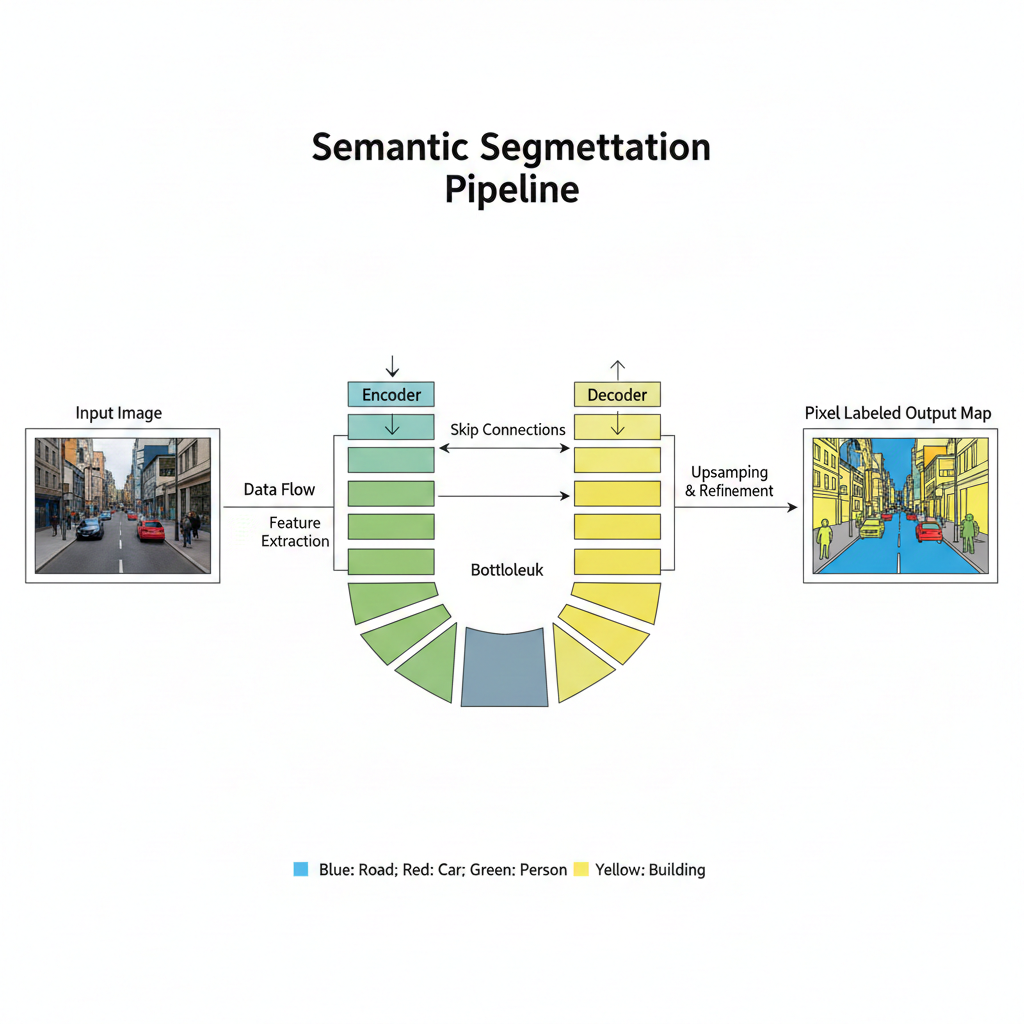
Below image is Semantic Segmentation pipeline showing input image, encoder decoder neural network, and pixel labeled output map
Evolution of Semantic Segmentation Architectures
Early Semantic Segmentation approaches relied on classical image processing and region based methods. These approaches struggled with complex scenes and variability.
The deep learning era introduced fully convolutional networks, which replaced dense layers with convolutional layers to enable pixel wise prediction. Encoder decoder architectures became the dominant pattern, where encoders capture context and decoders restore spatial detail.
Modern architectures incorporate attention mechanisms, multi scale feature extraction, and transformer based components. These innovations improve accuracy in challenging scenarios such as overlapping objects, fine boundaries, and small structures.
For AI architects, the key insight is that Semantic Segmentation models have matured into production ready systems capable of real time performance when optimized correctly.
Why Semantic Segmentation Matters for Business Leaders
Semantic Segmentation directly impacts safety, efficiency, and cost optimization.
In autonomous vehicles, it enables accurate understanding of drivable surfaces, lane boundaries, sidewalks, and obstacles. Industry data shows that pixel level segmentation reduces perception errors in complex urban environments by significant margins compared to bounding box methods alone.
In healthcare, Semantic Segmentation supports precise analysis of medical images such as MRI, CT, and X ray scans. Hospitals using AI assisted segmentation report faster diagnosis workflows and improved consistency across clinicians.
In manufacturing, it enables defect detection at a granular level. Instead of flagging an entire product as defective, segmentation identifies the exact region of failure, reducing waste and rework.
In agriculture, Semantic Segmentation analyzes crop health, soil conditions, and weed distribution. Precision agriculture solutions leveraging segmentation have demonstrated yield improvements while reducing water and fertilizer usage.
Data Insights That Highlight Its Impact
The global computer vision market is growing rapidly, driven by demand for automation and intelligent analytics. A significant portion of this growth is attributed to advanced vision tasks like Semantic Segmentation.
Enterprises deploying pixel level vision systems report improvements in accuracy ranging from 15 to 40 percent compared to traditional detection based approaches, depending on the domain. In safety critical systems, even small accuracy gains translate into substantial risk reduction.
Annotation costs remain one of the biggest investments. However, organizations adopting semi automated labeling and active learning strategies reduce labeling effort by up to 50 percent over time.
Semantic Segmentation and Edge AI
One of the most important trends shaping Semantic Segmentation is the rise of edge AI. Running segmentation models on edge devices such as cameras, drones, and embedded systems reduces latency and improves privacy.
Edge optimized models enable real time decision making in autonomous machines, industrial robots, and smart infrastructure. Advances in hardware accelerators and model optimization techniques make pixel level inference feasible even on constrained devices.
For organizations planning long term AI strategies, edge based Semantic Segmentation is a critical capability that aligns with data sovereignty and real time performance requirements.
Linking Semantic Segmentation to Object Detection
Semantic Segmentation does not replace Object Detection. It complements it.
In my previous article on Object Detection in Deep Learning and Intelligent Vision Systems, I explained how detection models form the backbone of many intelligent vision applications. Semantic Segmentation builds on this foundation by adding depth and precision.
Together, these techniques enable systems that see, understand, and act with confidence. Detection identifies what matters. Segmentation defines how it exists in space. This combination is becoming the standard architecture for advanced vision systems.
You can revisit that article here
https://muralimarimekala.com/2025/10/27/object-detection-in-deep-learning-driving-the-next-frontier-of-intelligent-vision-systems/
Current Technology Trends Driving Adoption
Several trends are accelerating the adoption of Semantic Segmentation.
Autonomous systems demand higher perception accuracy. Smart cities rely on pixel level understanding for traffic management and public safety. Healthcare is embracing AI driven diagnostics at scale. Digital twins require precise spatial modeling of physical environments.
Multimodal AI is also emerging, where segmentation outputs integrate with language models and decision systems. This allows machines not only to see but also to explain what they see.
Challenges and Practical Considerations
Despite its power, Semantic Segmentation presents challenges.
Data annotation is time consuming and requires expertise. Models must generalize across environments, lighting conditions, and sensor types. Deployment requires careful optimization to balance accuracy and performance.
Executives must approach segmentation projects with clear objectives, realistic timelines, and cross functional collaboration. Successful deployments treat Semantic Segmentation as a long term capability rather than a one time project.
Governance, Ethics, and Responsible AI
Pixel level vision systems often process sensitive visual data. Privacy, fairness, and transparency are essential considerations.
Organizations must establish governance frameworks that define how data is collected, processed, and stored. Models should be evaluated for bias and unintended consequences. Clear communication builds trust with users and stakeholders.
Responsible deployment ensures that Semantic Segmentation delivers value without compromising ethical standards.
The Future of Semantic Segmentation
The future of Semantic Segmentation is closely tied to the evolution of intelligent systems.
Self supervised learning will reduce dependency on labeled data. 3D Semantic Segmentation will enable richer spatial understanding for robotics and augmented reality. Integration with digital twins will support predictive maintenance and simulation driven planning.
As these trends mature, Semantic Segmentation will become an invisible yet indispensable layer of intelligent infrastructure.
Practical Guidance for Getting Started
Organizations should begin by identifying high impact use cases where pixel level understanding delivers clear value. Invest in data quality and annotation strategies. Choose architectures aligned with deployment constraints. Plan for continuous improvement and monitoring.
Most importantly, align Semantic Segmentation initiatives with business outcomes rather than technical experimentation.
Semantic Segmentation is redefining how machines understand the world. If your organization relies on visual data, now is the time to explore pixel level intelligence.
Share your thoughts in the comments, subscribe for notifications on future AI architecture insights, and share this article with leaders shaping your AI strategy.