Natural Language Processing has moved from experimental labs into the core of enterprise intelligence. Emails, customer chats, documents, reviews, policies, tickets, contracts, and social media streams are all unstructured text assets waiting to be converted into insight. Deep learning for Natural Language Processing, especially text classification, has become one of the most valuable capabilities for modern organizations that want to scale decision making, automation, and personalization.
We have seen text classification evolve from simple keyword matching into context aware intelligence that understands intent, sentiment, and domain meaning. This article explains how deep learning powers text classification, why it matters for enterprises, and how it connects naturally with my previous work on Image Generation and Style Transfer in Artificial Intelligence, where I discussed how deep models learn representations and transfer knowledge across tasks. The same architectural philosophy now drives intelligent language systems.
What Is Text Classification in Natural Language Processing
Text classification is the task of assigning predefined labels to text based on its content. These labels can represent topics, intent, sentiment, urgency, risk level, compliance category, or any business specific class.
Examples include
- Classifying customer support tickets into billing, technical, or account issues
- Detecting spam, phishing, or fraud messages
- Analyzing sentiment in product reviews or social media posts
- Tagging legal documents by contract type or risk category
- Routing emails and chats automatically to the right teams
In traditional systems, text classification relied heavily on rules and manually engineered features. These approaches struggled with scale, ambiguity, and language evolution. Deep learning changed this by enabling models to learn meaning directly from data.
Why Deep Learning Changed Text Classification
Deep learning models understand language through representations rather than rigid rules. Instead of relying on exact words, models learn context, semantics, and relationships between terms.
Key reasons deep learning outperforms older approaches
- Context awareness, the same word can mean different things in different sentences
- Scalability, models improve as more data becomes available
- Domain adaptation, pre trained models can be fine tuned for specific industries
- Multilingual support, modern architectures handle multiple languages effectively
According to industry benchmarks published by leading AI platforms, deep learning based text classification systems consistently outperform traditional machine learning by 15 to 30 percent in accuracy across enterprise datasets. This performance gap widens as text becomes more complex and domain specific.
Evolution of Deep Learning Models for NLP
Understanding the evolution of NLP models helps executives appreciate why modern systems are so powerful.
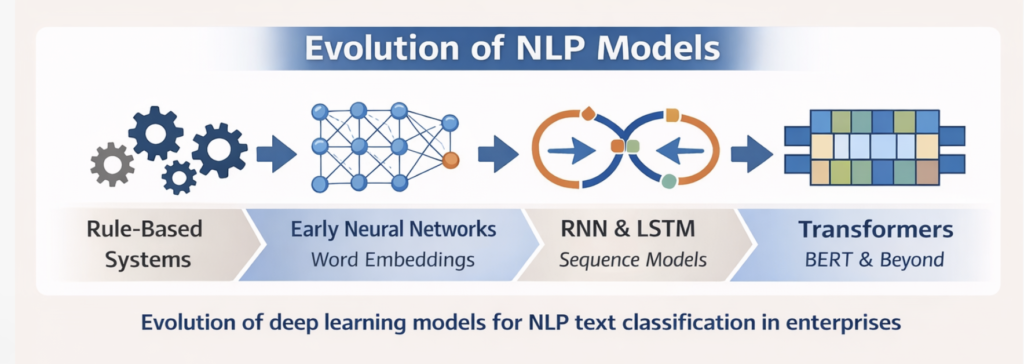
- Early Neural Approaches
Initial neural networks for NLP focused on simple word embeddings and shallow architectures. These models improved over bag of words methods but still struggled with long range dependencies. - Recurrent Neural Networks and LSTM
Recurrent architectures introduced sequence awareness, allowing models to consider word order. Long Short Term Memory networks helped capture longer context, improving classification of sentences and documents. - Transformer Architectures
Transformers marked a turning point. By using attention mechanisms, transformers analyze entire sequences simultaneously and understand relationships across long text spans. Models like BERT and its successors set new standards for text classification accuracy.
This architectural leap mirrors what I explored in my previous article on image generation and style transfer, where attention and deep representations enabled models to capture style, structure, and semantics. The same foundational principles now power language intelligence.
How Deep Learning Performs Text Classification
At a high level, deep learning text classification follows a structured pipeline.
- Text Ingestion
Text data is collected from emails, chats, documents, APIs, or databases. Quality and diversity of data directly impact model performance. - Preprocessing and Tokenization
Modern models tokenize text into subword units, preserving meaning even for rare or domain specific terms. This step enables better generalization across datasets. - Embedding and Representation Learning
Words and sentences are converted into dense vectors that capture semantic meaning. These representations are learned automatically during training. - Classification Layer
The model predicts probabilities for each class. The highest confidence label is assigned, or multiple labels in multi label scenarios. - Continuous Learning
In production, feedback loops allow models to improve over time, adapting to new language patterns and business needs. - Enterprise Use Cases That Drive ROI
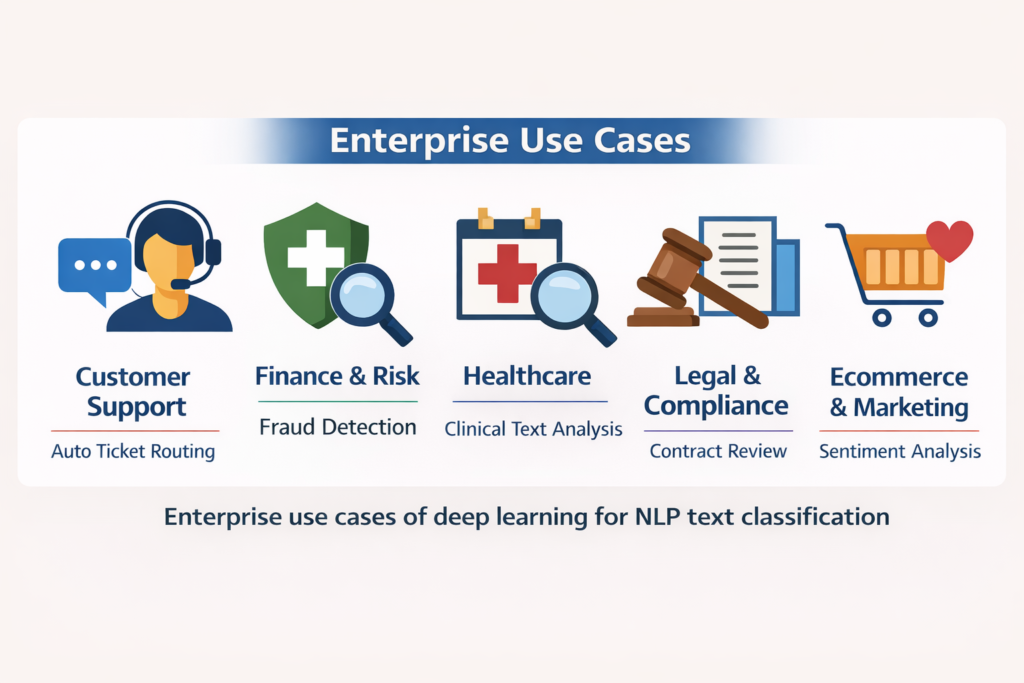
Text classification is not theoretical, it delivers measurable business value across industries. - Customer Experience and Support
Enterprises processing millions of support tickets per year use deep learning classification to auto route issues. This reduces response time by up to 40 percent and improves customer satisfaction. - Financial Services and Risk Management
Banks classify transaction descriptions, customer communications, and compliance documents to detect fraud, money laundering risks, and regulatory issues. Deep learning models reduce false positives significantly compared to rule based systems. - Healthcare and Life Sciences
Clinical notes and patient feedback are classified to identify risks, adverse events, and care quality issues. NLP models support clinicians without disrupting workflows. - Legal and Compliance
Contracts, policies, and legal documents are automatically categorized and flagged for risk. This saves thousands of hours of manual review annually. - Ecommerce and Marketing
Product reviews and social media content are classified for sentiment, topics, and emerging trends. Marketing teams gain real time insight into customer perception.
Data That Supports Adoption
The adoption of deep learning for NLP is accelerating rapidly.
Industry data shows
- Over 80 percent of enterprise data is unstructured text
- Organizations using AI driven text analytics report productivity gains of 20 to 35 percent
- The global NLP market is projected to grow at over 25 percent annually through the next five years
- Transformer based models reduce training time by up to 50 percent when fine tuned from pre trained checkpoints
These numbers explain why text classification is often the first NLP capability deployed at scale.
Linking Text Classification with Image Intelligence
In my previous article on Image Generation and Style Transfer in Artificial Intelligence, I discussed how deep learning models learn abstract representations that generalize across tasks. The same idea applies directly to NLP.
In image systems, models learn textures, shapes, and styles. In language systems, models learn syntax, semantics, and intent. Both rely on representation learning and transfer learning to reduce training cost and improve performance.
Enterprises increasingly combine image and text intelligence. Examples include
- Classifying documents using both scanned images and extracted text
- Analyzing social media posts that include images and captions
- Automating content moderation across visual and textual channels
This convergence highlights why a unified AI strategy matters.
Challenges and Practical Considerations
Despite its power, deep learning based text classification requires thoughtful implementation.
- Data Quality and Bias
Models learn from data. Biased or incomplete datasets lead to biased predictions. Governance and auditing are essential. - Explainability
Executives and regulators often need to understand why a model made a decision. Explainable AI techniques help interpret predictions. - Infrastructure and Cost
Training large models requires compute resources. Cloud based fine tuning and efficient architectures help control cost. - Domain Adaptation
General purpose models must be adapted to industry specific language. Fine tuning with curated datasets is critical. - Future Trends in Text Classification
The future of deep learning for NLP text classification is defined by a few clear trends. - Smaller and More Efficient Models
Models are becoming lighter while retaining accuracy, enabling deployment at the edge and in real time systems. - Multimodal Classification
Text classification increasingly integrates with images, audio, and video for richer context. - Continual Learning Systems
Models that adapt continuously without full retraining will become standard in dynamic environments. - Regulatory and Ethical Focus
AI governance frameworks will shape how text classification systems are designed and deployed.
How Enterprises Should Get Started
For leaders planning adoption, a structured approach works best.
Identify high impact text workflows
- Start with labeled pilot datasets
- Use pre trained transformer models and fine tune them
- Establish monitoring and feedback loops
- Align AI initiatives with governance and compliance requirements
Text classification often delivers quick wins while laying the foundation for advanced language intelligence.