What is Machine Learning?
Machine Learning is a branch of Artificial Intelligence that enables systems to learn patterns from data and make predictions without explicit programming. It’s the backbone of modern applications like recommendation engines, fraud detection, and autonomous systems.
Types of Machine Learning
- Supervised Learning
- Works with labeled data.
- Examples: Predicting house prices, spam detection.
- Algorithms: Linear Regression, Decision Trees.
- Unsupervised Learning
- Works with unlabeled data to find hidden patterns.
- Examples: Customer segmentation, anomaly detection.
- Algorithms: K-Means Clustering, PCA.
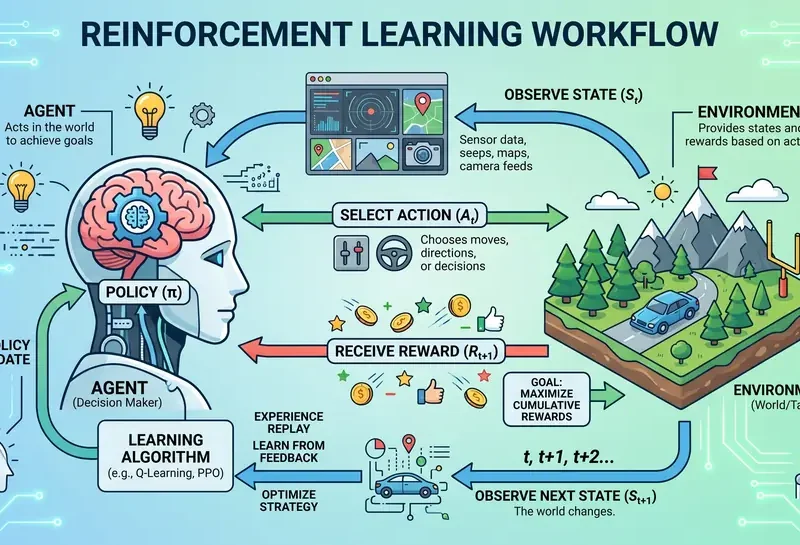
- Reinforcement Learning
- Learns through trial and error using rewards.
- Examples: Game-playing AI, robotics.
- Algorithms: Q-Learning, Deep Q-Networks.
ML Workflow
The typical ML pipeline includes:
- Data Collection
- Data Preprocessing (cleaning, normalization, encoding)
- Model Training
- Evaluation
- Deployment
- Monitoring
Why This Matters
Understanding ML fundamentals is crucial before diving into advanced topics like deep learning or AI strategy. Today’s learning sets the foundation for data preprocessing, which we’ll cover next.
Next Steps
I’ll explore Data Processing techniques:
- Handling missing values
- Scaling and normalization
- Encoding categorical variables
Stay tuned for my mini-project later this week: Cleaning and preprocessing a real dataset.
Call-to-Action:
What’s your favorite ML application? Share in the comments!