Artificial Intelligence has moved far beyond pattern recognition and prediction. Today, AI systems are capable of creating visual content that rivals human creativity. Image Generation and Style Transfer in Artificial Intelligence are no longer experimental research topics, they are production-grade capabilities shaping marketing, design, healthcare, manufacturing, and entertainment.
For executive leaders and technology decision-makers, this shift represents a strategic opportunity. Visual content creation has traditionally been expensive, time-consuming, and dependent on specialized talent. AI-driven image generation reduces cost, accelerates time to market, and enables personalization at scale.
In my previous article on Semantic Segmentation in Artificial Intelligence, I explained how pixel-level intelligence enables machines to understand images with precision. Image generation and style transfer build directly on that foundation. Once AI understands pixels, objects, and context, it can begin to generate, modify, and stylize images with remarkable control. Together, these technologies represent the full lifecycle of visual intelligence, understanding, creation, and transformation.
This article explains Image Generation and Style Transfer in a clear, practical, and future-focused way, combining technical depth with business relevance.
What Is Image Generation in Artificial Intelligence
Image generation is the process by which AI models create entirely new images from scratch or from structured inputs such as text, sketches, or other images. Unlike traditional image processing, which modifies existing pixels, image generation synthesizes new visual content based on learned patterns from massive datasets.
Modern image generation systems learn from millions or billions of images. They capture relationships between shapes, colors, textures, lighting, and spatial composition. When prompted, the model generates images that follow those learned distributions.
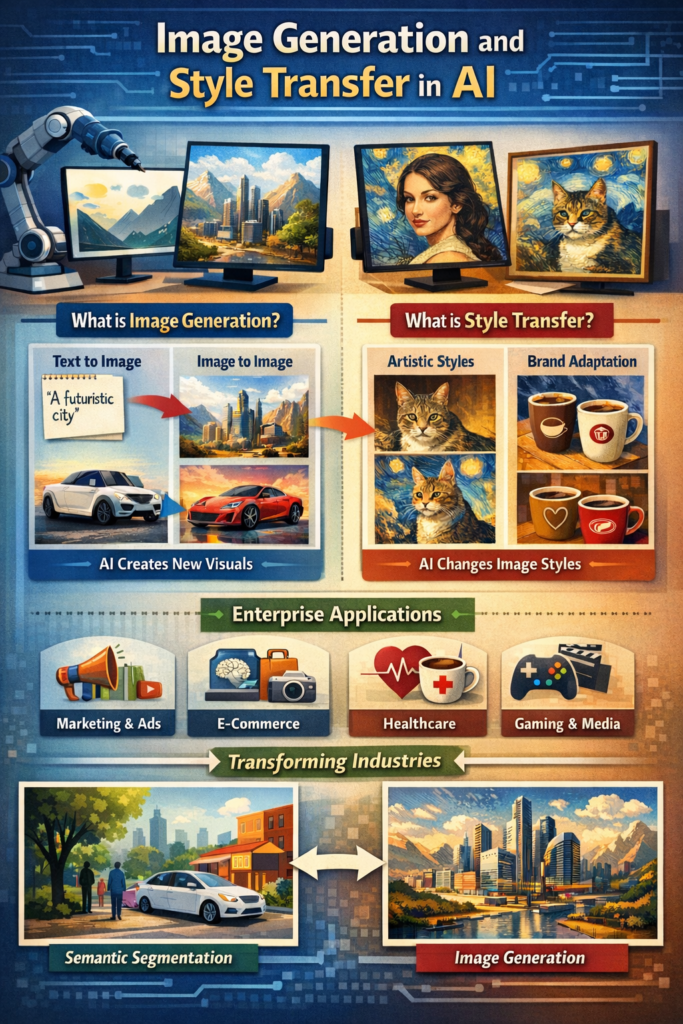
Key Capabilities of Image Generation
Text-to-image generation that converts natural language descriptions into realistic or artistic visuals
Image-to-image generation that transforms one image into another while preserving structure
Conditional image generation guided by attributes such as style, mood, or brand identity
High-resolution synthesis suitable for commercial use
According to industry benchmarks published in 2025, AI-generated images reduced creative production costs by nearly 40 percent in digital marketing workflows and cut campaign launch times by more than 50 percent in large enterprises.
What Is Style Transfer and Why It Is Powerful
Style Transfer is a specialized application of image generation. It separates the content of an image from its style and recombines them. Content refers to objects and layout, while style refers to texture, color patterns, brush strokes, and artistic characteristics.
In simple terms, style transfer answers this question. What if this image looked like it was painted by a specific artist, rendered in a brand’s visual language, or adapted to a different aesthetic?
Practical Meaning of Style Transfer
- A product photo rendered in multiple artistic styles for different markets
- A medical image visualized with enhanced contrast while preserving diagnostic content
- A video game environment restyled dynamically without redesigning assets
- Corporate branding applied consistently across thousands of visuals
Style transfer bridges creativity and automation, making it especially valuable for enterprises that manage large volumes of visual assets.
The Evolution of Image Generation Models
Understanding how image generation evolved helps leaders evaluate maturity and risk.
1. Early Neural Approaches
Initial neural image generation relied on autoencoders and basic convolutional neural networks. These models produced blurry results and lacked control.
2. Generative Adversarial Networks
Generative Adversarial Networks introduced a competitive learning setup where one model generates images and another evaluates them. This significantly improved realism and detail.
GAN-based systems powered early breakthroughs in face generation, synthetic data creation, and artistic style transfer.
3.Diffusion Models and Foundation Models
The current generation of image generation systems is dominated by diffusion models and large-scale foundation models. These models progressively refine noise into structured images, offering superior quality, stability, and control.
Diffusion-based systems now support
- Ultra-high-resolution image synthesis
- Fine-grained style control
- Text and image conditioning
- Enterprise-safe customization
By 2026, diffusion models have become the default architecture for commercial image generation platforms.
Why Semantic Segmentation Is the Foundation
In my earlier article on semantic segmentation, I emphasized pixel-level understanding as the backbone of visual AI. That same principle applies here.
Semantic segmentation enables image generation systems to
- Understand object boundaries
- Preserve spatial relationships
- Apply styles selectively
- Avoid visual artifacts
For example, when generating a street scene, segmentation ensures that roads, buildings, people, and vehicles are placed correctly and styled appropriately. Without segmentation awareness, generated images lose realism and usability.
This logical progression from understanding pixels to generating pixels is why image generation is now reliable enough for enterprise adoption.
Enterprise Use Cases of Image Generation and Style Transfer
1. Marketing and Brand Design
Marketing teams use AI-generated images to create campaign visuals, social media creatives, and personalized advertisements.
Data from global marketing agencies shows that AI-assisted creative pipelines increased engagement rates by up to 30 percent due to faster A B testing and hyper-personalized visuals.
2. E-commerce and Retail
Retailers generate product images in multiple environments without physical photoshoots. Style transfer allows brands to maintain a consistent visual identity across regions.
Large e-commerce platforms report a 25 percent reduction in product return rates when AI-generated visuals are customized to local preferences.
3.Healthcare and Medical Imaging
In healthcare, style transfer enhances image clarity while preserving diagnostic accuracy. Image generation also creates synthetic medical data for training models where real data is scarce.
Synthetic data generation has improved rare disease detection accuracy by up to 18 percent in controlled studies.
4.Manufacturing and Industrial Design
Manufacturers use image generation to simulate product designs, detect defects, and visualize outcomes before production. Style transfer supports digital twins by aligning visuals with real-world textures.
5.Entertainment, Gaming, and Media
Gaming studios and film production teams use AI to generate environments, characters, and concept art. Style transfer allows rapid experimentation without manual redesign.
Image Generation as a Strategic Business Capability
From an AI architect’s perspective, image generation is not just a creative tool, it is an operational capability.
1.Cost Optimization
AI-generated visuals significantly reduce dependency on repeated manual design cycles.
2.Speed and Scalability
What once took weeks now takes minutes. Enterprises can scale content creation globally.
3.Personalization at Scale
AI enables millions of visual variations tailored to individual users without additional human effort.
4.Data-Driven Creativity
Image generation systems learn from performance data, improving creative output continuously.
Risks, Ethics, and Governance
While powerful, image generation introduces new responsibilities.
1.Bias and Representation
Models trained on biased datasets can produce skewed outputs. Enterprises must curate training data carefully.
2.Intellectual Property Concerns
Generated images may resemble existing works. Clear governance and licensing strategies are essential.
3.Trust and Authenticity
As generated images become indistinguishable from real ones, transparency and watermarking become important for public trust.
Leading organizations are establishing AI governance frameworks that include visual AI audits and ethical review processes.
Integration with Enterprise AI Architectures
Image generation systems rarely operate in isolation. They integrate with
- Content management systems
- Marketing automation platforms
- Product lifecycle management tools
- Analytics and feedback loops
This integration mirrors the architectural patterns discussed in my semantic segmentation article, where modular AI components work together to deliver business value.
Future Trends in Image Generation and Style Transfer
1.Real-Time Generation
AI systems will generate visuals dynamically during user interaction.
2.Multimodal Intelligence
Image generation will merge with text, audio, and video generation into unified creative systems.
3.Brand-Specific Foundation Models
Enterprises will train private image generation models aligned with their visual identity.
4.Regulation and Standards
Industry standards for responsible image generation will emerge globally.
Market analysts project the global image generation market to exceed 90 billion dollars by 2030, driven by enterprise adoption and creative automation.
How Leaders Should Prepare
Executives and technology leaders should
- Invest in foundational visual AI understanding
- Build internal governance frameworks
- Pilot image generation in low-risk domains
- Upskill teams in prompt engineering and AI design thinking
Image generation is not replacing creativity, it is augmenting it at scale.