Text generation refers to the ability of an artificial intelligence system to automatically produce human-like written content based on prompts or data.
Modern AI text generation systems use Large Language Models (LLMs) trained on massive datasets that include:
• Books
• Websites
• Scientific articles
• Code repositories
• Business documents
These models learn patterns in language such as grammar, context, tone, and meaning.
Instead of copying text, they generate new original sentences based on the context provided.
For example, an AI text generation system can:
• Write product descriptions
• Summarize research reports
• Generate software documentation
• Draft emails or executive briefings
• Create blog articles or marketing campaigns
This capability allows enterprises to dramatically improve productivity.
How AI Text Generation Works
AI text generation relies on deep learning architectures called Transformer Models.
These models analyze relationships between words across extremely large datasets.
Instead of analyzing each word individually, the model understands the context of entire sentences and paragraphs.
The Text Generation Workflow
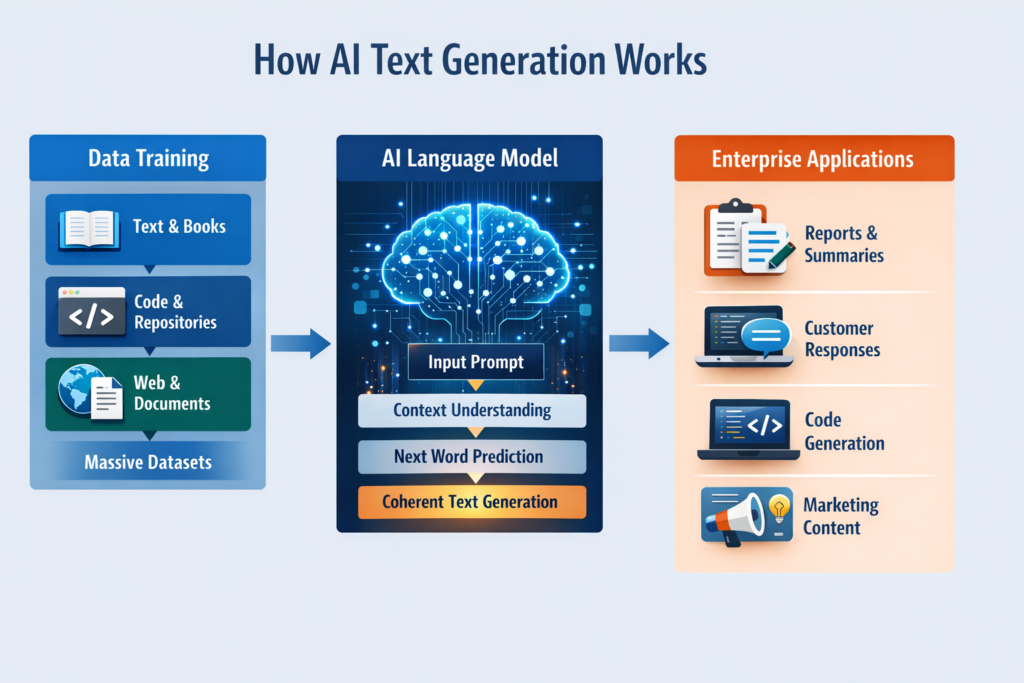
AI text generation generally follows three stages:
- 1. Training Data
Large datasets are used to train the model. These include books, websites, technical documents, and code repositories.
- 2. Language Model Processing
The model learns language patterns, grammar rules, context relationships, and semantic meaning.
- 3. Generated Output
When a prompt is provided, the model predicts the most relevant sequence of words to produce meaningful text.
Why Text Generation is Important for Enterprises
Text generation has become extremely valuable for organizations because modern businesses rely heavily on knowledge work and digital communication.
Employees constantly write emails, documentation, reports, and marketing content.
AI text generation helps organizations:
• Reduce content creation time
• Improve consistency across communication
• Automate repetitive writing tasks
• Enable faster decision making
Industry reports suggest that organizations adopting generative AI tools have seen:
• 40 percent faster content creation
• 30 percent improvement in customer response time
• 50 percent reduction in documentation backlog
These productivity improvements explain why generative AI is becoming a major investment area for enterprises.
Enterprise Use Cases of AI Text Generation
Text generation is already being deployed across multiple business functions.
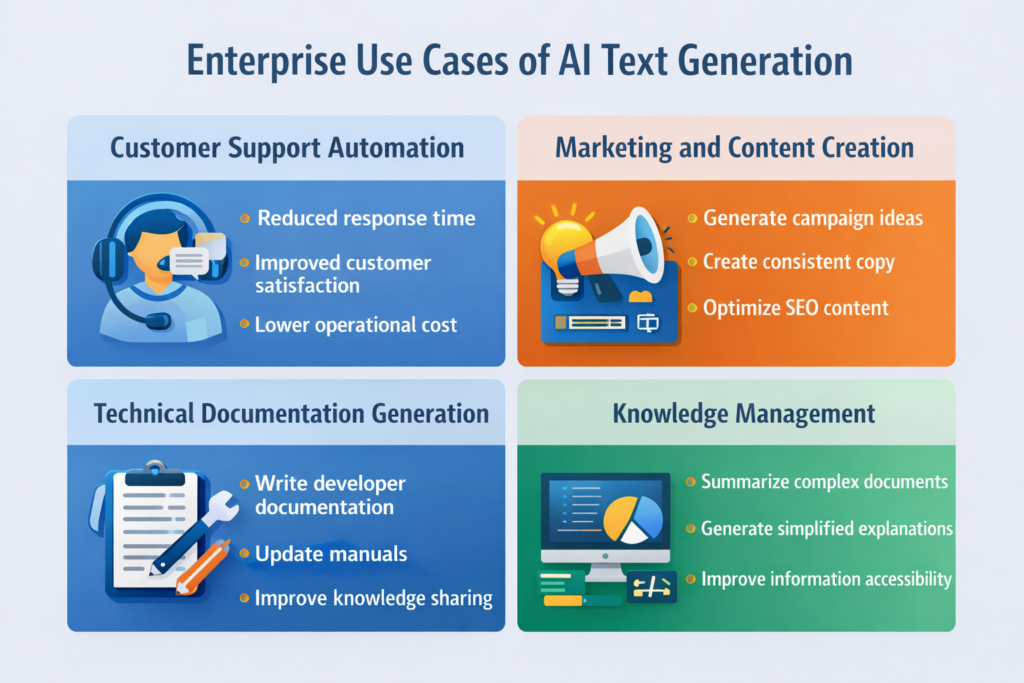
Customer Support Automation
Customer service teams handle thousands of support queries daily.
AI text generation assists support agents by suggesting responses to common questions.
Benefits include:
• Faster response time
• Improved customer satisfaction
• Reduced operational costs
Marketing and Content Creation
Marketing teams use text generation to create high quality digital content quickly.
AI tools help generate:
• Blog posts
• Product descriptions
• Campaign ideas
• SEO optimized website content
This enables marketing teams to scale their content strategy significantly.
Technical Documentation Generation
Engineering teams often struggle to maintain up to date documentation.
Text generation tools can automatically create:
• Developer documentation
• Software manuals
• Release notes
• System architecture explanations
This improves collaboration and knowledge sharing.
Knowledge Management
Large enterprises accumulate huge amounts of internal documentation.
Text generation tools can summarize complex documents and create simplified explanations.
This helps employees find and understand information faster.
Relationship Between Text Generation and Machine Translation
Text generation and machine translation are closely related technologies.
In my previous article on Machine Translation at Enterprise Scale, I explained how AI helps global organizations translate content into multiple languages.
Text generation extends that capability by automatically creating the content before translating it.
For example, a global company launching a product could use AI to:
• Generate product documentation
• Create marketing content
• Translate that content into multiple languages
This approach significantly accelerates global product launches.
Challenges in AI Text Generation
Despite its benefits, text generation also introduces several challenges.
Accuracy Issues
Language models sometimes generate incorrect information.
Organizations address this through human review processes and integration with trusted knowledge sources.
Data Privacy
Enterprises must ensure that sensitive business information is protected.
Many organizations deploy private AI environments or secure enterprise AI platforms.
Governance and Responsible AI
Companies must also ensure that AI generated content follows ethical guidelines and corporate policies.
Responsible AI governance includes:
• Bias monitoring
• Content validation
• Audit tracking
The Role of AI Architects
AI architects play a critical role in designing enterprise text generation systems.
A well designed architecture includes:
• Prompt engineering frameworks
• Retrieval augmented generation
• Knowledge graph integration
• Security and compliance layers
These components ensure that AI generated text remains accurate and relevant.
Future Trends in AI Text Generation
Text generation technology continues to evolve rapidly.
Several important trends are shaping its future.
Domain Specific AI Models
Organizations are increasingly developing language models trained on industry specific data.
Examples include:
• Healthcare AI models
• Financial compliance models
• Legal document AI systems
Multimodal Generative AI
Future AI systems will generate multiple forms of content simultaneously.
For example:
• Written reports
• Visual charts
• Presentation slides
• Video summaries
Autonomous AI Knowledge Agents
AI agents will increasingly act as digital assistants capable of generating research insights and business reports automatically.
These systems will support executives in decision making.
Conclusion
Text generation represents one of the most powerful advancements in modern artificial intelligence.
By enabling machines to generate meaningful language, organizations can accelerate knowledge creation, improve communication efficiency, and unlock new levels of productivity.
When combined with technologies such as machine translation, intelligent search, and knowledge graphs, text generation becomes a fundamental capability for the intelligent enterprise.
Organizations that invest in this technology today will gain a significant advantage in the future digital economy.