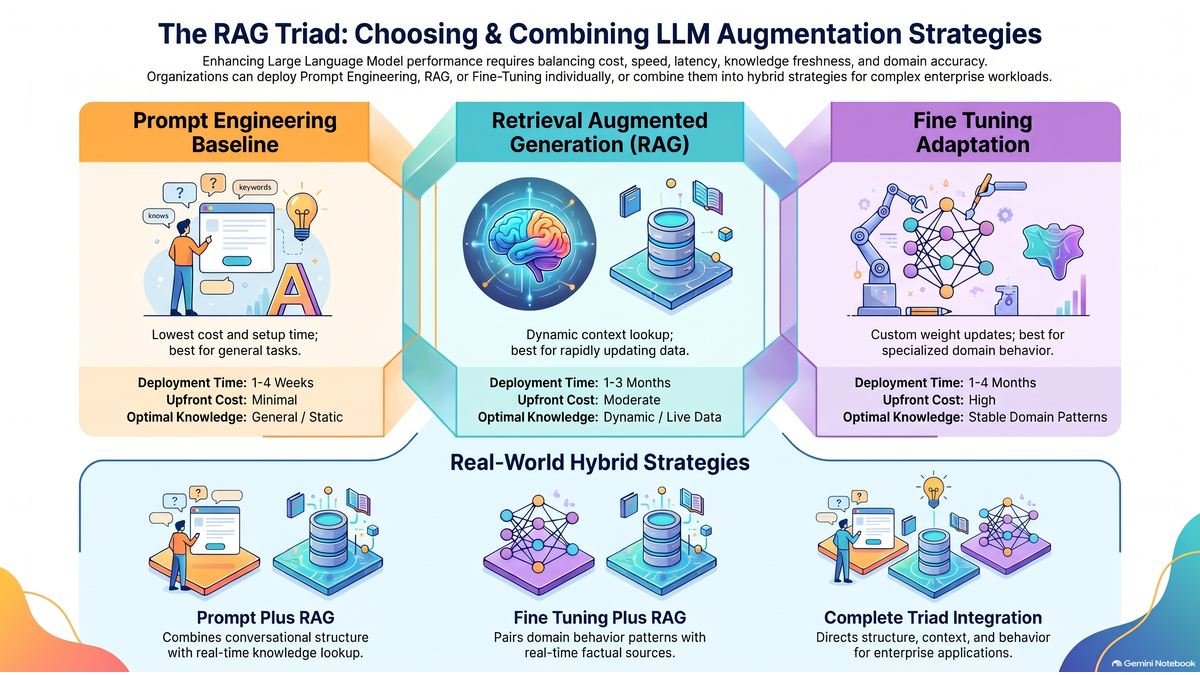
In the rapidly evolving landscape of AI and large language models, organizations face a critical decision: how to best enhance their models’ capabilities to handle specialized tasks and domain-specific knowledge. The answer rarely lies in choosing one approach. Success depends on understanding the RAG Triad: Retrieval-Augmented Generation (RAG), fine-tuning, and prompt engineering, and knowing when to deploy each strategy.
This comprehensive guide walks you through the decision-making framework that separates successful AI implementations from costly failures.
Part 1: The Three Pillars Explained
What is Retrieval-Augmented Generation (RAG)?
Retrieval-Augmented Generation is a technique that enhances LLM responses by dynamically retrieving relevant information from an external knowledge base during inference time. Instead of relying solely on the model’s training data, RAG systems search for context-specific information and feed it to the model.
How RAG works:
1. User asks a question
2. System searches external knowledge base for relevant documents
3. Retrieved documents are added as context to the prompt
4. LLM generates response using both its training data and the retrieved context
Example scenario: A customer support chatbot using RAG can retrieve current product specifications, pricing, and policies in real-time, ensuring responses reflect up-to-date information.
What is Fine-tuning?
Fine-tuning involves training a pre-trained model on task-specific data to adapt it for particular applications. This permanent modification of the model’s weights allows it to learn patterns specific to your domain.
How fine-tuning works:
1. Start with a pre-trained model
2. Gather domain-specific training data
3. Continue training on this specialized dataset
4. Model’s weights update to reflect domain knowledge
5. Deploy the adapted model
Example scenario: A legal tech company fine-tunes BERT on thousands of court documents to improve legal contract analysis accuracy.
What is Prompt Engineering?
Prompt engineering is the art of crafting inputs to LLMs to elicit better, more specific, and more reliable outputs. It’s the fastest and cheapest way to improve model performance without changing the model itself.
How prompt engineering works:
1. Design clear, specific prompts
2. Use examples (few-shot prompting)
3. Provide system instructions
4. Iterate based on results
Example scenario: Instead of asking “What is this document about?”, asking “Summarize this financial report in 3 bullet points focusing on revenue changes” produces dramatically better results.
Part 2: Head-to-Head Comparison
Cost Analysis
RAG:
- Initial cost: Moderate (database setup, retrieval infrastructure)
- Ongoing cost: Vector storage, retrieval compute
- Cost per query: $0.001 – $0.01
- Scaling cost: Linear with knowledge base size
Fine-tuning:
- Initial cost: High (compute for training)
- One-time investment: $500 – $10,000+
- Deployment cost: Standard inference cost
- Cost per query: Same as base model after deployment
Prompt Engineering:
- Initial cost: Minimal (human time)
- Ongoing cost: Negligible
- Cost per query: Same as standard model usage
- Scaling cost: Minimal
Winner for cost-conscious organizations: Prompt Engineering > RAG > Fine-tuning
Speed to Deployment
RAG:
- Setup time: 2-4 weeks
- Knowledge base population: 1-8 weeks (depending on data volume)
- Testing and refinement: 2-3 weeks
- Total: 1-3 months**
Fine-tuning:
- Data collection: 2-8 weeks
- Data preparation: 1-2 weeks
- Training: Few hours to days (depending on dataset size)
- Validation and testing: 2-3 weeks
- Total: 1-4 months**
Prompt Engineering:
- Exploration: 1-2 weeks
- Optimization: 1-2 weeks
- Total: 1-4 weeks**
Winner for speed: Prompt Engineering > RAG ≈ Fine-tuning
Latency Impact
RAG:
- Added latency from retrieval: 50-500ms
- Total response time: 2-5 seconds (including LLM generation)
- Typical query: 300-500 tokens retrieved
Fine-tuning:
- No retrieval overhead
- Same inference latency as base model: 1-3 seconds
- Pure generation time
Prompt Engineering:
- Minimal latency impact
- Same inference latency as base model: 1-3 seconds
Winner for real-time systems: Fine-tuning ≈ Prompt Engineering > RAG
Knowledge Freshness
RAG:
- Real-time updates possible: Knowledge can be updated instantly
- Stale data risk: Minimal (depends on update frequency)
- Best for: Rapidly changing information
Fine-tuning:
- Update frequency: Requires retraining
- Stale data risk: High if data changes frequently
- Retraining cycle: Days to weeks
- Best for: Static domain knowledge
Prompt Engineering:
- Update frequency: Immediate (via prompt changes)
- Stale data risk: Medium (depends on model knowledge cutoff)
- Best for: General knowledge queries
Winner for dynamic content: RAG > Prompt Engineering > Fine-tuning
Accuracy and Hallucination Reduction
RAG:
- Hallucination reduction: 60-80% (with proper retrieval)
- Accuracy improvement: 15-40%
- Risk: Garbage in, garbage out (poor retrieval = poor output)
Fine-tuning:
- Hallucination reduction: 20-50%
- Accuracy improvement: 20-60%
- Risk: Overfitting to training data peculiarities
Prompt Engineering:
- Hallucination reduction: 10-30%
- Accuracy improvement: 5-20%
- Risk: Inconsistent results across different queries
Winner for accuracy: Fine-tuning > RAG > Prompt Engineering
Part 3: The Decision Matrix
When to Choose RAG
Choose RAG if you have:
1. Large, frequently updated knowledge bases (>10,000 documents)
– Medical records systems
– Legal document repositories
– Product catalogs with frequent updates
– News and information portals
2. Need for real-time information
– Customer support systems
– Financial market analysis
– Current events handling
– Live pricing and availability
3. Limited budget for training
– Startup constraints
– Proof-of-concept phases
– Quick MVP requirements
4. Multiple use cases from same knowledge base
– Shared corporate knowledge base
– Multi-tenant systems
– Unified customer service platform
5. Transparency and traceability requirements
– Financial services
– Healthcare applications
– Compliance-heavy industries
– Regulated markets
RAG Success Indicators:
- Retrieval accuracy >80%
- Relevant documents consistently in top-5 results
- Clear ROI within 2-3 months
When to Choose Fine-tuning
Choose fine-tuning if you have:
1. Limited, stable domain-specific data (500-50,000 quality examples)
– Company-specific jargon and patterns
– Specialized technical documentation
– Proprietary methodologies
– Industry-specific terminology
2. Need for consistent behavioral patterns
– Writing style adherence
– Format consistency
– Specific output structures
– Tone and voice requirements
3. Performance-critical latency requirements
– Real-time systems
– User-facing interactive applications
– High-volume, low-latency services
– Edge deployment scenarios
4. Budget for upfront training investment
– Enterprise deployments
– Long-term projects
– High-value use cases
5. Static domain knowledge
– Medical diagnosis frameworks (not patient data)
– Legal reasoning patterns (not specific cases)
– Software development practices
– Research methodologies
Fine-tuning Success Indicators:
- Training data quality >90%
- Validation accuracy improvement >15%
- Inference cost comparable to base model
When to Choose Prompt Engineering
Choose prompt engineering if you have:
1. General-purpose use cases
– Content generation
– Question answering
– Code generation
– Creative writing
2. Rapid experimentation needs
– Proof of concepts
– Feature exploration
– Quick iterations
– A/B testing capabilities
3. Limited technical resources
– Small teams
– Non-ML engineers
– Resource-constrained environments
4. Varied, unpredictable query patterns
– Open-ended conversations
– Exploratory use cases
– Multi-domain support
Prompt Engineering Success Indicators:
- Performance improvements within 10% of specialized approaches
- Quick iteration cycles (<1 week)
- User satisfaction scores >4/5
Part 4: Hybrid Approaches – The Real-World Strategy
The most effective implementations don’t choose one approach – they intelligently combine them.
Strategy 1: Prompt Engineering + RAG
Best for: Customer support, knowledge-based Q&A
Begin with prompt engineering to structure the conversation, identify missing information, and define a reliable answer format. Trigger RAG when the user requests domain-specific knowledge or asks about information that may change. Combine the retrieved context with the engineered prompt and require the system to distinguish source-supported answers from general guidance.
The result should be a faster, more accurate, and more current response. This combination is especially useful in customer support because it preserves a consistent service experience while allowing answers to reflect product specifications, policies, and availability that change over time.
Example: A support chatbot uses a prompt engineer-designed conversation flow but retrieves technical specifications via RAG for specific product questions.
Strategy 2: Fine-tuning + RAG
Best for: Specialized analysis, enterprise systems
Fine-tune the model on approved domain patterns, terminology, writing style, and recurring decision formats. Use RAG to retrieve current facts, documents, regulations, or case information during the response. This keeps specialized model behavior stable while preventing the knowledge layer from becoming unnecessarily expensive to retrain.
The result is expert-level behavior grounded in current information. Teams should still evaluate the final answer because fine-tuning can influence tone and interpretation while RAG supplies external facts. Both layers require separate governance and testing.
Example: A legal research tool fine-tuned on case law patterns uses RAG to retrieve current case citations and precedents.
Strategy 3: All Three Combined
Best for: Complex enterprise solutions
Prompt engineering handles conversation structure and clarifying questions. RAG provides current, specific context. Fine-tuning teaches the model domain-appropriate behavior and output conventions. Together, they can support a system that is sophisticated, accurate, and responsive.
Example: A medical diagnosis assistant uses engineered prompts for symptom gathering, RAG for latest medical literature, and fine-tuning for domain reasoning patterns.
Part 5: Implementation Considerations
Technical Infrastructure Needs
RAG Requirements:
- Vector database (Pinecone, Weaviate, Milvus)
- Embedding model (OpenAI, Hugging Face)
- Retrieval pipeline
- Document preprocessing pipeline
- Estimated setup: 2-4 weeks
Fine-tuning Requirements:
- GPU compute (or cloud provider)
- Training data pipeline
- Validation and evaluation framework
- Model versioning system
- Estimated setup: 1-3 weeks
Prompt Engineering Requirements:
- Experimentation framework
- Version control for prompts
- A/B testing infrastructure
- Minimal infrastructure cost
Data Quality Requirements
RAG:
- Source quality critical
- Document relevance key
- Indexing accuracy essential
- Poor quality sources directly impact output
Fine-tuning:
- Label quality essential
- Class balance important
- Edge cases need representation
- Garbage data = garbage model
Prompt Engineering:
- Specification clarity needed
- Context comprehensiveness helpful
- Example quality matters
- Flexible data requirements
Part 6: Real-World Case Studies
Case Study 1: E-commerce Support (RAG Success)
Challenge: 10,000+ SKUs, frequently changing inventory and pricing
Solution: RAG system retrieving product specs, inventory, and policies in real-time
Results:
- Response accuracy: 92%
- Response time: 2.3 seconds
- Cost per interaction: $0.004
- Deployment time: 6 weeks
- ROI: Positive within 3 months
Case Study 2: Legal Research (Fine-tuning Success)
Challenge: Hundreds of legal briefs with consistent format and reasoning requirements
Solution: Fine-tuned BERT model on company case law and reasoning patterns
Results:
- Document classification accuracy: 94%
- Response latency: 1.2 seconds
- Cost per query: $0.0001
- Deployment time: 10 weeks (including data prep)
- ROI: Positive within 6 months
Case Study 3: Content Generation (Prompt Engineering Success)
Challenge: Generate marketing copy maintaining brand voice
Solution: Few-shot prompt engineering with brand guidelines
Results:
- Quality baseline: 85% acceptable on first draft
- Response time: 2 seconds
- Cost per query: $0.002
- Deployment time: 2 weeks
- ROI: Immediate
Part 7: Common Pitfalls and How to Avoid Them
RAG Pitfalls
1. Poor retrieval quality → Invest in proper embedding and indexing
2. Outdated knowledge base → Implement automated updates
3. Over-reliance on context → Combine with fine-tuning for consistency
4. Privacy concerns with retrieved data → Implement proper data governance
Fine-tuning Pitfalls
1. Overfitting to training data → Use proper validation and regularization
2. High cost for marginal gains → Establish clear performance thresholds
3. Difficulty updating knowledge → Plan for regular retraining cycles
4. Catastrophic forgetting → Use techniques like continual learning
Prompt Engineering Pitfalls
1. Inconsistent results → Establish prompt standards and templates
2. Context window limitations → Plan for prompt compression
3. Model updates breaking prompts → Implement prompt versioning
4. Complexity becoming unmaintainable → Document and test all prompts
Part 8: Building Your Decision Framework
Step 1: Assess Your Requirements
- What’s your budget? (Time and money)
- What’s your latency requirement?
- How fresh must your knowledge be?
- What’s your accuracy target?
- How often will requirements change?
Step 2: Evaluate Your Data
- Do you have high-quality training data?
- Is your knowledge base large and changing?
- Can you create a comprehensive knowledge base?
- What’s your data governance situation?
Step 3: Consider Your Team
- Do you have ML engineers?
- Can you support production systems?
- What’s your infrastructure expertise?
- Do you have DevOps capabilities?
Step 4: Plan Your MVP
- Start with prompt engineering (fastest)
- Add RAG if knowledge freshness matters
- Add fine-tuning if you need consistency
- Iterate based on real performance metrics
Step 5: Measure and Iterate
- Establish clear success metrics
- Monitor production performance
- Gather user feedback
- Adjust your approach quarterly
Executive Governance for the RAG Triad
Technology selection is only the beginning. Leaders must also decide who owns data, who approves prompt changes, how model behavior is measured, and how quickly a failed answer can be removed or corrected. A system that performs well in a demonstration can still create operational risk if those responsibilities are unclear.
Treat knowledge as a governed asset
RAG makes data quality a visible product decision. The organization should know which repositories feed the system, who is allowed to update them, how source documents are approved, and when outdated material is withdrawn. Retrieval relevance matters, but authorization and document freshness matter too.
The same employee directory, archive, or support database may contain records with different retention, privacy, and access requirements. A retrieval layer must preserve those boundaries rather than making all permitted content equally visible to every user. Define document owners and access policies before expanding the knowledge base.
Design for evidence, not just fluency
A polished answer is not necessarily a reliable answer. Production evaluations should test whether citations support the claims they accompany, whether retrieved passages are relevant, and whether the system refuses or escalates questions outside its approved scope. Reviewers should measure incorrect, incomplete, and unsupported answers separately from overall satisfaction.
This distinction is particularly important for fine-tuning. A model can become consistent in tone or format while repeating a subtle but incorrect assumption from training examples. RAG may correct facts, but it cannot repair every reasoning or policy error. Prompt changes can improve instructions, but they can also expose conflicting expectations across departments.
Build an accountable model lifecycle
Each version of a prompt, retrieval configuration, or fine-tuned model should have an owner, release record, test results, and rollback plan. Teams should also retain representative failed queries so the next improvement addresses observed behavior rather than assumptions.
A simple lifecycle is more valuable than a complex one that nobody follows:
1. Capture a baseline from real or representative employee and customer tasks.
2. Define quality thresholds for accuracy, latency, security, and cost.
3. Test candidate changes against the baseline before release.
4. Deploy a limited group and monitor both outcomes and usage.
5. Roll back quickly if evidence, support volume, or operating cost deteriorates.
This process gives executives a decision trail. It also helps the organization compare the cost of a model change with the business benefit, rather than approving improvements based only on a benchmark score.
Ask for measurable evidence
Before expanding a pilot, executives should ask for evidence across four dimensions:
- Quality:** Is the system better on the organization’s actual tasks, or only on general demonstrations?
- Operations:** Can it meet expected response time, availability, and support requirements?
- Economics:** What are the costs of retrieval, model usage, human review, infrastructure, and ongoing maintenance?
- Risk:** Can the system protect confidential information, cite reliable sources, and produce a usable audit trail?
The strongest implementation decision is the one that remains defensible after these questions are answered. RAG, fine-tuning, and prompt engineering are not interchangeable. They solve different problems and introduce different dependencies. A disciplined leader chooses the smallest combination that achieves the desired outcome, then expands only when evidence supports the next investment.
Conclusion: The Path Forward
The choice between RAG, fine-tuning, and prompt engineering isn’t binary – it’s strategic. The most successful organizations understand that:
1. RAG excels at bringing fresh, traceable context to responses
2. Fine-tuning creates specialized, consistent behavior
3. Prompt engineering enables rapid iteration and experimentation
The future of AI isn’t choosing one approach. It’s intelligently combining them to create systems that are accurate, efficient, and maintainable.
Start with your most pressing need, measure ruthlessly, and iterate continuously. The RAG Triad isn’t a constraint – it’s a toolkit for building AI systems that actually deliver business value.
Key Takeaways
✅ RAG for: Real-time knowledge, transparency, and multiple use cases
✅ Fine-tuning for: Domain consistency, latency requirements, and stable knowledge
✅ Prompt Engineering for: Speed, flexibility, and resource constraints
✅ Hybrid for: Maximum performance and enterprise scalability
The question isn’t which one to use – it’s how to orchestrate all three for maximum impact.