Transformers have become the default architecture behind modern language models. But they are not the only way to process a sequence. State Space Models (SSMs), and the Mamba architecture built around them, offer a different approach: instead of repeatedly comparing every token with all the others, they carry a compact state forward as they process the sequence.
That change can make computation scale more gently as sequences grow. It also changes what the model can remember, how it uses hardware, and what teams must measure before choosing it. So are SSMs about to replace Transformers or“` do they solve a different part of the problem?
First, what is a State Space Model?
State Space Models come from control theory, where they describe how a system evolves over time. At each step, the system receives an input, updates an internal state, and produces an output. A simple analogy is a person taking notes during a long meeting: they do not keep every spoken word in active attention; they update a running summary that helps them interpret what comes next.
In sequence modeling, each token is an input step. The model updates a hidden state that carries information forward, then uses that state to compute an output representation. The state is not a literal summary in plain language. It is a learned collection of numerical values that encodes information the model may need later.
Earlier State Space Models proved they could handle long sequences without bogging down. However, they used fixed rules to update their memory meaning they couldn’t adapt what they remembered based on the actual content coming in. Making those memory updates dynamic without sacrificing speed on modern GPUs remained a major hurdle.
What Mamba changes: the state becomes selective
Traditional recurrent models update their hidden state at every step, but their update rules are often fixed or only weakly dependent on the current input. Mamba introduces a selective State Space Model: some of the parameters governing what to retain, forget, and expose are computed from the current input.
In plain terms, the model can respond differently to different content. It can preserve a detail that seems relevant, let another detail fade, and decide what information to pass onward. This selectivity addresses a limitation of earlier sequence models: treating every position in a uniform way makes content-dependent reasoning harder.
Mamba also combines the selective SSM with other operations into a repeated block that serves as an alternative to the usual Transformer attention-and-feed-forward combination. It is not simply a conventional SSM placed beside a Transformer. The selective mechanism and its implementation are central to the architecture.
Why sequence length changes the efficiency equation
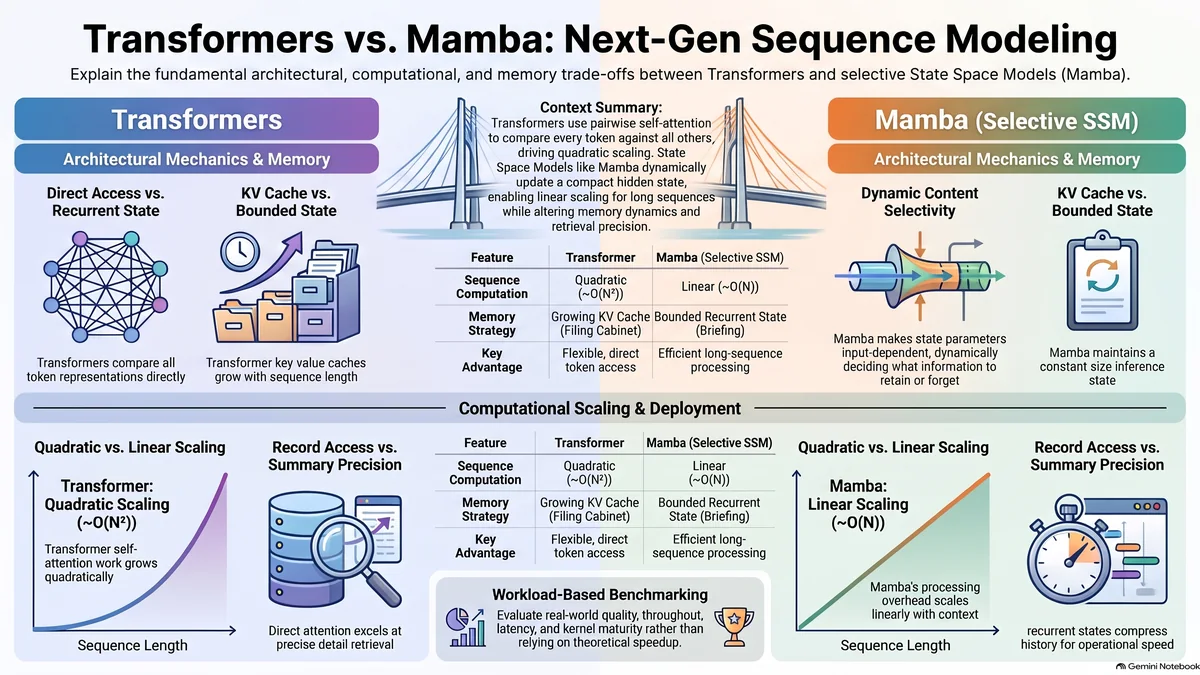
In a Transformer’s self-attention layer, processing a sequence is like a room where every new speaker has to individually cross-check what they are saying with every person who spoke before them. That exhaustive cross-checking gives the model rich context, but the effort explodes quadratically: double the length of the conversation, and the work increases roughly fourfold.
Mamba takes a fundamentally different approach. Instead of comparing every token to every other token, it folds each new input into a fixed-size running state. Instead of appending the new word to a growing pile of old words (like a Transformer does), Mamba mathematically blends the new word’s information right into that existing snapshot strengthening important details and letting unimportant ones fade away.
Because the cost of updating that state stays constant at each step, total compute scales linearly 10x longer input means roughly 10x the work. For long-horizon tasks like analyzing hours of audio, genomic sequences, or multi-document repositories, that difference turns an engineering bottleneck into a manageable workload.
Autoregressive generation has another practical distinction. A Transformer commonly stores a key-value (KV) cache containing representations from previous tokens, and that cache grows with the generated context. A recurrent SSM carries a state forward instead, so its per-step state does not grow with the number of prior tokens in the same way. The model still has memory and compute requirements, the state, parameters, activations, batch size, and implementation all matter, but the growth profile can differ substantially.
These are architectural scaling properties, not a guarantee that every Mamba model will run faster or cost less than every Transformer. Optimized attention kernels, sequence lengths, batch sizes, hardware, and serving software all affect actual results.
Mamba versus Transformers: a different memory strategy
The central trade-off is how each architecture makes earlier information available.
- Transformers use direct access. Attention lets a token look back at representations of earlier tokens and weigh them against the current context. This is expressive and supports flexible content-to-content interaction, but the KV cache grows as the context grows.
- Mamba uses a recurrent state. Information from earlier tokens is carried forward through state updates. This can keep inference state bounded with respect to sequence length, but the model must compress useful history into that state.
Think of the difference as searching a filing cabinet versus maintaining a working briefing. The filing cabinet gives you direct access to individual records, but takes more space as records accumulate. The briefing is compact and always at hand, but it cannot preserve every detail with equal precision.
That analogy is imperfect, but it highlights a real evaluation question: does a task benefit more from flexible access to earlier token representations, or from efficiently carrying forward information in a recurrent state? The answer depends on the task and model not just the architecture label.
What Mamba-2 adds
Mamba-2, introduced in the work on State Space Models are Transformers, develops a connection between structured State Space Models and attention. The paper describes a framework called State Space Duality and uses it to derive a more parallelizable SSM layer, with reported improvements in computation efficiency over the original Mamba layer.
This connection matters because it makes the comparison less like “old recurrent models versus Transformers” and more like a search for efficient ways to express and compute sequence interactions. It does not mean that Mamba-2 is a standard Transformer, nor that attention and SSMs are identical in their behavior. It shows that the mathematical relationship between the families is richer than a simple either-or story.
Where SSMs may fit and where caution is needed
SSMs are especially interesting when sequences are long and processing efficiency is a priority. Potential applications include long-form text, audio, biological sequences, time series, and other domains where inputs may extend far beyond the lengths typically used in conventional language-model interactions.
But linear scaling alone does not establish a business case. Teams should check:
- Quality on the real task. Test retrieval, instruction following, reasoning, and long-context behavior using representative inputs. A large context window does not guarantee that the model will reliably recall every detail in it.
- End-to-end latency and throughput. Measure prompt processing and generation separately, under realistic batch sizes and concurrency. The fastest theoretical algorithm may not be the fastest deployed system.
- Memory and serving requirements. Compare parameter memory, runtime state, cache behavior, accelerator utilization, and the cost of operating the model at your expected traffic levels.
- Ecosystem maturity. Check availability of model checkpoints, inference kernels, fine-tuning tools, quantization support, monitoring, and experienced operators.
- Failure modes. Evaluate whether the architecture handles the dependencies your application needs, including cases where a response must refer precisely to a detail far back in the input.
For some systems, the best answer may be a hybrid: use attention where direct access to prior representations is valuable and SSM layers where efficient sequence processing is advantageous. The right comparison is not “Mamba versus Transformers in the abstract.” It is which model and serving stack meets a workload’s quality, latency, cost, and reliability requirements.
What this means for technology leaders
SSMs are worth tracking because they challenge a costly assumption: that every token must attend directly to every earlier token to model a sequence well. Mamba demonstrates a practical alternative built around selective state updates and hardware-aware computation.
That does not make Transformers obsolete. Attention remains a strong, flexible mechanism, and architecture-level efficiency must be confirmed against deployed workloads. For leaders, the practical opportunity is to widen the evaluation set. When long context, streaming input, or generation-time memory is a bottleneck, include SSM and hybrid models in a controlled benchmark rather than defaulting to a Transformer-only shortlist.
If you are following the evolution of model architectures, see our related explainer on Mixture of Experts (MoE), another approach that changes how modern models allocate computation.
Key takeaways
- State Space Models process sequences by updating a learned internal state from one step to the next.
- Mamba makes important SSM parameters input-dependent, allowing selective propagation or forgetting of information.
- Mamba’s sequence computation scales approximately linearly with sequence length; full self-attention’s pairwise work scales approximately quadratically.
- A compact recurrent state can change long-context inference memory needs, but it does not automatically make every model faster, cheaper, or more accurate.
- Evaluate SSM, Transformer, and hybrid models on your own workload; compare quality, latency, memory, throughput, and operating cost together.
Conclusion
Mamba is not proof that the Transformer era is over. It is evidence that sequence modeling has more than one promising design path. By replacing repeated all-to-all attention with selective state updates, SSMs offer a different efficiency profile, particularly for long sequences ,while making information retention and task quality essential parts of the evaluation.
The executive takeaway: treat SSMs as a serious alternative to benchmark, not a guaranteed replacement for Transformers.