The promise of Artificial Intelligence, particularly in the realm of large language models, has captivated boardrooms globally. From automating customer service to accelerating drug discovery, the potential for transformative impact is undeniable. For many years, the prevailing wisdom in the pursuit of advanced AI capabilities could be distilled into a simple mantra: “bigger is better.” The race to build ever-larger models, boasting billions or even trillions of parameters, seemed to be the direct path to unlocking unprecedented intelligence and performance.
This intuitive approach, while yielding impressive results in some instances, has simultaneously created significant challenges for business leaders. The sheer scale of resources required, the astronomical compute costs, the extended training times, and the inherent inefficiencies began to raise critical questions about the return on investment. Is simply throwing more processing power and data at an AI problem always the most effective or even sustainable strategy? The answer, as leading research now firmly establishes, is a resounding no.
Welcome to the era of Scaling Laws, a profound paradigm shift that is reshaping how organizations approach AI development and deployment. These empirical observations provide a scientific framework for understanding how model performance improves with increased resources. Among these, the insights from what is colloquially known as “Chinchilla scaling laws” have proven particularly revolutionary. They challenge the “blindly bigger” mentality, revealing that intelligent resource allocation – specifically, finding the optimal balance between model size and the volume of training data for a given compute budget – is paramount for achieving superior performance, efficiency, and ultimately, greater business value. For C-suite executives, understanding these principles is no longer a niche technical concern, but a strategic imperative for unlocking sustainable competitive advantage in the AI landscape.
The Allure and Limitations of “Bigger is Better”
For much of the last decade, the narrative surrounding cutting-edge AI, particularly in generative models, was dominated by a relentless pursuit of scale. Landmark models like OpenAI’s GPT-3 and Google’s PaLM showcased an almost magical ability to generate human-like text, answer complex questions, and even write code, all largely attributed to their immense size. These models often contained hundreds of billions of parameters, the internal variables that define the model’s knowledge and capabilities.
The business implications of this scale-first approach were equally massive. Developing and training these colossal models demanded:
- Astronomical Compute Costs: Requiring vast arrays of specialized graphical processing units (GPUs) or tensor processing units (TPUs), running for weeks or months, consuming immense amounts of energy. The capital expenditure for hardware and the operational expenditure for electricity and cooling were staggering.
- Specialized Infrastructure: Building and maintaining data centers capable of supporting such operations required highly specialized engineering expertise and infrastructure.
- Extended Development Cycles: The sheer time to train these models meant slower iteration, delaying time to market for new AI capabilities.
- Environmental Impact: The energy consumption raised significant environmental, social, and governance (ESG) concerns for organizations committed to sustainability.
While these super-large models demonstrated remarkable new capabilities, their development often reached a point of diminishing returns. Simply increasing the parameter count no longer guaranteed a proportional improvement in performance, especially when held back by the amount of data they were trained on. Organizations began to realize that the path to creating ever-larger models was becoming economically unsustainable for most enterprise applications, and in many cases, outright inefficient. The intuitive appeal of “bigger” was colliding with the practical realities of budgets, timelines, and measurable business impact.
Unveiling Scaling Laws: A Data-Driven Approach to AI Strategy
Scaling laws represent a fundamental shift from intuitive guesswork to data-driven decision-making in AI development. In essence, these are empirical regularities that describe how the performance of large machine learning models improves as various resources – such as the number of model parameters, the size of the training dataset, or the total compute budget – are increased. They are not theoretical constructs in the abstract sense, but rather observed patterns derived from extensive experimentation with training numerous models of varying sizes on different amounts of data.
Why do these laws matter to business leaders? Because they offer a predictive framework. Instead of embarking on costly, months-long training runs with an uncertain outcome, scaling laws allow organizations to forecast, with remarkable accuracy, how a model’s performance will change given specific resource allocations. This ability to predict performance before investment fundamentally transforms AI strategy from a speculative endeavor into a more calculated and optimized process.
Think of it like designing a new manufacturing plant. You wouldn’t simply buy the biggest machines available and hope for the best. Instead, you would analyze production needs, raw material availability, operational costs, and desired output, then design a system that optimizes all these factors. Scaling laws provide this kind of engineering blueprint for AI. They help answer critical questions: How much compute should we invest? How much data do we truly need? What size model should we aim for to achieve our desired performance targets within our budget?
Before scaling laws gained prominence, many organizations, driven by the “bigger is better” mantra, were inadvertently making sub-optimal choices. They might have been investing heavily in larger models without providing them with enough data to truly learn and generalize effectively, or conversely, spending too much on data for a model that was too small to fully leverage it. Scaling laws highlight that performance is not just a function of one variable, but a careful interplay of several, and that balance is key.
The Chinchilla Revolution: Compute Budgets and Optimal Scaling
The most impactful contribution to our understanding of scaling laws came from Google DeepMind’s research in 2022, encapsulated in their paper titled “Training Compute-Optimal Large Language Models.” This work, which led to the development of the Chinchilla model, delivered a profound and counter-intuitive insight that reverberated across the AI community and has significant implications for business strategy.
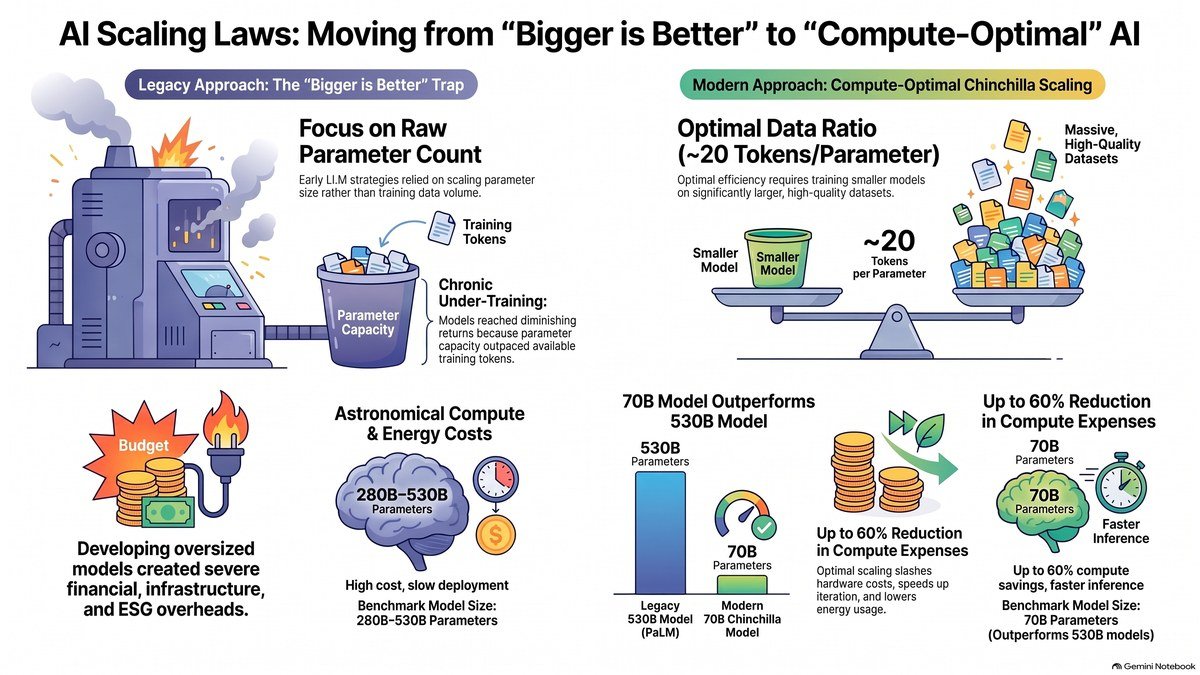
The core finding of the Chinchilla research was this: for a fixed compute budget, optimal model performance is achieved by training a smaller model on significantly more data than had previously been considered standard practice.
Prior to Chinchilla, many large language models were effectively “under-trained” on data relative to their parameter count. The prevailing heuristic was to train models on roughly 20 tokens of data per parameter. The DeepMind team demonstrated through extensive experimentation that this ratio was far from optimal. Their research indicated that for a given amount of compute, the ideal balance was to train a model with more parameters per unit of compute but crucially, with a far greater proportion of data. Specifically, they found that approximately 20 tokens of data per parameter was often the sweet spot, meaning that for a model with 70 billion parameters, you’d ideally need 1.4 trillion tokens of data. This was a monumental shift in perspective.
To illustrate the impact, consider their direct comparison: The 70-billion-parameter Chinchilla model, trained optimally according to these new scaling laws, outperformed the much larger 280-billion-parameter Gopher model and even the 530-billion-parameter PaLM model on a wide range of tasks, despite being significantly smaller. The key differentiator was that Chinchilla was trained with far more data for its size, maximizing the utility of its compute budget.
This discovery fundamentally re-calibrated the understanding of how to efficiently achieve high-performing AI. It revealed that simply increasing model size without commensurately increasing the data fed to it is an inefficient use of resources. It’s akin to buying a high-performance sports car but only ever driving it in first gear; you’re not utilizing its full potential. Chinchilla demonstrated that judiciously balancing the model’s capacity (parameters) with its learning opportunities (data) within a given compute budget leads to superior outcomes.
For business decision-makers, this insight is nothing short of revolutionary. It provides a strategic roadmap for achieving state-of-the-art AI performance without necessarily having to participate in the prohibitively expensive race for the largest models. It shifts the focus from raw scale to intelligent optimization.
Business Value and Strategic Implications of Chinchilla Scaling
The implications of Chinchilla scaling laws for enterprise AI strategy are profound, offering tangible business value across several dimensions:
- Optimized Resource Allocation and Significant Cost Savings (ROI):
- Reduced Compute Infrastructure Costs: By training smaller, optimally scaled models, organizations can significantly reduce their expenditure on specialized hardware (GPUs/TPUs) and the associated infrastructure. This impacts both capital expenditure and ongoing operational costs.
- Lower Energy Consumption: Less compute means less electricity, directly translating to lower utility bills and a reduced carbon footprint, aligning with corporate sustainability goals.
- Faster Iteration Cycles: Smaller models train faster, enabling AI teams to experiment, refine, and deploy new capabilities more rapidly. This accelerates innovation and time to market for AI-powered products and services.
- Real-world Example: A leading financial services firm, initially considering building a 100-billion-parameter internal LLM for complex compliance document analysis, estimated training costs in the tens of millions. By applying Chinchilla scaling principles, they re-evaluated, opting for a 30-billion-parameter model trained on a meticulously curated, much larger dataset of financial reports and regulatory documents. This approach reduced their compute expenditure by an estimated 60% while achieving equivalent or superior accuracy in identifying critical clauses and anomalies, delivering a substantial ROI.
- Enhanced Performance and Efficiency:
- Superior Performance for the Budget: Optimally scaled models often achieve better accuracy, fluency, and reasoning capabilities on specific tasks for a given compute budget, outperforming larger, sub-optimally trained counterparts.
- Faster Inference Times: Smaller models require less compute for inference (making predictions or generating responses). This is critical for real-time applications such like customer service chatbots, recommendation engines, or autonomous systems, leading to better user experiences and operational efficiency.
- Easier Deployment and Management: Smaller models are simpler to deploy on less powerful hardware, including edge devices, and are generally easier to manage, fine-tune, and maintain in production environments. This reduces the operational overhead of AI systems.
- Sustainability and ESG Considerations:
- By explicitly optimizing for compute efficiency, Chinchilla scaling directly contributes to reduced energy consumption and a lower carbon footprint for AI development. This aligns directly with corporate environmental, social, and governance (ESG) mandates and positions companies as responsible innovators.
- Real-world Example: A global logistics company used Chinchilla principles to optimize its route optimization AI. By reducing the model size and increasing the data volume, they cut down the training energy consumption by 40%. This not only saved costs but also bolstered their public image as a sustainable tech leader.
- Competitive Advantage and Innovation:
- Companies that master optimal scaling can develop high-performing AI solutions more quickly and affordably than competitors relying on brute-force “bigger is better” methods. This agility allows them to pivot faster, explore more use cases, and bring innovative AI products to market ahead of the curve.
- Democratization of Advanced AI: Chinchilla’s insights lower the barrier to entry for developing advanced AI. Organizations without hyper-scale budgets can now realistically aim to build powerful, bespoke AI models that were previously thought to be the exclusive domain of tech giants. This fosters broader innovation across industries.
- Data-Centric Strategy Reinforcement:
- The emphasis on data volume and quality inherent in Chinchilla scaling reinforces the strategic importance of a robust data strategy. It shifts focus from merely collecting data to actively curating, cleaning, and augmenting high-quality datasets, recognizing data as a primary driver of AI performance. This investment in data stewardship yields dividends across all AI initiatives.
Risks and Challenges of Adoption
While the strategic advantages are compelling, adopting a Chinchilla-informed approach is not without its challenges. Executives must be aware of these potential hurdles to ensure a smooth and successful transition:
- Mindset Shift and Overcoming Inertia: The deeply ingrained “bigger is better” mentality is a significant psychological and cultural barrier. Technical teams and even business stakeholders may initially resist the idea that a smaller model can outperform a larger one. This requires clear communication, education, and demonstrable proof of concept within the organization.
- Data Scarcity and Quality: The core of Chinchilla scaling is the demand for significantly more high-quality training data. For many organizations, sourcing, acquiring, cleaning, labeling, and curating truly massive and diverse datasets can be a monumental task. Data governance, privacy concerns, and the sheer cost of data pipelines can become substantial challenges. Inferior data will undermine the benefits of optimal scaling.
- Advanced Tooling and Expertise: Implementing Chinchilla scaling effectively requires sophisticated expertise in distributed training, hyperparameter optimization, and managing large-scale data pipelines. It’s not just about having more data; it’s about knowing how to effectively utilize it. Organizations may need to invest in upskilling existing teams or hiring specialized talent.
- Benchmarking and Evaluation Complexities: Reliably measuring the performance of optimally scaled models against legacy approaches can be complex. Choosing the right metrics, establishing robust evaluation frameworks, and demonstrating the “equivalence or superiority” of a smaller model to a larger one requires careful scientific rigor.
- Trade-offs for Extreme Generality: While optimal scaling is excellent for efficiency and specific tasks, there might still be situations where truly enormous models (even if sub-optimally trained by Chinchilla standards) exhibit unique “emergent capabilities” – unexpected new skills – that arise only from sheer, unprecedented scale, often for highly general, foundational tasks. The strategic choice is about balancing extreme generality against targeted efficiency for most enterprise applications.
Strategic Adoption Choices and Roadmap for Leaders
For C-suite executives ready to leverage the power of scaling laws, here is a strategic roadmap for adoption:
- Conduct an AI Investment Audit: Begin by evaluating your existing AI initiatives and planned investments. Are your current models over-parameterized relative to their training data? Are you paying for capabilities you don’t fully utilize? This audit can identify immediate opportunities for optimization.
- Elevate Data Strategy to a Top Priority: Chinchilla scaling underscores that data is the ultimate competitive differentiator. Invest strategically in data acquisition, quality control, cleansing, governance, and augmentation. Establish robust data pipelines and cultivate a data-centric culture throughout your organization. This includes exploring synthetic data generation where appropriate and secure data sharing agreements.
- Invest in Internal Expertise and Education: Empower your technical leadership and AI teams with the knowledge and tools to implement scaling laws. Provide training in advanced model optimization techniques, distributed computing, and large-scale data management. Consider bringing in external experts for initial guidance or proof-of-concept projects.
- Pilot Projects with Clear ROI: Start small to demonstrate big impact. Select specific business units or use cases where an optimally scaled AI model can deliver measurable improvements in cost, speed, or performance. For instance, optimize an internal search engine, enhance a fraud detection system, or refine a supply chain forecasting model.
- Example: A major e-commerce retailer adopted Chinchilla principles to rebuild their product recommendation engine. By training a smaller model on a significantly larger, meticulously curated dataset of customer interaction and purchase history, they reduced their cloud inference costs by 25% and saw a 10% uplift in recommendation conversion rates within six months.
- Explore Partnerships and Open-Source Solutions: The AI ecosystem is rapidly evolving. Collaborate with AI research institutions, specialized vendors offering MLOps platforms, or leverage the thriving open-source community. Projects like Meta’s Llama series, while large, demonstrate a strong commitment to efficient scaling and high-quality data, aligning with these principles and making powerful models accessible. Microsoft’s smaller, high-performing Phi-2 model is another excellent example from the open-source community demonstrating how meticulous data curation and clever architecture can yield powerful results even with fewer parameters.
- Adopt a Hybrid AI Architecture: For many enterprises, the optimal approach will involve a hybrid strategy. This might mean leveraging massive, general-purpose foundational models (like GPT-4) for broad tasks, but then applying Chinchilla-style optimal scaling to develop smaller, highly specialized models for specific, proprietary enterprise functions. These smaller models can be fine-tuned more cheaply and efficiently using internal, high-value data, delivering targeted precision and maintaining data privacy.
- Embrace Continuous Learning and Adaptability: The field of AI is dynamic. What’s optimal today might evolve tomorrow. Foster a culture of continuous learning, experimentation, and adaptability to stay at the forefront of AI efficiency and innovation.
Conclusion: Smarter, Not Just Bigger, AI for Business Advantage
The era of “bigger is blindly better” in AI is yielding to a more sophisticated, data-driven, and economically rational approach. Scaling laws, particularly the groundbreaking insights from Chinchilla research, have provided business leaders with a powerful blueprint for building high-performing, cost-efficient, and sustainable AI solutions.
The strategic imperative is clear: companies that understand and implement optimal scaling principles will gain a significant competitive edge. They will allocate resources more effectively, realize greater return on investment from their AI initiatives, accelerate their pace of innovation, and reduce their environmental footprint. This is not just about making AI cheaper; it’s about making AI smarter, more impactful, and more strategically aligned with long-term business objectives.
For C-suite executives, the message is unambiguous: success in the next wave of AI will belong to those who prioritize data strategy, embrace compute-optimal model development, and strategically deploy resources, transforming the quest for AI excellence from a brute-force expenditure into a precise, highly efficient, and ultimately more rewarding endeavor.