The advent of Generative Artificial Intelligence (AI) marks a pivotal moment in technological history, presenting both unprecedented opportunities and complex strategic challenges for businesses worldwide. From automating mundane tasks to sparking radical innovation in product development and customer engagement, Generative AI is rapidly moving from theoretical concept to practical application across every industry vertical. For C-suite executives, senior leaders, and strategic decision-makers, comprehending the intricate landscape of Generative AI is no longer a matter of future planning, but an immediate imperative for maintaining competitive advantage and driving sustainable growth.
This article delves into the core components of this transformative technology. We will explore foundation models, the powerful, versatile AI systems that underpin many Generative AI applications. We will then dissect the critical strategic choice between adopting open-source and proprietary AI models, examining their respective business values, return on investment (ROI) implications, inherent risks, and crucial adoption considerations. Finally, we will map out the broader Generative AI ecosystem, highlighting the diverse players and services essential for successful implementation and scaling. Our aim is to provide a clear, boardroom-ready perspective, empowering leaders to make informed decisions that align technology investments with strategic business objectives.
Understanding the Core: Foundation Models as the Bedrock of Generative AI
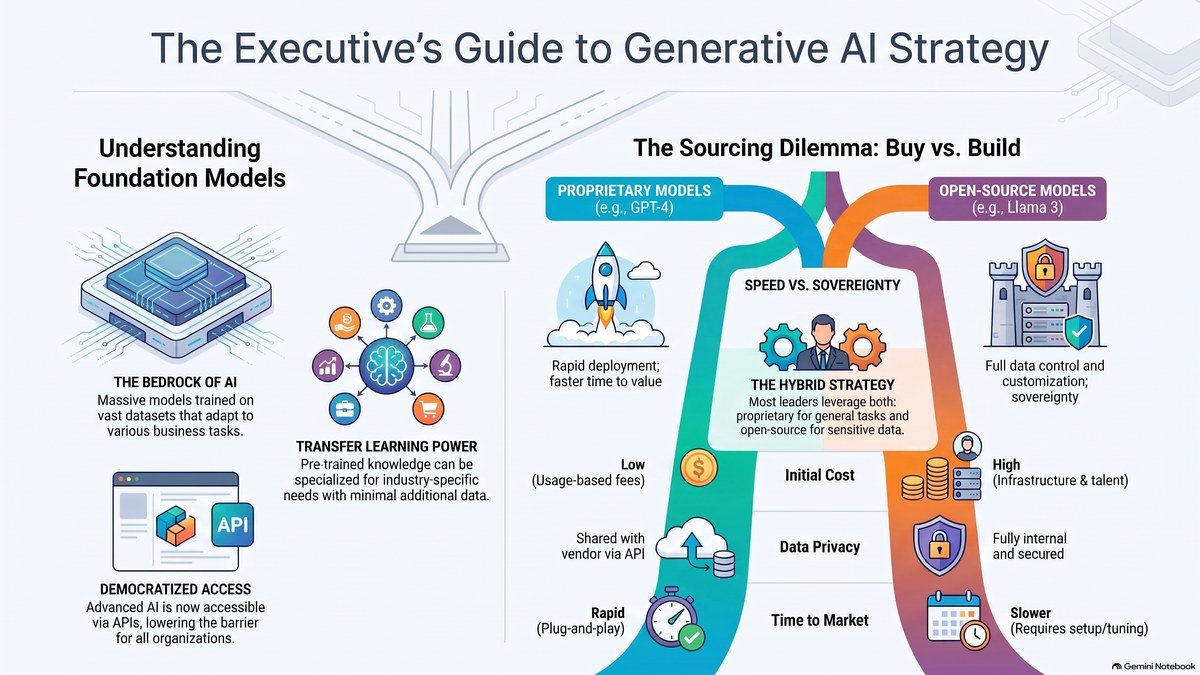
At the heart of the current Generative AI revolution lie “foundation models.” These are not merely algorithms; they are large-scale AI models trained on vast and diverse datasets, often encompassing petabytes of text, images, code, and other forms of data. This extensive pre-training enables them to develop a broad understanding of patterns, relationships, and context, allowing them to perform a wide array of tasks and adapt to new ones with minimal further training. They are called “foundation” models because they serve as the base layer upon which more specialized AI applications can be built.
What Makes Foundation Models Unique and Powerful?
The significance of foundation models stems from several key characteristics:
- Generalization and Versatility: Unlike traditional AI models designed for specific tasks like image classification or sentiment analysis, foundation models exhibit remarkable versatility. A single foundation model can generate human-like text, summarize documents, translate languages, write code, create images, or even compose music. This broad applicability significantly reduces the need to develop bespoke AI models for every single use case, drastically lowering development costs and accelerating deployment timelines.
- Transfer Learning: A cornerstone of their power is the ability to leverage “transfer learning.” Once a foundation model has learned general knowledge from its vast pre-training, this knowledge can be transferred and adapted to new, narrower tasks with relatively small, task-specific datasets. This process, often called “fine-tuning,” allows businesses to specialize a general model for their unique needs – for instance, adapting a large language model to understand specific industry jargon or a company’s internal documentation style.
- Scale and Complexity: The sheer scale of data and computational power used to train these models is unprecedented. This scale contributes to their emergent capabilities – behaviors and skills that are not explicitly programmed but arise from the model’s complex interactions with massive datasets. These emergent abilities often surprise even their creators, opening unforeseen avenues for innovation.
- Democratization of AI: By providing powerful, pre-trained capabilities, foundation models lower the barrier to entry for developing sophisticated AI applications. Businesses that lack the resources to train models from scratch can now access highly advanced AI through Application Programming Interfaces (APIs) or by fine-tuning open-source alternatives. This democratizes access to cutting-edge AI, enabling a broader range of organizations to harness its potential.
Business Value and ROI of Foundation Models
The strategic importance of foundation models translates directly into tangible business value and compelling ROI opportunities across various functions:
- Accelerated Innovation: Product development cycles can be significantly shortened. Companies like Adobe leverage foundation models to power features in their Creative Cloud suite, allowing designers to generate variations of images, create marketing copy, or even assist with video editing, rapidly prototyping new ideas. This fosters creativity and speeds up content production.
- Enhanced Efficiency and Automation: Routine, labor-intensive tasks can be automated or significantly augmented. Customer service operations, for instance, can utilize foundation models to generate responses to common queries, summarize complex support tickets for human agents, or even proactively identify customer sentiment. Companies like Salesforce integrate Generative AI into their CRM platforms, providing sales teams with AI-generated email drafts and meeting summaries, saving valuable time.
- Cost Reduction: By reducing the need for specialized AI model development and enabling automation, foundation models can lead to substantial cost savings. The ability to fine-tune existing models rather than building from scratch drastically cuts down on research and development expenses, computational resources, and specialized talent requirements.
- New Revenue Streams: Foundation models enable the creation of entirely new products and services. Consider startups built around Generative AI for personalized learning, drug discovery simulation, or legal document analysis. These models unlock capabilities that were previously economically or technically unfeasible.
- Improved Decision-Making: By rapidly processing and synthesizing vast amounts of information, foundation models can support better decision-making. From analyzing market trends to summarizing competitive intelligence, they provide insights that can inform strategic choices more quickly and comprehensively.
Risks and Considerations with Foundation Models
While transformative, foundation models come with their own set of risks that C-suite leaders must address proactively:
- Bias and Fairness: As these models learn from existing data, they can inadvertently absorb and amplify societal biases present in that data. This can lead to unfair or discriminatory outputs, particularly in critical applications like hiring, loan approvals, or legal judgments. Careful monitoring and mitigation strategies are essential.
- Accuracy and Hallucinations: Foundation models can sometimes generate incorrect, nonsensical, or entirely fabricated information, a phenomenon known as “hallucination.” Ensuring the veracity of outputs, especially in factual domains, requires robust verification mechanisms and human oversight.
- Computational Cost: Training and running very large foundation models demand significant computational resources, primarily powerful Graphics Processing Units (GPUs). This can translate into substantial energy consumption and operational costs, a factor to weigh heavily in budgeting.
- Transparency and Explainability: Due to their immense complexity, understanding precisely why a foundation model produces a particular output can be challenging. This “black box” nature can hinder trust, accountability, and regulatory compliance, particularly in sensitive applications.
- Intellectual Property and Data Privacy: The use of large datasets for training raises questions about intellectual property rights of the original creators. Furthermore, if proprietary or sensitive company data is used for fine-tuning or prompt engineering, robust data privacy and security protocols are paramount to prevent leakage or misuse.
Successfully integrating foundation models requires not just technical prowess but a deep strategic understanding of their capabilities and limitations. The next crucial decision for any organization is how to access and deploy these powerful tools.
The Sourcing Dilemma: Open-Source vs. Proprietary Models
A fundamental strategic choice facing organizations embarking on their Generative AI journey is whether to adopt proprietary models offered by commercial vendors or to utilize open-source alternatives. This decision carries significant implications for cost, control, customization, security, and long-term strategic flexibility. There is no universally “correct” answer; the optimal choice depends heavily on an organization’s specific needs, resources, risk tolerance, and strategic objectives.
Proprietary Models: The “Buy” Approach
Proprietary models are developed, owned, and maintained by commercial entities. Access is typically granted through APIs (Application Programming Interfaces) via cloud services, often on a subscription or usage-based pricing model. Leading examples include OpenAI’s GPT series, Anthropic’s Claude, and Google’s Gemini.
Business Value and ROI of Proprietary Models:
- Ease of Use and Rapid Deployment: Proprietary models are generally designed for ease of integration. Vendors provide well-documented APIs, Software Development Kits (SDKs), and often managed infrastructure, allowing businesses to integrate powerful AI capabilities quickly with minimal setup. This translates to faster time to market for new AI-powered applications. For example, a marketing agency can rapidly deploy OpenAI’s GPT-4 via an API to generate marketing copy or social media content, instantly boosting productivity without needing deep AI expertise.
- High Performance Out-of-the-Box: Leading proprietary models often represent the cutting edge in terms of performance, accuracy, and breadth of capabilities. They benefit from massive training datasets, state-of-the-art architectures, and continuous refinement by large research teams. This means organizations can often achieve impressive results with less fine-tuning or specialized prompt engineering.
- Vendor Support and Maintenance: Commercial vendors typically offer comprehensive support, including technical assistance, documentation, and continuous updates. They manage the underlying infrastructure, security patches, and model improvements, offloading significant operational burden from the adopting organization. This ensures reliability and allows internal teams to focus on application development rather than model maintenance.
- Security and Compliance Assurance: Reputable proprietary model providers invest heavily in security, data privacy, and compliance certifications. They often offer enterprise-grade service level agreements (SLAs), robust access controls, and assurances regarding how customer data is handled (e.g., not using customer data for model retraining without explicit consent). This is particularly crucial for industries with strict regulatory requirements, such as finance or healthcare. For instance, Microsoft Azure OpenAI Service offers enterprise-grade security and compliance features for accessing OpenAI models, appealing to large corporations.
- Reduced Upfront Investment: Organizations avoid the substantial upfront capital expenditure (CAPEX) associated with procuring and maintaining high-performance computing infrastructure (GPUs) and building expert AI teams for model development and deployment. Costs are typically operational expenses (OPEX) that scale with usage.
Risks and Adoption Choices with Proprietary Models:
- Vendor Lock-in: Relying on a single proprietary vendor creates dependence. Switching providers can be costly and disruptive due to API differences, data migration challenges, and retraining efforts. This limits strategic flexibility and can impact future negotiation leverage.
- Subscription and Usage Costs: While upfront costs are lower, ongoing usage-based pricing can become substantial, especially for high-volume applications. Unpredictable usage patterns can lead to unexpected cost escalations. Businesses must carefully forecast usage and negotiate favorable terms.
- Limited Customization and Control: Organizations have less control over the model’s internal workings, architecture, and training data. While fine-tuning is often possible, deeper modifications or tailoring the model to extremely niche, proprietary datasets may be constrained. Data privacy concerns also persist, as data is shared with a third-party vendor, even if only via APIs.
- Potential for Downtime and API Changes: Service disruptions or unexpected changes to APIs or model versions by the vendor can impact mission-critical applications. Organizations must design their systems with resilience and abstraction layers to mitigate these risks.
- Data Sovereignty and Geographic Restrictions: Depending on the vendor’s data centers and compliance policies, data may be processed in jurisdictions that do not align with an organization’s data sovereignty requirements, posing legal and compliance challenges.
Open-Source Models: The “Build” Approach
Open-source models, conversely, have their underlying code, weights, and architectures publicly available. This allows anyone to inspect, download, modify, and deploy them on their own infrastructure. Prominent examples include Meta’s Llama series, Hugging Face’s vast repository of models, and Falcon models from the Technology Innovation Institute.
Business Value and ROI of Open-Source Models:
- Full Control and Customization: This is the paramount advantage. Organizations gain complete control over the model, its deployment environment, and its training data. They can fine-tune, pre-train on specialized datasets, or even modify the model architecture to fit unique business needs precisely. This is invaluable for highly differentiated applications or sensitive industry sectors. For example, a financial institution can fine-tune a Llama 2 model on its proprietary market data and internal compliance documents, ensuring that the model’s outputs are perfectly aligned with its specific regulatory and business context, without sharing that sensitive data externally.
- Enhanced Data Privacy and Security: By deploying and managing open-source models on their own premises or within their private cloud infrastructure, organizations can ensure that sensitive data never leaves their control. This mitigates risks associated with third-party data sharing and helps meet stringent data sovereignty and compliance requirements (e.g., HIPAA, GDPR, CCPA).
- Cost Predictability and Avoidance of Usage Fees: While open-source models require investment in infrastructure and talent, they eliminate per-token or usage-based fees. Once deployed, the operational costs are primarily tied to hardware, energy, and maintenance, which can be more predictable and potentially lower in the long run for high-volume use cases.
- No Vendor Lock-in: The freedom from proprietary vendors means organizations are not tied to a single provider’s roadmap, pricing, or service levels. This fosters long-term strategic flexibility and allows for agile adaptation to the rapidly evolving AI landscape.
- Community Support and Innovation: The open-source community is a vibrant hub of innovation. Developers globally contribute improvements, identify vulnerabilities, and share best practices. This collective intelligence can accelerate development and provide robust, peer-reviewed solutions. Organizations can leverage this collaborative ecosystem, like the Hugging Face Hub, to discover, experiment with, and deploy a wide range of models.
Risks and Adoption Choices with Open-Source Models:
- Higher Upfront Investment and Complexity: Deploying and managing open-source models requires significant upfront investment in specialized talent (AI engineers, MLOps specialists), high-performance computing infrastructure (GPUs), and complex software stacks. The learning curve can be steep.
- Increased Operational Burden: The responsibility for model deployment, infrastructure management, security patching, performance monitoring, and ongoing maintenance falls entirely on the organization. This demands robust internal capabilities and continuous resource allocation.
- Performance and Quality Variability: While some open-source models are highly performant, others may require substantial fine-tuning or further pre-training to match the capabilities of leading proprietary models, especially for complex tasks. Achieving desired performance often requires significant internal expertise and resources.
- Lack of Direct Vendor Support: Open-source models typically do not come with commercial support contracts. While community forums are valuable, critical issues may lack immediate, guaranteed resolutions, potentially impacting production systems. Organizations might need to engage third-party consultants or build strong internal support teams.
- Responsibility for Responsible AI: Mitigating biases, ensuring fairness, and addressing ethical implications become the sole responsibility of the adopting organization. This requires developing robust internal governance frameworks and continuous oversight to prevent harmful or discriminatory outcomes.
Strategic Considerations for the Sourcing Decision
The choice between open-source and proprietary models is not binary; a hybrid approach is often the most pragmatic. Organizations might start with proprietary models for rapid prototyping and non-sensitive applications, then migrate to open-source or fine-tune proprietary models for core, sensitive, or highly differentiated use cases.
Key factors guiding the decision include:
- Data Sensitivity and Regulatory Compliance: For highly sensitive data or strict regulatory environments (e.g., healthcare, defense), the control offered by open-source models deployed on private infrastructure is often preferred.
- Talent and Resource Availability: Organizations with strong internal AI and MLOps teams are better positioned to leverage open-source models. Those with limited specialized talent may find proprietary solutions more accessible.
- Speed to Market: For applications requiring rapid deployment and immediate impact, proprietary models often provide a faster path.
- Level of Customization Required: If deep customization or integration with unique internal systems is paramount, open-source models offer greater flexibility.
- Budget and Cost Structure: Evaluate total cost of ownership, factoring in usage fees for proprietary models versus infrastructure, talent, and maintenance costs for open-source.
- Strategic Differentiator: If AI is a core differentiator for the business, investing in open-source to build proprietary advantage may be strategic. If AI is a utility for efficiency, proprietary APIs might suffice.
Many organizations are embracing a multi-model strategy, leveraging the strengths of both approaches. They might use a proprietary model like GPT-4 for general knowledge tasks and content generation, while concurrently fine-tuning a Llama 3 model on their internal knowledge base for specialized customer support or internal document analysis, ensuring data privacy and domain specificity.
The Broader Ecosystem: Beyond the Core Models
Foundation models, whether open-source or proprietary, are merely the building blocks. A robust and interconnected ecosystem has emerged around Generative AI, providing the tools, infrastructure, data, and services necessary to deploy, manage, and scale AI applications effectively within an enterprise context. Understanding this broader ecosystem is crucial for C-suite leaders to strategize complete end-to-end solutions.
Key Components of the Generative AI Ecosystem:
- Infrastructure Providers (Cloud and Hardware):
- Role: These providers supply the foundational computing power and services needed to train, fine-tune, and run Generative AI models. This includes high-performance GPUs, specialized AI accelerators, and cloud-based platforms.
- Business Value: Scalability, flexibility, and reduced capital expenditure. Cloud providers like Amazon Web Services (AWS), Microsoft Azure, and Google Cloud Platform (GCP) offer managed services (e.g., AWS SageMaker, Azure ML, GCP Vertex AI) that simplify the deployment and management of AI workloads, including access to powerful compute resources.
- Adoption Choices: Organizations can choose between public cloud offerings for elasticity and reach, private cloud for enhanced control, or even hybrid deployments. The choice impacts cost, latency, and data governance.
- Tooling and Frameworks (Development and Orchestration):
- Role: This category includes software libraries, frameworks, and platforms that help developers interact with, extend, and manage Generative AI models. Key areas include prompt engineering, retrieval-augmented generation (RAG), fine-tuning, evaluation, and monitoring.
- Business Value: Accelerates development cycles, improves model reliability, ensures responsible AI practices, and enables complex AI applications. Tools like LangChain and LlamaIndex help orchestrate interactions with multiple models and data sources, making it easier to build intelligent agents. Platforms like Weights & Biases offer comprehensive tools for experiment tracking, model evaluation, and monitoring AI systems in production.
- Adoption Choices: Businesses must select tools that integrate well with their existing technology stack and support their chosen models (open-source or proprietary). This often involves building internal expertise in these frameworks.
- Data Providers and Annotation Services:
- Role: High-quality, domain-specific data is critical for fine-tuning foundation models and improving their performance for niche applications. Data providers offer curated datasets, while annotation services help label and enrich proprietary data.
- Business Value: Significantly enhances model performance and accuracy for specific business contexts, turning generic models into specialized assets. For example, a healthcare company might use a data annotation service to label medical images or patient records, improving a model’s ability to diagnose or analyze specific conditions.
- Risks: Data quality, privacy, intellectual property, and cost are significant considerations. Companies must ensure data sourcing complies with regulations and ethical guidelines.
- AI-Native Applications and Vertical Solutions:
- Role: These are complete software products and services built on top of foundation models, often tailored for specific industries or business functions. They encapsulate Generative AI capabilities into user-friendly interfaces.
- Business Value: Provides off-the-shelf solutions for common business problems, reducing the need for in-house AI development. This enables rapid value realization without extensive technical investment. Examples include GitHub Copilot for code generation (leveraging OpenAI’s models), Jasper AI for marketing content creation, and specialized legal research platforms like Harvey AI for legal professionals.
- Adoption Choices: For businesses seeking quick wins or specific functional improvements, adopting these pre-built applications can be highly efficient. However, ensure they integrate seamlessly with existing workflows and provide necessary customization options.
- Consulting and System Integrators:
- Role: As the Generative AI landscape is complex and rapidly evolving, consulting firms and system integrators play a crucial role in helping organizations define their AI strategy, select appropriate technologies, implement solutions, manage change, and build internal capabilities.
- Business Value: Provides specialized expertise, accelerates adoption, mitigates risks, and helps bridge the gap between business objectives and technical implementation. Firms like Accenture or Deloitte are actively guiding clients through Generative AI strategy and deployment across various sectors.
- Adoption Choices: Engaging external experts can be invaluable for organizations lacking internal AI maturity or facing complex integration challenges.
The Importance of Interoperability and Standards
As the ecosystem matures, the demand for interoperability and standardization becomes critical. Businesses want the flexibility to swap out models, leverage different tools, and integrate various services without massive rework. Efforts towards common APIs, model formats, and data exchange protocols are underway, aiming to reduce fragmentation and foster a more seamless Generative AI landscape. Leaders should prioritize solutions that adhere to emerging standards and offer open integration pathways.
Risks, Governance, and Responsible AI
The transformative power of Generative AI is accompanied by significant risks that demand proactive management and robust governance frameworks. For C-suite leaders, addressing these risks is not merely a compliance issue but a strategic imperative to protect reputation, ensure ethical operations, and build trust.
- Ethical Considerations and Bias: As previously noted, foundation models can perpetuate and amplify biases present in their training data. This can lead to unfair outcomes in areas like hiring, lending, or even criminal justice.
- Mitigation: Implement rigorous fairness audits, diverse training data strategies, continuous monitoring for bias, and transparent communication about model limitations. Develop internal ethical AI guidelines and frameworks.
- Security Risks: Generative AI introduces new attack vectors:
- Data Leakage: Inadvertently revealing sensitive company or customer data through model outputs, especially when proprietary data is used for fine-tuning or in prompts.
- Prompt Injection: Malicious users crafting prompts to bypass safety mechanisms or extract confidential information.
- Model Poisoning: Adversarial attacks on training data to corrupt model behavior.
- Mitigation: Adopt robust data governance protocols, strict access controls, encryption, input/output validation, and regular security audits. Train employees on secure prompting practices.
- Compliance and Regulatory Landscape: The regulatory environment around AI is rapidly evolving, with initiatives like the EU AI Act setting precedents. Organizations must navigate issues related to:
- Data Privacy: Adherence to GDPR, CCPA, and other data protection laws.
- Intellectual Property: Questions about copyright of generated content and the use of copyrighted material in training data.
- Transparency and Accountability: Requirements to disclose when AI is being used and to explain model decisions.
- Mitigation: Establish dedicated legal and compliance teams focused on AI regulations, develop internal policies for IP and data usage, and engage with industry bodies and policymakers.
- Operational Risks:
- Cost Overruns: Uncontrolled usage of API-based models or inefficient management of open-source infrastructure can lead to unexpectedly high costs.
- Performance Drift: Models can degrade over time as real-world data changes or new biases emerge.
- Talent Gaps: Lack of skilled professionals to build, deploy, and maintain Generative AI solutions.
- Mitigation: Implement strict cost monitoring and optimization strategies, establish robust MLOps practices for continuous model evaluation and retraining, and invest in talent acquisition and upskilling programs.
Building a Robust AI Governance Framework:
Effective Generative AI adoption requires a comprehensive governance framework that addresses these risks. This framework should include:
- Dedicated AI Ethics Committees: To review use cases, assess risks, and guide responsible development.
- Clear Policies and Guidelines: For data usage, model development, deployment, and monitoring.
- Regular Audits and Assessments: Of models, data, and infrastructure for security, bias, and compliance.
- Transparency and Explainability Measures: To build trust and meet regulatory requirements.
- Continuous Employee Training: On responsible AI practices, data security, and ethical considerations.
Ultimately, responsible AI is not an afterthought; it must be embedded into the entire Generative AI lifecycle, from initial strategy to deployment and ongoing operations.
Strategic Adoption and the Path Forward
The Generative AI landscape is dynamic, presenting both immense potential and considerable complexity. For C-suite executives, a clear, strategic approach to adoption is paramount to harness its power while mitigating risks.
- Start with Business Problems, Not Just Technology: Resist the urge to deploy Generative AI simply because it is new. Identify clear business challenges or opportunities where AI can deliver tangible value – whether it is improving customer experience, boosting employee productivity, accelerating product development, or uncovering new insights. Begin with pilot projects that are well-defined and measurable.
- Foster a Culture of Experimentation and Learning: Generative AI is an iterative journey. Encourage teams to experiment, learn from failures, and continuously adapt strategies based on real-world results. This requires psychological safety and leadership support for innovation.
- Invest in Talent and Upskilling: The success of Generative AI hinges on human expertise. Invest in training existing employees and hiring new talent with skills in AI engineering, data science, MLOps, prompt engineering, and ethical AI. Equip your workforce to leverage these new tools effectively.
- Embrace a Hybrid and Multi-Model Strategy: Recognize that a single Generative AI solution rarely fits all needs. Be prepared to leverage a mix of proprietary and open-source models, deployed across various infrastructure environments, to optimize for performance, cost, control, and data sensitivity across different use cases.
- Prioritize Governance and Responsible AI: Integrate responsible AI practices from the outset. Develop a robust governance framework that addresses ethical considerations, security, data privacy, and compliance. This proactive approach builds trust and safeguards your organization’s reputation.
- Continuous Monitoring and Adaptation: The Generative AI landscape evolves rapidly. Establish mechanisms for continuous monitoring of model performance, industry trends, and emerging technologies. Be prepared to adapt your strategy, tools, and models to remain competitive and innovative.
Conclusion
Generative AI is not merely an incremental technological advancement; it is a foundational shift poised to redefine how businesses operate, innovate, and interact with their customers. From the underlying power of foundation models to the strategic choices between open-source and proprietary solutions, and the comprehensive support of a burgeoning ecosystem, the landscape demands informed and decisive leadership.
For C-suite executives, the imperative is clear: embrace Generative AI not as a transient trend, but as a core pillar of your long-term business strategy. By understanding its fundamental components, carefully weighing the trade-offs of different adoption models, diligently managing risks, and fostering an agile, learning-oriented culture, organizations can unlock unprecedented levels of efficiency, innovation, and competitive advantage. The future belongs to those who proactively navigate this transformative landscape, leveraging Generative AI to build resilient, intelligent, and forward-looking enterprises.