In the rapidly evolving landscape of artificial intelligence, understanding the foundational mechanics of how AI processes information is no longer a luxury but a strategic imperative for C-suite executives and senior leaders. We regularly interact with AI systems that interpret human language – from chatbots and search engines to sophisticated analytical tools and generative AI platforms. Yet, beneath the seamless user experience lies a complex, numerical transformation of text that dictates an AI model’s effectiveness, accuracy, and ultimately, its business value.
This article pulls back the curtain on two core concepts at the heart of natural language processing (NLP): tokenization and embeddings. We will explore leading techniques like Byte-Pair Encoding (BPE) and WordPiece, demystifying how AI models convert the rich, nuanced tapestry of human language into a format they can “understand.” More importantly, we will connect these technical underpinnings to tangible business value, potential risks, and critical adoption choices, equipping you with the knowledge to make informed strategic decisions for your organization’s AI journey.
The Fundamental Challenge: Bridging Human Language and Machine Logic
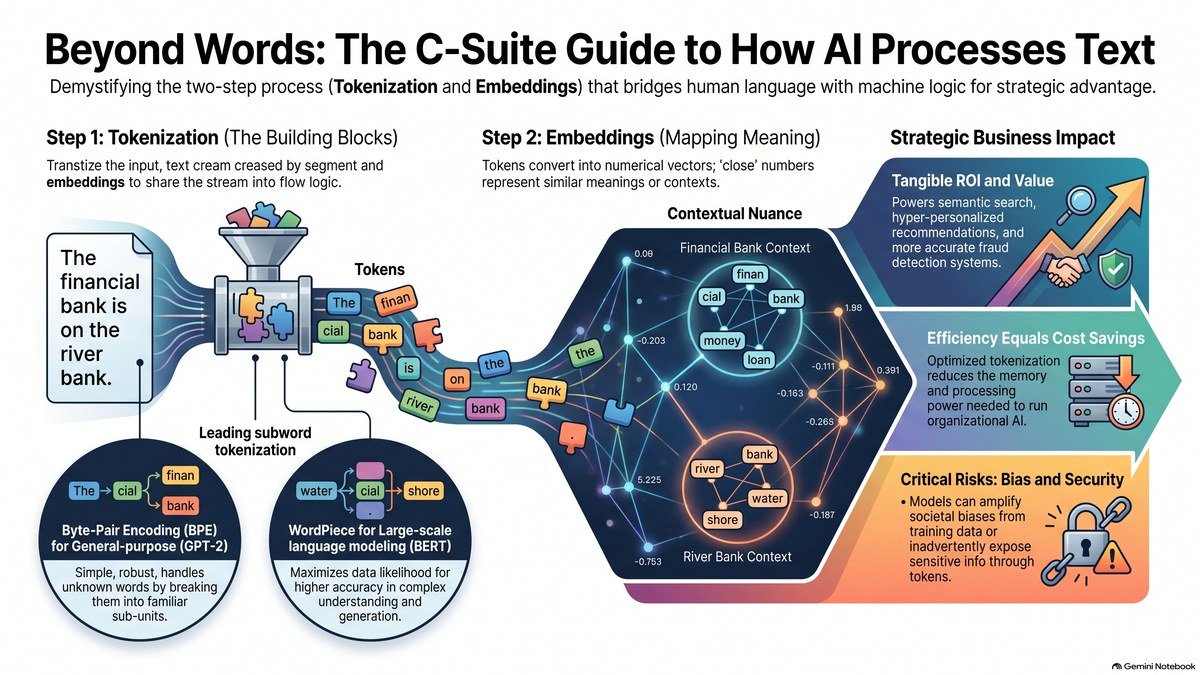
At its core, artificial intelligence, particularly the kind that deals with language, operates on numbers, not words. A computer does not intuitively grasp the meaning of “synergy” or the context of a customer complaint. For AI models to derive insights, generate content, or answer queries, text must first be translated into a numerical representation. This translation is a two-step process:
- Tokenization: Breaking down raw text into smaller, discrete units called “tokens.” These tokens are the fundamental building blocks an AI model will analyze.
- Embeddings: Converting these tokens into dense numerical vectors, which encode meaning and relationships, allowing the model to perform complex computations.
Failing to grasp these fundamental steps can lead to misallocated investments, unrealistic project expectations, and missed opportunities. Conversely, a clear understanding empowers leaders to ask the right questions, evaluate AI solutions more effectively, and steer their organizations towards data-driven innovation.
The Art of Tokenization: Crafting the Building Blocks of Understanding
Imagine trying to understand a book by simply counting the number of letters. It would be an impossible task. Similarly, for an AI, treating an entire sentence or even a whole word as a single, indivisible unit presents significant challenges.
Consider the word “unbelievable.” If an AI only recognizes “unbelievable” as one unit, it might struggle with “believe” or “believable,” even though they share semantic roots. Traditional tokenization might simply split text by spaces, treating each word as a token. However, this simplistic approach quickly runs into limitations:
- Handling unknown words (Out-Of-Vocabulary – OOV): If a new word appears that wasn’t in the model’s training data, a word-level tokenizer might discard it or treat it as an “unknown” token, losing valuable information.
- Vocabulary size: Human language is vast. A purely word-based vocabulary for an AI model could run into millions of unique words, requiring immense computational resources and making models unwieldy.
- Morphological variations: Words like “run,” “running,” “ran,” and “runs” all relate to the same core concept but would be treated as distinct units, missing inherent connections.
- Domain-specific jargon and proper nouns: New terms constantly emerge, and a fixed word list would quickly become outdated.
Effective tokenization aims to strike a delicate balance: breaking text into units small enough to handle novelty and morphological variations, yet large enough to retain meaningful context without an unmanageable vocabulary. This is where advanced techniques like Byte-Pair Encoding and WordPiece become indispensable.
Business Value of Effective Tokenization:
- Improved Model Accuracy and Performance: Well-tokenized data leads to more precise AI models for tasks like sentiment analysis, machine translation, and content generation.
- Reduced Computational Overhead: A compact, efficient vocabulary reduces the memory and processing power required to train and run AI models, translating into cost savings.
- Better Handling of Novelty: Models can generalize better to new words or domain-specific jargon, making them more robust and adaptable.
- Enhanced Data Utilization: More of your raw text data can be effectively used, even if it contains unusual spellings or emerging terminology.
Risks and Challenges in Tokenization:
- Bias Amplification: If the data used to train the tokenizer is biased (e.g., disproportionately representing certain demographics or language styles), the resulting tokens and their representations can perpetuate or even amplify those biases.
- Security Vulnerabilities: Poorly designed tokenization or a lack of data sanitization can inadvertently expose sensitive information if parts of private data become unique tokens.
- Computational Cost of Training: Training a highly effective tokenizer on massive datasets can be resource-intensive, requiring specialized infrastructure and expertise.
- Lack of Transparency: For some complex tokenization schemes, it can be challenging to understand exactly how a particular word or phrase was broken down, hindering debugging or auditing.
Deep Dive into Leading Tokenization Techniques
To address the challenges of traditional tokenization, AI researchers developed sophisticated subword tokenization techniques. These methods break words into smaller, semantically meaningful units (subwords) that are more flexible than characters but more granular than full words.
1. Byte-Pair Encoding (BPE): The Iterative Combiner
Byte-Pair Encoding, or BPE, is an elegant and surprisingly effective subword tokenization algorithm. Originating from data compression, its application to NLP in 2015 revolutionized how AI models process text.
How it Works (Conceptually):
Imagine you have a large body of text, like all customer reviews for your products. BPE starts by treating every character in the text as an initial “token.” It then repeatedly performs a simple, yet powerful, operation:
- Count Frequencies: It identifies the most frequent adjacent pair of characters (or tokens) in the entire text. For example, in “lowest,” “l-o” might be a pair. In “eating,” “e-a” might be a pair.
- Merge Pairs: It merges this most frequent pair into a new, single token. So, if “e-s” is the most frequent pair in your corpus, BPE replaces all occurrences of “e s” with “es” (now a single token).
- Repeat: This process is repeated for a predefined number of iterations or until a desired vocabulary size is reached. Each iteration finds the most frequent new pair (which can now include the merged tokens) and merges them.
Over many iterations, this process builds up a vocabulary of common words and subwords. For instance, “unbelievable” might first be broken into “un”, “believe”, “able” as these are frequent sub-units. The word “running” might become “run” and “##ing,” where “##” denotes a subword piece that does not start a new word.
Advantages for Business:
- Robust OOV Handling: BPE inherently handles unknown words. If a word like “synergistic” hasn’t been seen before, it will be broken down into familiar subwords like “syner”, “gis”, “tic.” This means the model still gets some meaningful input, rather than a generic “unknown” token, leading to better generalization. This is critical for businesses dealing with evolving product names, jargon, or user-generated content.
- Compact Vocabulary: BPE creates a relatively small, manageable vocabulary compared to pure word-based methods, reducing the memory footprint and computational costs for training and deploying models. This translates to lower infrastructure expenses and faster model inference.
- Captures Morphological Nuances: By segmenting words into roots, prefixes, and suffixes (e.g., “un”, “run”, “##ing”, “##able”), BPE allows the model to implicitly learn relationships between morphologically related words. This improves understanding in tasks like sentiment analysis where “happy” and “unhappy” share a root but have opposite meanings.
- Simpler and Transparent: The merging rules are straightforward, making BPE relatively easier to understand and debug compared to more complex tokenizers.
Real-World Application: Google’s machine translation systems, and many early large language models, leveraged BPE or its variants due to its efficiency and ability to handle the vast and diverse linguistic landscape of the internet. Companies building multilingual customer support systems or global content platforms benefit immensely from BPE’s strengths.
2. WordPiece: Optimizing for Language Model Performance
WordPiece, developed by Google, shares a conceptual similarity with BPE in its goal of creating a subword vocabulary, but it employs a subtly different strategy for merging token pairs. It is perhaps best known for its role in the groundbreaking BERT (Bidirectional Encoder Representations from Transformers) model and other significant Transformer architectures.
How it Works (Conceptually):
Instead of merging the most frequent pair of characters or tokens, WordPiece merges the pair that, when combined, maximizes the likelihood of the training data for a language model. This means WordPiece isn’t just looking for frequency; it’s looking for pairs that are “most useful” in predicting the next token in a sequence, according to a statistical model.
Specifically, it uses a greedy approach:
- Initial Vocabulary: Starts with a vocabulary of all individual characters present in the text, plus a special marker for the beginning of a word.
- Iterative Merging based on Likelihood: It repeatedly searches for the pair of tokens that, if merged, would result in the greatest increase in the likelihood of the overall training corpus. This “likelihood” is typically based on how well a statistical language model can predict tokens given their context.
- New Token Creation: Once the “best” pair is found, it’s merged into a new token, and the process repeats until a predefined vocabulary size is reached.
The effect is often similar to BPE – words are broken into subwords – but the specific segmentation can differ because the merging criterion is different. For example, “tokenization” might become “token” and “##ization”.
Advantages for Business:
- Optimized for Language Modeling: By directly optimizing for the likelihood of the training data, WordPiece often produces tokenizations that are highly effective for language understanding and generation tasks. This translates directly to more accurate chatbots, more nuanced sentiment analysis, and higher-quality generated text.
- High Performance in Large-Scale Models: Its design makes it particularly well-suited for very large datasets and powerful language models like BERT, which have become industry standards for complex NLP tasks. Companies leveraging these state-of-the-art models gain a direct performance advantage.
- Efficient Representation of Common Morphemes: Similar to BPE, WordPiece learns common prefixes, suffixes, and roots, enabling the model to handle variations and generalize across related words.
Real-World Application: Google’s search algorithms, Google Translate, and many of its internal AI systems rely on WordPiece or its descendants. Any company building sophisticated AI applications using models like BERT, RoBERTa, or similar Transformer architectures will inevitably interact with WordPiece tokenization. Think of how Google Search can still understand your query even if you misspell a word or use slightly unusual phrasing – WordPiece plays a role in enabling this robustness.
Strategic Comparison: BPE vs. WordPiece
It’s not a matter of one being inherently “better” than the other, but rather which is a better fit for a given strategic objective and operational context:
- BPE: Generally simpler to implement and understand. It’s robust and effective across various NLP tasks, particularly where explainability of the subword merging process might be beneficial or where computational resources are more constrained. It’s an excellent choice for a solid, all-around subword tokenizer.
- WordPiece: Often yields slightly better performance on large-scale language modeling tasks due to its probabilistic merging strategy. It’s favored in environments where maximizing model accuracy on massive datasets is the paramount concern, even if the internal merging logic is less intuitive.
Adoption Choices: For businesses, the choice often comes down to:
- Existing Model Infrastructure: If you’re building on top of pre-trained models like BERT (WordPiece) or GPT-2 (BPE), you’ll likely use their respective tokenizers.
- Data Volume and Complexity: For very large, diverse datasets where fine-grained predictive power is essential, WordPiece might offer an edge. For more constrained datasets or when a simpler, more interpretable approach is preferred, BPE is a strong contender.
- Performance vs. Resources: WordPiece training can be more computationally intensive, but can yield superior model performance. BPE offers a good balance.
The Bridge to Meaning: Embeddings – How Models “See” Meaning and Context
Tokenization gives us discrete units, but these units are still just identifiers. “Cat” is token 1234, and “dog” is token 5678. An AI model needs to understand that “cat” and “dog” are both animals, that “feline” is closer to “cat” than “automobile,” and that “king” minus “man” plus “woman” equals “queen.” This is where embeddings come into play.
Embeddings transform tokens into dense numerical vectors – essentially lists of numbers. Each token, whether it’s a full word, a subword, or even a character, is assigned a unique vector. The magic lies in how these vectors are constructed:
- Semantic Relationships: Words with similar meanings are mapped to vectors that are numerically “close” to each other in a high-dimensional space. “King” and “queen” might be close, and “cat” and “dog” might be close.
- Contextual Understanding: Modern embeddings (contextual embeddings) go a step further. The vector for “bank” will be different depending on whether it’s used in “river bank” or “financial bank.” This allows models to grasp nuance and resolve ambiguities.
- Mathematical Operations: Because embeddings are numerical vectors, mathematical operations can be performed on them. This is what enables the famous “king – man + woman = queen” analogy. The geometric relationships between vectors encode semantic relationships between words.
Think of an embedding as a coordinate on a vast, multi-dimensional map. Every word or subword occupies a specific point. Words that are related in meaning or context are clustered together. The dimensions of this map (often hundreds or thousands) capture various aspects of a word’s meaning and usage.
Business Value and ROI of Embeddings:
- Enhanced Semantic Search: Beyond keyword matching, embeddings power search engines that understand the intent behind a query, leading to more relevant results. This improves customer experience on e-commerce sites, internal knowledge bases, and document management systems.
- Superior Recommendation Systems: By understanding the semantic relationships between products, content, or services, embeddings drive highly accurate recommendation engines (e.g., “customers who bought X also liked Y”). This directly boosts sales, engagement, and customer loyalty.
- Advanced Sentiment Analysis: Embeddings allow models to distinguish subtle shades of emotion and opinion, even with nuanced language or slang. This is invaluable for monitoring brand reputation, understanding customer feedback, and identifying emerging trends from unstructured text data.
- Intelligent Customer Service and Support: Chatbots and virtual assistants powered by rich embeddings can understand complex queries, summarize conversations, and provide more accurate and empathetic responses, reducing operational costs and improving customer satisfaction.
- Fraud Detection and Risk Management: By identifying unusual patterns or semantic anomalies in transaction descriptions, emails, or reports, embeddings can enhance the detection of fraudulent activities or compliance risks.
- Personalized Experiences: From marketing messages to product offerings, embeddings enable a deeper level of personalization by understanding individual user preferences and matching them with relevant content or services.
Risks and Challenges of Embeddings:
- Bias Perpetuation: Embeddings learn from the data they are trained on. If that data contains societal biases (e.g., gender stereotypes, racial prejudices), the embeddings will reflect and potentially amplify these biases, leading to unfair or discriminatory AI outputs. This is a significant ethical and reputational risk.
- Interpretability and Explainability: While powerful, embeddings are high-dimensional and abstract. It’s often difficult for humans to understand exactly why certain words are close or why a model made a specific decision based on its embeddings. This can hinder auditing and regulatory compliance.
- Security and Data Privacy: Sensitive information, if present in the training data, could theoretically be “encoded” into the embeddings. While not directly revealing, sophisticated techniques could potentially reverse-engineer some aspects, posing a data privacy risk.
- Computational Resources: Training highly effective embeddings, especially for large, custom vocabularies, requires substantial computational power and data. Managing and deploying these large embedding models can also be resource-intensive.
- Data Quality Dependency: The quality of embeddings is directly proportional to the quality and diversity of the training data. Poor or insufficient data will result in ineffective or biased embeddings, undermining the entire AI application.
Strategic Implications for Business Leaders
Understanding tokenization and embeddings moves beyond technical curiosity; it’s about strategic advantage. Here’s how this knowledge empowers C-suite executives:
- Informed Investment Decisions:
- Resource Allocation: Knowing that tokenization and embeddings are foundational allows for proper budgeting for data pipelines, specialized talent, and computational infrastructure, rather than just focusing on the “model” itself.
- Build vs. Buy: It helps evaluate whether to leverage pre-trained models (which come with pre-built tokenizers and embeddings) or to invest in training custom ones. For unique industry jargon or highly specialized datasets, custom solutions might offer a competitive edge, but at a higher cost.
- Mitigating AI Risks Proactively:
- Bias Auditing: Leaders must demand transparency and establish processes to audit the training data for tokenizers and embeddings to detect and mitigate bias. This involves diverse data collection and continuous monitoring.
- Data Security and Privacy: Understand that sensitive data can inadvertently influence tokenizers and embeddings. Robust data governance, anonymization, and security protocols are paramount from the outset.
- Model Explainability: For critical applications (e.g., financial fraud detection, medical diagnostics), the ability to understand why an AI made a decision is crucial. While embeddings are abstract, knowing their role helps define acceptable levels of explainability.
- Driving Innovation and Competitive Advantage:
- Custom AI Capabilities: For companies operating in niche markets or with proprietary language, investing in custom tokenizers and embeddings can unlock superior performance for industry-specific NLP tasks, creating unique business capabilities that competitors cannot easily replicate.
- Enhanced Customer Experience: Leveraging sophisticated embeddings for personalized recommendations, intelligent chatbots, and semantic search can significantly elevate customer satisfaction and loyalty, directly impacting revenue.
- Operational Efficiency: Better text processing leads to more accurate automation in areas like document processing, legal review, and customer support, driving down operational costs and freeing up human capital for higher-value tasks.
- Shaping Your Data Strategy:
- Data Quality is Paramount: The performance of tokenizers and embeddings hinges entirely on the quality, volume, and relevance of the training data. Leaders must champion a robust data strategy that prioritizes data collection, cleansing, and curation.
- Domain-Specific Data: Recognizing that generic models might not perform optimally for industry-specific language means investing in collecting and preparing domain-specific text data, a valuable asset.
- Cultivating an AI-Ready Culture:
- Cross-Functional Collaboration: These concepts highlight the interdisciplinary nature of AI. Data scientists, business analysts, legal teams, and product managers all have a role to play in shaping effective and ethical AI solutions.
- Continuous Learning: The field of NLP is dynamic. Leaders should foster a culture of continuous learning and adaptation to stay abreast of new techniques and best practices in tokenization and embeddings.
Adoption Pathways and Best Practices
For organizations looking to leverage the power of tokenization and embeddings effectively, consider these strategic adoption pathways and best practices:
- Start with Strategic Pilots: Begin with well-defined pilot projects that address specific business problems where advanced NLP can provide a clear ROI. This allows teams to gain experience with tokenization and embeddings without committing to large-scale, enterprise-wide deployments immediately.
- Prioritize Data Governance: Establish clear data governance policies from day one. This includes guidelines for data collection, storage, anonymization, and usage to mitigate bias, ensure privacy, and maintain data quality for tokenizer and embedding training.
- Leverage Pre-trained Models and Transfer Learning: For many common tasks, utilizing pre-trained large language models (which come with their own tokenizers and embeddings) can significantly accelerate development and reduce costs. Fine-tuning these models with your specific data (transfer learning) can achieve excellent results without building from scratch.
- Invest in Skilled Talent: Ensure your teams include individuals with expertise in NLP, data science, and machine learning engineering. These professionals are crucial for selecting appropriate tokenization strategies, building custom embeddings when necessary, and managing the entire AI pipeline.
- Embed Ethical AI Principles: Integrate ethical considerations into every stage of your AI project. Regularly audit models for fairness, transparency, and accountability, especially concerning potential biases introduced by tokenization and embedding processes.
- Monitor and Iterate Continuously: AI models are not static. The language used by customers, the nature of business problems, and even societal contexts evolve. Implement robust monitoring systems for your AI applications and be prepared to retrain tokenizers and embeddings as needed to maintain optimal performance and relevance.
Conclusion
Tokenization and embeddings are far more than technical jargon; they are the unseen gears driving the most impactful AI applications today. For C-suite executives and senior leaders, a clear understanding of these foundational concepts is paramount for navigating the complexities of AI, making astute investment choices, mitigating critical risks, and unlocking unprecedented opportunities for innovation and competitive advantage.
By demystifying how AI models “see” and process text – through the strategic lens of Byte-Pair Encoding, WordPiece, and sophisticated embeddings – you gain a powerful framework for evaluating AI initiatives, steering your data strategy, and ultimately, building a more intelligent, efficient, and forward-looking enterprise. The future of business is intrinsically linked to the intelligent processing of information, and mastering these fundamentals is a crucial step towards leading that future.