In 2022, a quiet transition happened inside the world’s most advanced AI labs. The tools they had spent a decade perfecting systems that could detect tumors, flag fraud, recommend your next Netflix show suddenly felt limited. Not because they stopped working. But because a completely different kind of AI started creating things.
Today, that transition is your problem to manage.
Generative AI is not a product upgrade. It is a fundamentally different way of thinking about what software can do. And if you are leading a team, a division, or a company, understanding the difference between the old AI and the new AI is not optional, it is the prerequisite for making every AI investment decision correctly.
This post will explain the shift clearly, without a single formula, in under ten minutes.
Executive Summary
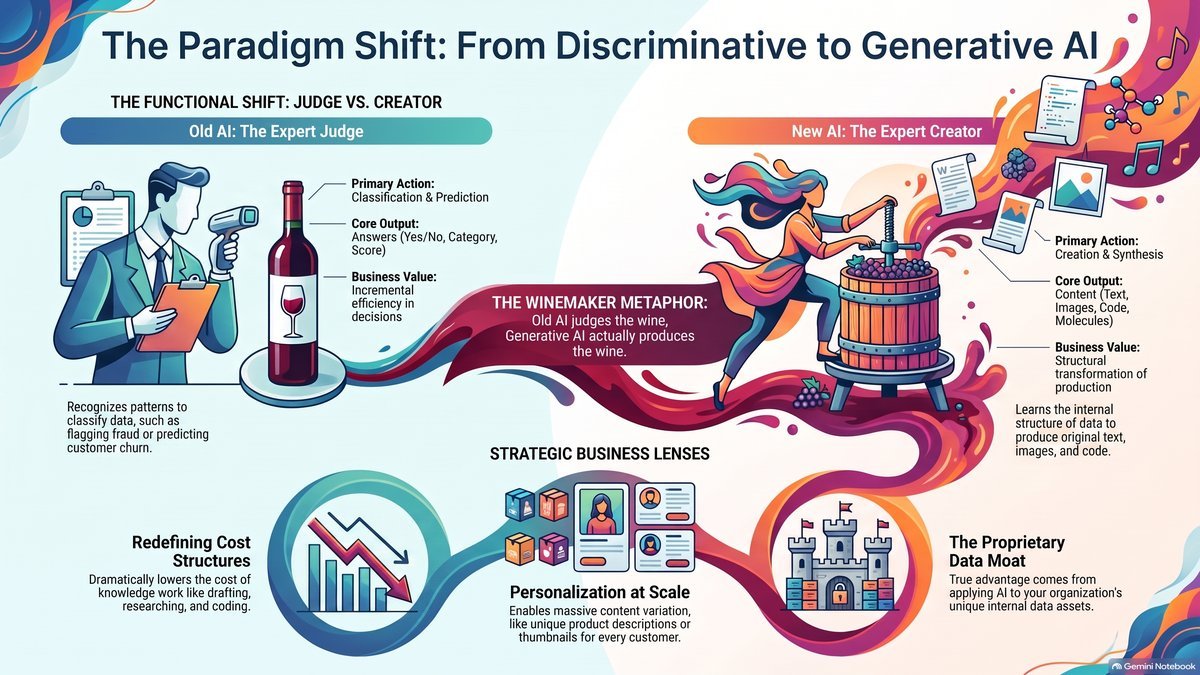
Old AI (the kind most companies already use): Answers questions. Is this transaction fraudulent? Which customers are most likely to churn? What is in this image? It is incredibly powerful, but it can only react to data it receives.
New AI Generative AI: Creates things. Writes a contract. Designs a product prototype. Synthesizes a drug candidate. Generates a thousand personalized ad variations. It does not just analyze the world it produces new content, new options, new possibilities.
The business implications are significant. Old AI helped you make better decisions faster. New AI changes what your organization can produce and at what cost and speed.
The companies that understand this distinction early will build structural advantages that are very hard to reverse.
Two Different Jobs
Think of AI as having two fundamentally different job descriptions.
The first job description is the expert judge. You give it something, a photo, a transaction record, a customer email and it tells you what it sees. Spam or not spam. Approved loan or rejected loan. High-risk patient or low-risk patient. This is the AI that has been quietly powering business operations for the last decade. It is reliable, well-understood, and deeply embedded in most enterprise software stacks.
The second job description is the expert creator. You give it a brief or nothing at all and it produces something new. A legal brief. A software feature. A molecule that might treat a disease. A marketing campaign. This is generative AI.
Both are powerful. But they are not the same technology, they are not suited to the same problems, and they do not carry the same strategic implications.
The mistake most executives make is treating these two as interchangeable as if generative AI is simply “better AI.” It is not better at the same job. It is doing a completely different job.
What the Old AI Actually Learned
To understand why generative AI is different, it helps to understand precisely what the older generation of AI was trained to do.
When you train a fraud detection model, you show it millions of transactions that were fraudulent and millions that were not. The model learns to recognize the patterns , the tells, the statistical fingerprints , that separate the two groups. It learns a boundary between classes.
That is all it knows. It knows where the line is. It does not know anything else about what a legitimate transaction looks like beyond that line. It cannot create a plausible synthetic transaction, fill in a missing field, or explain why a transaction feels off in human language. It only knows: this side of the line, or that side.
This constraint is not a flaw. It is a deliberate design choice that makes these models incredibly efficient and accurate for their intended purpose. But it is also a hard ceiling. A model trained to recognize things cannot create things. Just as knowing the difference between good writing and bad writing does not make you a writer.
What Generative AI Learned Instead
Generative AI was trained on a richer, harder problem.
Instead of learning where the line between categories is, it learned the full texture of the data — what the data actually looks like, what patterns and structures exist within it, what makes it coherent. A generative model trained on text did not just learn to categorize sentences; it learned what sentences, paragraphs, arguments, and narratives look like from the inside. A generative model trained on images did not just learn to label images; it learned what makes an image visually coherent and realistic.
The result is a model that can produce new instances of what it learned from. It can write new sentences. It can create new images. It understands not just the boundary but the whole territory.
Think of the difference between a wine judge and a winemaker. A judge can tell you whether a wine is good or bad, even identify the grape and region. A winemaker can actually produce the wine. Generative AI is the winemaker.
The Five Engines Powering Generative AI
The term “generative AI” covers several distinct technologies, each invented to solve the creative problem in a different way. As a leader, you do not need to understand how each one works internally — but you do need to know what each one is good at, because they power different categories of products and vendors.
Language Models (The Engine Behind ChatGPT, Claude, Gemini)
These systems were trained to predict the next word in a sequence — millions of times, across billions of documents. That sounds simple, but at scale it forces the model to develop an implicit understanding of facts, logic, cause and effect, and human intent. The result is a system that can write, summarize, translate, reason, answer questions, and generate code.
Business use cases: Document drafting, customer support automation, code generation, contract analysis, knowledge management, sales enablement, research synthesis.
Maturity level: Commercially ready today. Most Fortune 500 companies have active pilots or production deployments.
Image Generators (The Engine Behind DALL-E, Midjourney, Stable Diffusion)
These systems learn from massive datasets of images and descriptions, building an understanding of visual composition, style, and subject matter. They can create images from text descriptions, modify existing images, generate product variants, or adapt visual content to different styles.
Business use cases: Marketing creative, product visualization, architectural rendering, game asset generation, e-commerce imagery, fashion prototyping.
Maturity level: Production-ready for creative workflows. Governance and brand consistency policies are the main adoption bottleneck.
Synthetic Data Generators
These systems learn the statistical patterns within a dataset and produce new data that behaves like the original but contains no real records. This is crucial in healthcare, finance, and any regulated industry where real data cannot be shared freely.
Business use cases: Augmenting training data for other AI models, privacy-preserving data sharing, testing software systems with realistic data, enabling AI development in data-scarce domains.
Maturity level: Established in healthcare and financial services, growing in other regulated industries.
Drug and Molecule Design Systems
These systems learn from databases of known molecular structures and biological activity, then generate new candidate molecules optimized for specific properties — a target disease, a desired safety profile, a manufacturing constraint.
Business use cases: Accelerated drug discovery, materials science, agricultural chemistry, specialty chemicals.
Maturity level: Active in pharmaceutical R&D. Insilico Medicine brought an AI-designed drug candidate to Phase II clinical trials in 2023 — the first of its kind.
Code Generation Systems
Trained on billions of lines of code across hundreds of programming languages, these systems can write, explain, debug, review, and refactor software. They are increasingly integrated directly into developer environments.
Business use cases: Developer productivity, legacy code modernization, automated testing, documentation generation, low-code application development.
Maturity level: Widely adopted. GitHub Copilot alone has over 1.8 million paid subscribers. Productivity gains of 30–50% in software development tasks are documented.
What This Means for Your Business: Three Lenses
1. The Cost Structure Lens
Creative and knowledge work — writing, coding, designing, researching, analyzing — has historically been expensive because it required human time and expertise at every step. Generative AI does not eliminate these activities, but it dramatically changes the economics. A task that required a senior analyst three days can, in the right context, be reduced to an hour of review and refinement.
This does not mean eliminating roles. It means that the same team can take on a larger portfolio of work — or that you can redirect expensive human talent toward higher-judgment tasks while AI handles the drafting, structuring, and first-pass synthesis.
The companies that will win are those that redesign workflows not just add AI on top of existing ones.
2. The Product Capability Lens
Generative AI opens product capabilities that were not economically feasible before. Personalization at scale is the clearest example. Netflix has always known that different customers respond to different messaging — but producing thousands of unique thumbnail variations for every show was impractical. Generative AI makes it cheap. Amazon uses AI-generated product descriptions tailored to specific search contexts. Spotify’s AI DJ synthesizes personalized commentary in real time.
Ask yourself: What products could you offer your customers if content and personalization cost almost nothing to produce?
3. The Competitive Moat Lens
The organizations building sustainable advantages are not the ones with access to the best foundation models , those are largely commoditized through APIs. The sustainable advantage comes from proprietary data and proprietary workflows. A generative AI system fine-tuned on your company’s ten years of customer interaction data, product documentation, and institutional knowledge is qualitatively different from a generic AI assistant. It knows your business, your language, your customers’ patterns.
This is the real strategic question for most executive teams: What proprietary data assets do we have, and how do we build AI systems on top of them before our competitors do?
What Executives Get Wrong About This Shift
“It’s just a chatbot.”
This is the most common and most costly misperception. Language models are the most visible form of generative AI, but they are one engine among many. Companies treating this as a search enhancement or FAQ automation are missing the broader strategic picture. The same underlying technology enables drug design, code generation, synthetic data, and automated scientific research.
“We need to build our own.”
For the vast majority of organizations, this is the wrong framing. Building and training a foundation model from scratch costs hundreds of millions of dollars and requires research teams most companies do not have. The real leverage is in fine-tuning, integration, and workflow redesign on top of existing models from OpenAI, Google, Anthropic, or Meta. The question is not “how do we build an AI” — it is “how do we apply AI to our most valuable data and workflows.”
“The risks are too high to move.”
The risks are real — hallucination, bias, IP concerns, privacy — but they are manageable with the right governance. The bigger risk that does not appear on risk registers is the cost of organizational inertia. Competitors who move thoughtfully today will have significantly more operational experience, better data pipelines, and stronger vendor relationships twelve months from now. There is a real first-mover advantage in the deployment and learning curve, even if not in the underlying technology.
“It will replace our workforce.”
History of technology automation suggests this consistently overstates replacement and understates augmentation. The most effective AI deployments pair AI capabilities with human judgment — AI handles the first draft, the pattern recognition, the synthesis, the options generation. Humans handle the final judgment, the ethical decisions, the relationship context that AI cannot access. Organizations that redesign workflows around this collaboration model outperform those that simply add AI as a tool or those that use it as a justification to cut headcount prematurely.
Key Takeaways for Decision-Makers
- There are two fundamentally different kinds of AI. Old AI (discriminative) answers questions about data it receives. New AI (generative) creates new content. They are suited to different problems and carry different strategic implications.
- Generative AI’s power comes from learning the full structure of data, not just where the lines between categories are. This is what enables creation rather than classification.
- Five distinct technology families drive generative AI: language models, image generators, synthetic data systems, molecule designers, and code generators. Each is suited to different business problems. Knowing which applies to your industry matters.
- The near-term business value shows up in three places: cost structure transformation in knowledge work, new product capabilities at previously impractical scale, and competitive moats built on proprietary data.
- The real strategic question is not whether to adopt generative AI, but how to pair it with your organization’s unique data assets before competitors do.
- Common executive mistakes — treating it as “just a chatbot,” thinking you need to build your own, waiting due to risk without quantifying the risk of inaction, expecting replacement rather than augmentation — each has a cost that compounds over time.
- The companies pulling ahead are not those with the biggest AI budgets. They are those that redesigned workflows, trained their people, and built governance structures that let them move with confidence rather than caution.
What’s Coming in This Series
Generative AI Foundations will run over the coming weeks. Each post is written for business leaders, not data scientists — practical, jargon-light, and grounded in real examples.
1. This post — The paradigm shift: what changed and why it matters for your business
2. How AI learns to create: the engine room explained for leaders — a plain-English look at how these systems actually develop their capabilities
3. Generative AI in the enterprise: five deployment patterns that work — frameworks for implementation
4. The data advantage: why your internal data is your most valuable AI asset — practical guide to data strategy
5. Controlling what AI creates: prompting, fine-tuning, and guardrails — how to direct AI output toward business goals
6. Measuring AI value: the right metrics for generative AI investments — beyond cost savings
7. AI governance without bureaucracy: practical risk management — what leaders need in place before scaling
8. What’s next: the generative AI roadmap through 2028 — where the technology is heading and what to prepare for
This is Part 1 of the Generative AI Foundations series on muralimarimekala.com. If this was useful, subscribe to get each new post in the series delivered directly to your inbox.