In today’s data‑driven enterprises, predicting the future is no longer a competitive advantage, it is a necessity. From financial markets and supply chains to customer behavior, IoT systems, and energy grids, organizations increasingly depend on time series analysis and forecasting to anticipate change and act with confidence.
Deep Learning has fundamentally transformed how sequential data is modeled. It moves forecasting beyond traditional statistical techniques into adaptive, intelligent systems that continuously learn from historical and real‑time data. This transformation is not just technical, it is deeply strategic.
In my previous article on Text Generation in Artificial Intelligence, I explored how enterprises are turning language into a strategic asset by modeling text as sequential data:
That discussion focused on language as a sequence. This article builds on the same principle and examines another critical domain of sequential intelligence: time series forecasting.
What Is Sequential Data and Time Series Data?
Sequential data refers to any data where ordering matters, each data point is influenced by what came before it. Time series data is a specific form of sequential data where observations are indexed across time.
Common examples include:
- Stock market prices recorded at fixed intervals
- Daily or hourly retail sales data
- Website traffic and clickstream logs
- Sensor readings from IoT devices
- Energy consumption and load patterns

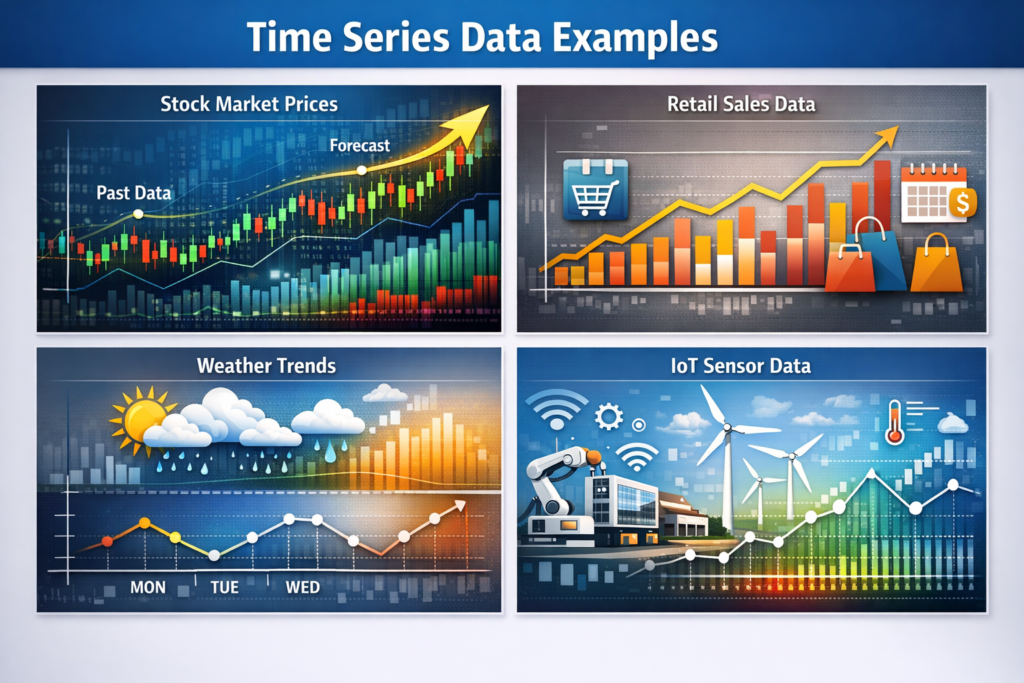
Unlike static datasets, time series data carries temporal context. Trends, seasonality, cycles, and anomalies unfold over time—making accurate modeling both more complex and more valuable.
Why Time Series Forecasting Matters for Enterprises
Executives are no longer satisfied with historical reports. They expect forward‑looking insights that directly inform strategic and operational decisions.
Industry outcomes consistently show that:
- Predictive analytics improves forecasting accuracy by up to 35 percent
- Retail demand forecasting reduces inventory and logistics costs by 20–30 percent
- Predictive maintenance reduces unplanned downtime by nearly 40 percent
Time series forecasting enables organizations to:
- Predict revenue and demand
- Optimize inventory and supply chains
- Identify financial and operational risks early
- Detect anomalies in complex systems
- Support data‑driven strategic planning
This is where Deep Learning becomes a true enterprise game changer.
Traditional Forecasting Methods vs Deep Learning
Historically, time series forecasting relied on statistical models such as ARIMA, SARIMA, and exponential smoothing.
While effective for simple scenarios, traditional approaches struggle with modern enterprise data due to:
- Limited ability to model non‑linear patterns
- Poor scalability with high‑volume and high‑frequency data
- Heavy reliance on manual feature engineering
- Difficulty handling multiple correlated variables
Deep Learning overcomes these constraints by learning patterns directly from the data, without rigid assumptions.
How Deep Learning Models Time Series Data
Deep Learning models are designed to process sequences by maintaining context across time steps. This enables them to capture:
- Long‑term trends
- Seasonality and cyclical behavior
- Sudden changes and anomalies
- Complex, non‑linear relationships
Key strengths include:
- Learning long‑term dependencies automatically
- Supporting multivariate and high‑dimensional time series
- Adapting to streaming and real‑time data
- Scaling efficiently with large datasets
Core Deep Learning Models for Time Series Forecasting
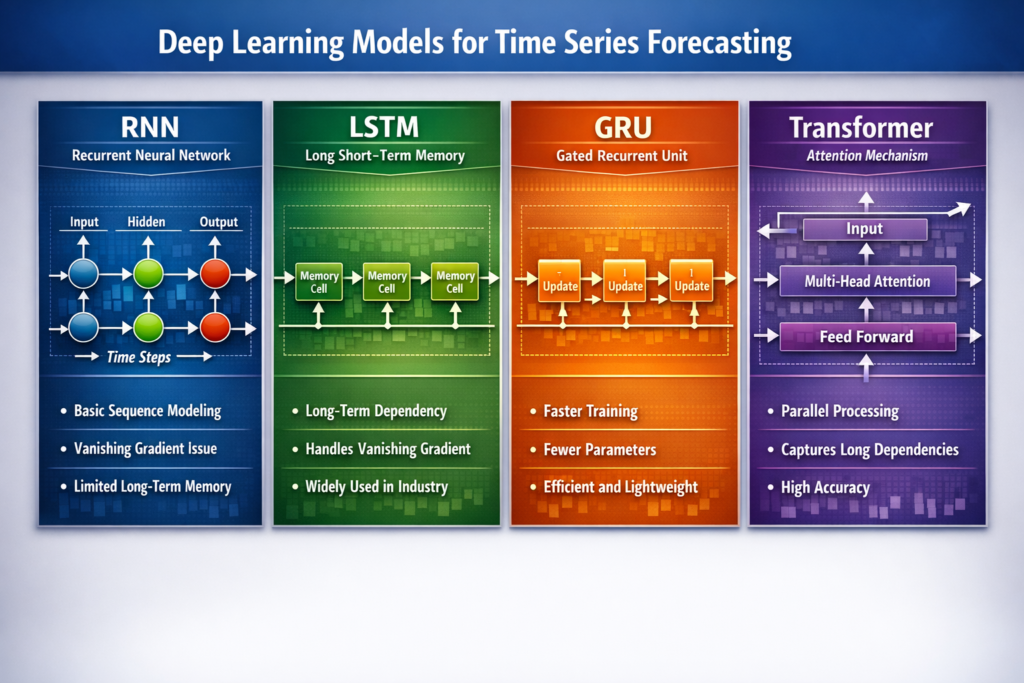
1. Recurrent Neural Networks (RNNs)
RNNs were among the first neural architectures designed specifically for sequential data. They pass information from one time step to the next.
Typical use cases include:
- Time‑based classification
- Basic forecasting tasks
- Sequential pattern recognition
However, standard RNNs struggle with long sequences due to vanishing gradient issues.
2. Long Short‑Term Memory (LSTM) Networks
LSTM networks address RNN limitations by introducing gated memory cells, enabling the model to retain information over long time spans.
Key benefits:
- Strong handling of long‑term dependencies
- Stability during training
- Proven performance in real‑world systems
Common applications include:
- Financial and market forecasting
- Demand and supply planning
- Healthcare monitoring and diagnostics
3. Gated Recurrent Units (GRUs)
GRUs simplify LSTM architectures while maintaining comparable performance.
Advantages include:
- Faster training and inference
- Fewer parameters
- Effective performance in resource‑constrained environments
4. Transformer Models for Time Series
Transformers are redefining how sequential data is modeled. Instead of recurrence, they rely on attention mechanisms to capture relationships across time steps.
Why transformers matter:
- Parallel processing of sequences
- Superior handling of long‑range dependencies
- Strong performance for large‑scale forecasting tasks
This naturally extends the transformer architectures discussed in my earlier article on text generation.
Real‑World Enterprise Use Cases
Finance
- Stock and market forecasting
- Fraud and risk detection
- Portfolio optimization
Retail & E‑commerce
- Demand and inventory forecasting
- Dynamic pricing optimization
- Customer purchase prediction
Healthcare
- Patient health monitoring
- Disease progression modeling
- Hospital resource planning
Energy & Utilities
- Load and consumption forecasting
- Renewable energy optimization
- Grid stability and outage prediction
IoT & Smart Systems
- Predictive maintenance
- Anomaly detection
- Smart city and infrastructure planning
Data Preparation: A Critical Success Factor
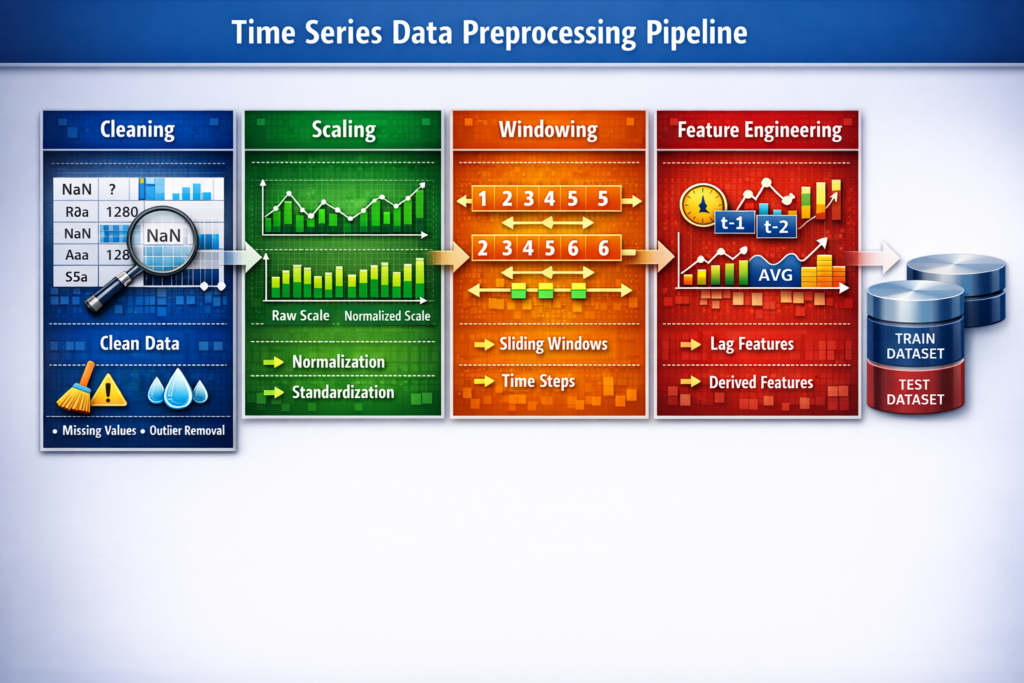
The success of time series deep learning depends heavily on data preparation.
Key steps include:
- Handling missing and irregular data
- Normalization and scaling
- Creating sliding windows
- Engineering lag‑based and contextual features
- Splitting data based on time, not randomness
This aligns with broader deep learning best practices where preprocessing often determines model performance.
Challenges in Deep Learning‑Based Forecasting
Despite its advantages, deep learning introduces enterprise‑scale challenges:
- Limited historical data in some domains
- Overfitting in complex architectures
- Reduced interpretability
- High training and infrastructure costs
- Concept drift in live systems
Balancing accuracy, explainability, and operational cost is essential.
Best Practices for Enterprise Adoption
Organizations adopting deep learning for forecasting should:
- Anchor models to clear business objectives
- Combine statistical and deep learning approaches when appropriate
- Continuously evaluate and retrain models
- Invest in robust data engineering pipelines
- Use scalable cloud‑native AI platforms
Future Trends in Time Series Forecasting
The field continues to evolve rapidly with innovations such as:
- Foundation models for time series data
- AutoML‑driven forecasting pipelines
- Real‑time streaming intelligence
- Integration with generative AI systems
- Explainable AI for trusted enterprise decisions
Early adopters will gain a lasting competitive edge.
Key Insights for Executives
- Time series forecasting is a strategic capability
- Deep Learning dramatically improves scale and accuracy
- Data quality is the single biggest success factor
- Business integration matters more than model complexity
- The future lies in unifying sequential intelligence across text, time, and behavior
Deep Learning for Sequential Data is reshaping how organizations predict, plan, and compete. Time series analysis and forecasting are no longer confined to analysts—they are foundational capabilities embedded within intelligent systems.
From financial markets to smart cities, mastering time‑based patterns determines how effectively enterprises navigate uncertainty.
As highlighted in my article on text generation, sequential intelligence is the backbone of modern AI. Whether the sequence is language or time, the ability to model dependencies is what turns raw data into real‑world impact.
2 thoughts on “Deep Learning for Sequential Data: Time Series Analysis and Forecasting”