The Critical Hour for AI Ethics
Imagine a loan application system powered by deep learning that consistently denies credit to applicants from certain neighborhoods. Or a hiring algorithm that quietly filters out female candidates before their resumes even reach human recruiters. These aren’t hypothetical scenarios—they’re happening today in production systems affecting millions of people. The fundamental question isn’t whether deep learning is powerful enough to solve our problems, but whether we’re building it responsibly enough to deserve our trust.
We’re at a critical inflection point. Deep learning has revolutionized everything from healthcare diagnostics to criminal justice decisions. Yet as these systems handle increasingly consequential decisions about our lives, we’re discovering a hard truth: raw accuracy isn’t enough. A model that’s 99% accurate might be systematically unfair to specific groups. That’s where ethical considerations and fairness in deep learning become not just nice-to-have, but absolutely essential.
Understanding Bias in Deep Learning: The Silent Problem
Bias in AI isn’t new, but deep learning has given it new dimensions. The challenge is that bias creeps in at multiple stages, often invisibly.
Historical Bias in Training Data
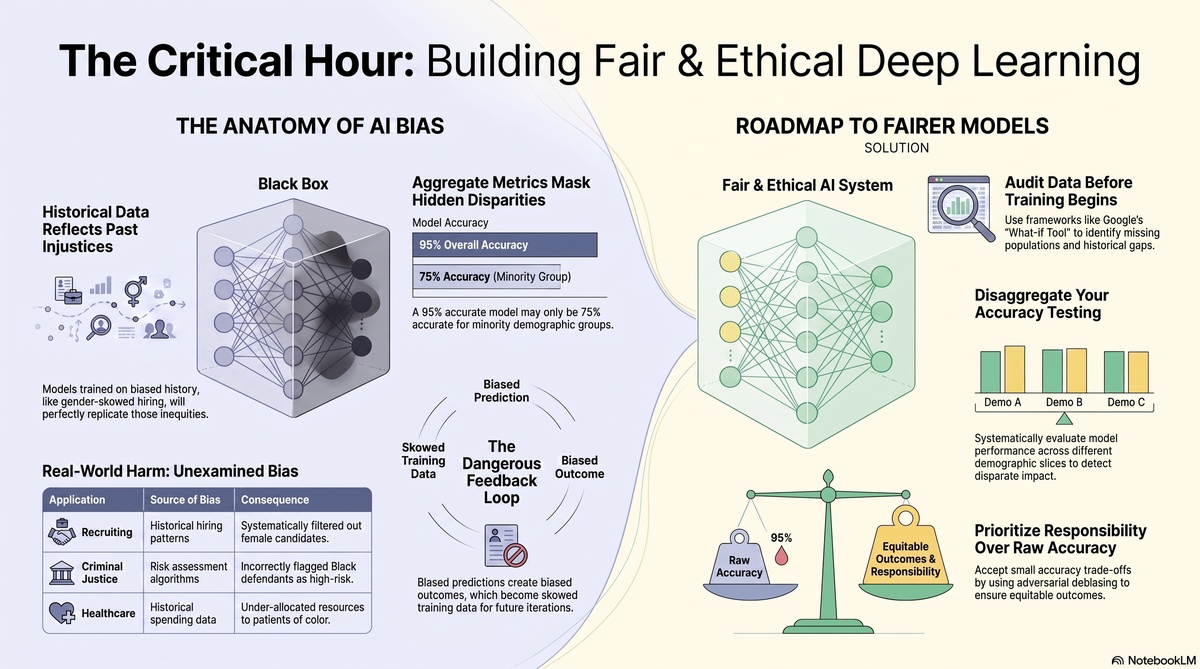
The most insidious form of bias comes from the data itself. Deep learning models are fundamentally pattern-matching machines—they learn from examples. If your training data reflects historical injustices, your model will learn them perfectly. Consider facial recognition systems developed in the early 2010s: they had error rates of 30% for darker-skinned individuals versus less than 1% for lighter-skinned faces. Why? The training data skewed heavily toward lighter skin tones, so the model learned to recognize those faces better.
This isn’t a technical glitch; it’s a direct consequence of biased data. If you train a model predominantly on images of wealthy neighborhoods, it’ll perform worse in low-income areas. If your historical hiring data shows that past hiring decisions favored men in technical roles, your model will perpetuate that pattern.
Representational Bias
Not all bias comes from unfair data—sometimes it’s about what’s missing. When certain groups are underrepresented in training data, models simply haven’t learned their patterns well enough. Healthcare algorithms trained primarily on light-skinned patients make riskier predictions for patients of color. Speech recognition systems perform worse for non-native English speakers. These gaps create real disparities in system performance.
Measurement and Evaluation Bias
Here’s where many teams stumble: they measure accuracy on aggregate metrics, missing disparities lurking beneath. A model might be 95% accurate overall but only 75% accurate for a minority group. If you’re only checking the overall metric, you’ll miss this completely. This is particularly dangerous in high-stakes applications like criminal justice or medical diagnosis.
Feedback Loop and Amplification
Perhaps most insidious is feedback loop bias. Biased predictions become biased outcomes, which become biased training data for the next iteration. A predictive policing algorithm trained on historical data showing heavier policing in minority neighborhoods will predict more crime there, leading to more police deployment, more arrests, and more biased training data. The bias amplifies with each cycle.
Real-World Consequences That Matter
The abstract becomes concrete when we look at actual cases.
In 2019, Amazon famously scrapped an AI recruiting tool that systematically discriminated against women. The model learned from Amazon’s hiring history—which heavily favored men in technical roles—and perpetuated it.
COMPAS, a risk assessment algorithm used in criminal sentencing, was found to be significantly more likely to incorrectly flag Black defendants as high-risk compared to white defendants. Judges using this tool were unknowingly basing sentencing decisions on biased predictions, affecting human lives for decades.
In healthcare, a widely used risk prediction algorithm was found to be racially biased. It allocated resources based on historical healthcare costs, which differed between racial groups due to systemic healthcare disparities, not actual health needs. The solution seemed efficient—but it was systematically unfair.
These aren’t edge cases. They’re warnings about what happens when we deploy unexamined models into consequential domains.
Building Fair Deep Learning Systems: Practical Approaches
So what can practitioners actually do? Fairness in deep learning is an active area of research, and while there’s no silver bullet, several proven approaches exist.
1. Audit Your Data
Start before training even begins. Conduct rigorous data audits:
– What populations are represented? Who’s missing?
– What historical biases might be encoded?
– Are labels applied consistently across groups?
– What’s the quality of data for minority groups?
Google’s What-If Tool and similar frameworks let you visualize how model performance varies across different slices of your data. This visibility is your first defense against blind spots.
2. Define Fairness for Your Context
Here’s the uncomfortable truth: fairness isn’t one thing. Is a fair model one where error rates are equal across groups? Where positive outcomes are distributed equally? Where the relationship between inputs and predictions is consistent across groups? Different notions of fairness can conflict.
For a loan approval system, you might prioritize equal opportunity (same approval rate given the same creditworthiness for all groups). For a disease screening tool, you might prioritize equal false negative rates (missing the disease equally across groups). Your business context matters.
3. Collect More Representative Data
Obvious but critical: minority groups in your data need adequate representation. This doesn’t mean equal representation—it means enough data that you can reliably evaluate performance for those groups. Studies suggest you need at least several hundred examples per group to get reliable fairness metrics.
This is more feasible than it sounds. Companies like Twitter and Pinterest have made deliberate efforts to audit and expand their training data for different skin tones and gender presentations, with measurable improvements in model fairness.
4. Test for Disparate Impact
After training, systematically evaluate whether your model treats different groups fairly:
– Test accuracy disaggregated by demographic groups
– Check whether prediction errors are correlated with sensitive attributes
– Measure whether your model exhibits disparate impact (statistically worse outcomes for protected groups)
This requires careful thought about what “protected attributes” means in your domain and what “worse outcomes” constitutes.
5. Use Fairness-Aware Learning Techniques
Researchers have developed techniques that explicitly incorporate fairness constraints into model training:
– Constrained optimization: Add fairness constraints to your loss function
– Adversarial debiasing: Train a second model to predict demographic attributes from model predictions, then use this as a regularizer to prevent the model from using demographic information
– Reweighting and resampling: Adjust training data distribution to balance representation
These techniques involve tradeoffs—enforcing fairness often means accepting some reduction in overall accuracy. That’s usually the right tradeoff in high-stakes domains.
6. Implement Monitoring and Governance
Fairness isn’t a one-time achievement—it’s continuous. Once deployed, monitor whether your model maintains fairness:
– Track performance metrics disaggregated by demographic groups
– Set up alerts for drift in fairness metrics
– Establish clear escalation procedures when disparities emerge
– Create accountability structures for addressing bias
Companies like Microsoft and IBM have published open-source tools (Fairlearn, AI Fairness 360) specifically for this ongoing monitoring.
Common Mistakes to Avoid
“We’re already fair because we don’t use protected attributes”
Fairness through obscurity doesn’t work. Even if you don’t explicitly use race or gender, proxies in your data (like zip code, name, or educational background) can encode these attributes. Removing sensitive attributes often doesn’t remove bias—it just makes it harder to detect and audit.
“We measured accuracy and it looks good”
This is perhaps the most dangerous mistake. Aggregate accuracy masks disparities. You must disaggregate metrics by demographic groups. A model that’s 95% accurate might be 99% accurate for the majority group and 70% accurate for a minority group.
“Our domain is objective, so bias isn’t a concern”
Every domain has human judgment embedded somewhere—in what we measure, how we label data, what outcomes we care about. Loan approvals seem objective (payment history, income) but encode assumptions about who “deserves” credit. Purely “objective” domains don’t exist.
“Fairness and accuracy are always in tension”
Sometimes they are, but often fixing fairness also improves overall performance. Poor data quality, mislabeling, and representation gaps hurt both fairness and accuracy. Many fairness interventions improve the model overall.
Deploying without stakeholder input
Your model affects real people. Without involving affected communities in defining fairness and evaluating outcomes, you’ll likely miss important considerations. This isn’t just ethical—it’s practical. Communities affected by your system often have insights you’d never discover alone.
Key Takeaways for Building Responsible AI
1. Bias is not optional: Deep learning systems deployed today that don’t address fairness are creating documented harms. This isn’t theoretical.
2. Start with data: The highest-leverage point for addressing bias is ensuring your training data is representative and well-understood. Garbage in, bias out.
3. Define fairness explicitly: Different contexts demand different fairness definitions. Spend time understanding what fairness means for your specific problem.
4. Measure disparities across groups: Break down your metrics by demographic groups. Aggregate metrics hide unfairness. What you don’t measure, you can’t improve.
5. Plan for trade-offs: Fairness often requires accepting some reduction in overall accuracy or model complexity. That’s the cost of building trustworthy systems.
6. Monitor continuously: Fairness isn’t an achievement—it’s an ongoing practice. Systems drift over time. Build monitoring and governance structures.
7. Involve affected communities: The people affected by your model often understand the stakes better than anyone. Their input is invaluable.
The Path Forward
Building ethical, fair deep learning systems isn’t about perfection, it’s about demonstrating care. It’s about acknowledging that these systems affect real lives and committing to continuously work toward better outcomes for everyone, especially those historically underserved by technology.
The good news? You don’t need to solve fairness perfectly to start. You need to start measuring it, thinking about it, and building it into your process from day one. Teams at Google, Microsoft, IBM, and countless organizations are doing this work right now. The tools exist. The frameworks exist. What matters most is the commitment to doing better.
The deep learning systems we build today will determine what opportunities millions of people have access to tomorrow. That’s not just a technical responsibility, it’s a human one.
Understanding Your Model: The Link Between Fairness and Interpretability
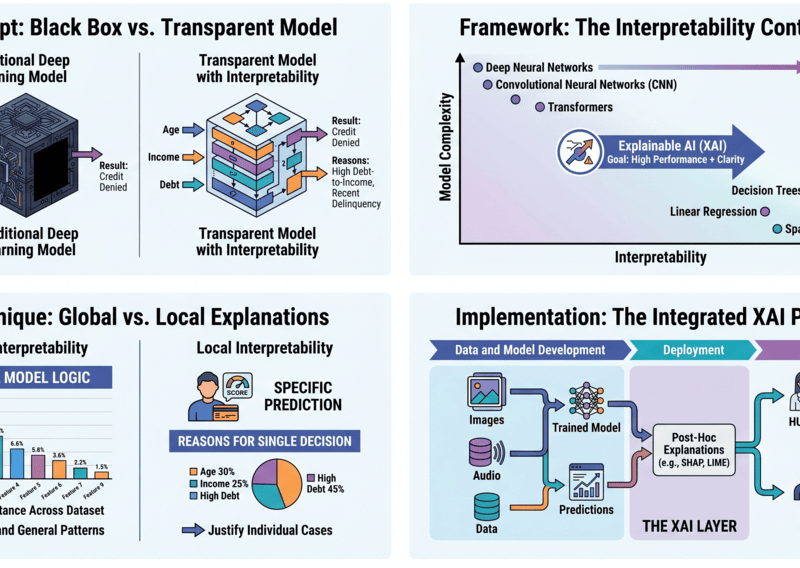
One final critical point: you can’t manage fairness if you can’t understand what your model is doing. Model interpretability and explainability are essential complements to fairness work. When you can’t explain why your model made a prediction, you can’t identify whether it’s fair. For a deeper dive into making your models interpretable and understanding their decision-making processes, check out our companion article: Demystifying the Black Box: The Technical Guide to Explainable AI and Interpretability in Deep Learning. Understanding how your model thinks is the foundation for building truly fair systems.
What fairness challenges are you encountering in your work? What’s your approach to building fair systems? Share your thoughts in the comments, and if you’re tackling these problems in your organization, I would love to hear what’s working.
That’s a really important topic. It’s fascinating to see the specific techniques being developed to address bias in these models – I’d love to read more about that.