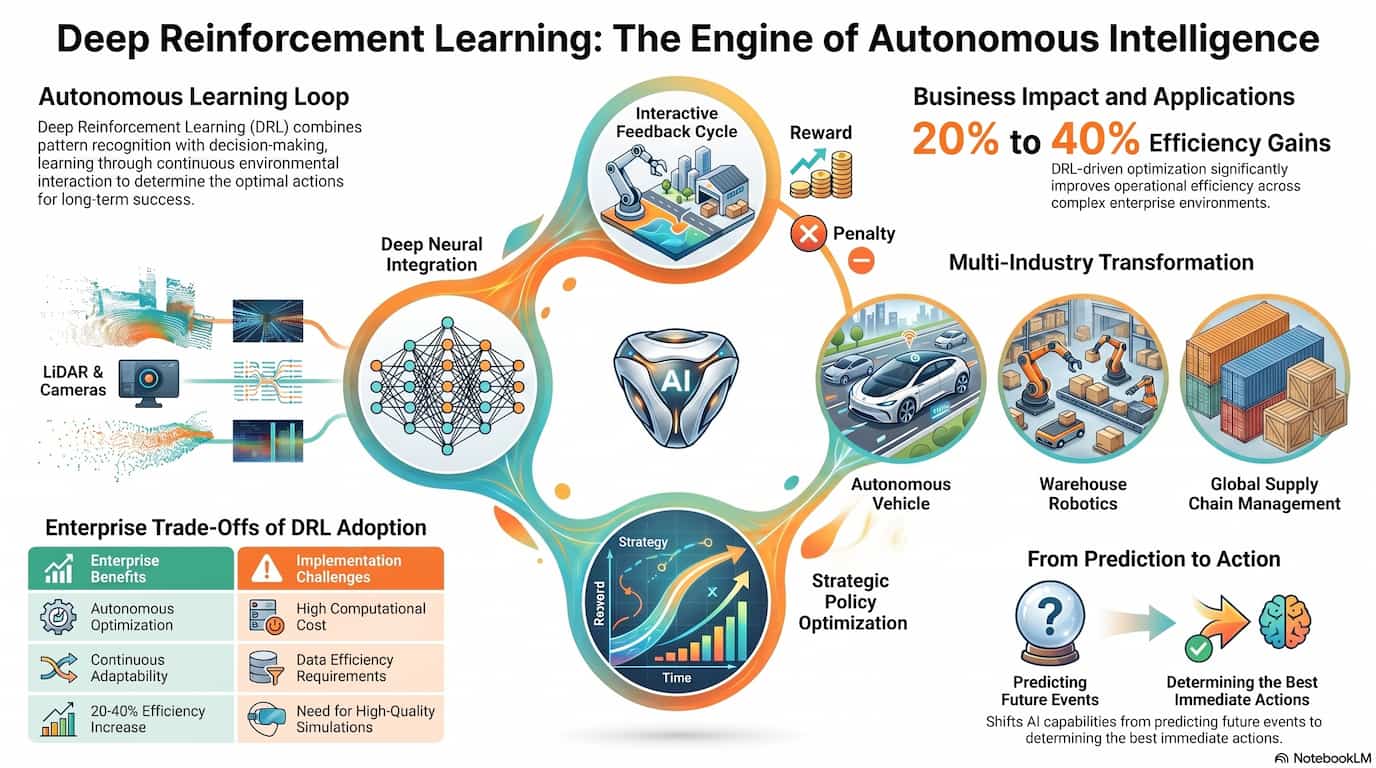
Artificial Intelligence is rapidly evolving from systems that simply analyze data to systems that can independently make decisions, adapt to changing environments, and continuously improve through experience. One of the most exciting technologies enabling this transformation is Deep Reinforcement Learning (DRL).
Deep Reinforcement Learning combines the learning capabilities of Deep Learning with the decision making framework of Reinforcement Learning. Together, they create intelligent agents capable of solving complex problems that traditional machine learning approaches struggle to address.
From self driving cars and robotic automation to advanced recommendation systems and autonomous industrial operations, Deep Reinforcement Learning is becoming a cornerstone technology for the next generation of AI.
For technology leaders, architects, data scientists, and business executives, understanding Deep Reinforcement Learning is becoming increasingly important as organizations seek competitive advantages through autonomous intelligence.
As I discussed in my previous article on Autoencoders and Variational Autoencoders (VAE), representation learning allows AI systems to understand and compress complex data efficiently. Deep Reinforcement Learning extends this concept by enabling AI systems not only to understand environments but also to act intelligently within them, learning optimal behaviors through continuous interaction.
What is Deep Reinforcement Learning?
Deep Reinforcement Learning is a machine learning approach where an AI agent learns by interacting with an environment and receiving feedback based on its actions.
Instead of learning from historical labeled datasets, DRL learns through trial and error.
The agent:
- Observes the environment
- Takes actions
- Receives rewards or penalties
- Learns which actions maximize long term rewards
Over time, the system discovers strategies that produce the best outcomes.
Think of teaching a child to ride a bicycle.
The child falls, adjusts balance, learns from mistakes, and gradually improves.
Deep Reinforcement Learning follows a similar process, except that the learner is an AI system.
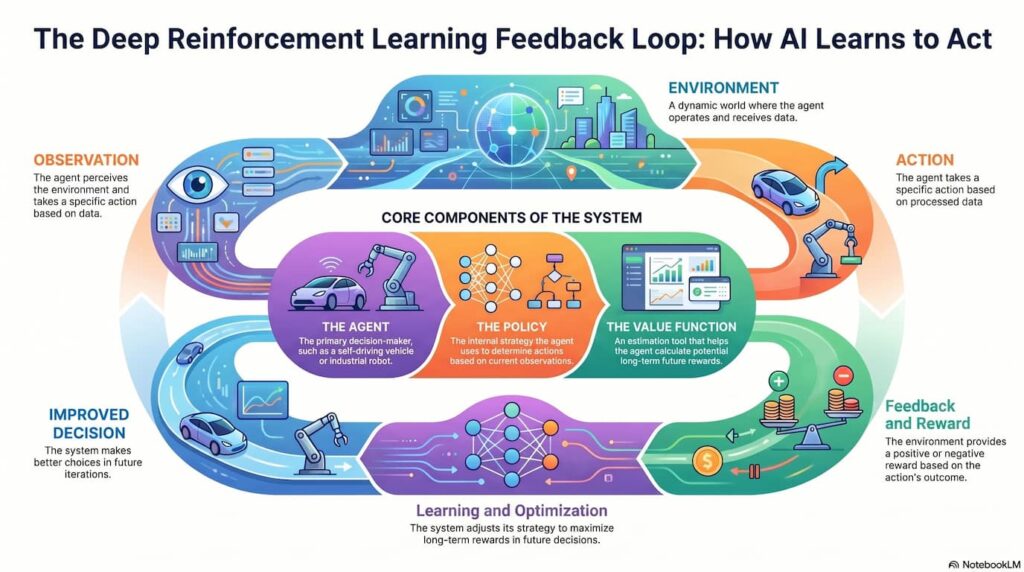
Environment → Observation → Agent → Action → Reward → Learning → Improved Decision → Environment
Why Deep Reinforcement Learning Matters
Traditional Machine Learning excels when historical data exists and future conditions remain relatively stable.
However, many real world problems involve:
- Dynamic environments
- Continuous adaptation
- Long term planning
- Sequential decision making
- Uncertainty
Examples include:
- Autonomous vehicles
- Supply chain optimization
- Robotic automation
- Smart energy grids
- Algorithmic trading
- Personalized recommendations
Deep Reinforcement Learning addresses these challenges by learning directly from interactions.
This ability makes it one of the most powerful forms of AI currently available.
The Core Components of Deep Reinforcement Learning
The Agent
The agent is the decision maker.
Examples:
- Self driving vehicle
- Industrial robot
- AI game player
- Virtual assistant
The Environment
The environment is everything the agent interacts with.
Examples:
- Roads and traffic conditions
- Manufacturing facilities
- Video games
- Financial markets
Actions
Actions represent choices available to the agent.
Examples:
- Turn left
- Accelerate
- Buy stock
- Move robotic arm
Rewards
- Rewards provide feedback.
- Positive rewards encourage behavior.
- Negative rewards discourage behavior.
- The agent’s goal is maximizing cumulative rewards over time.
Policy
- The policy represents the strategy used by the agent.
- It defines how decisions are made based on observations.
Value Function
- The value function estimates long term future rewards.
- It helps the agent think beyond immediate outcomes.
How Deep Learning Enhances Reinforcement Learning
Classic Reinforcement Learning works well for simple environments.
However, modern problems involve enormous amounts of data.
Consider autonomous driving.
The system must process:
- Cameras
- Radar
- LiDAR
- GPS
- Traffic conditions
- Road signs
- Weather conditions
Traditional Reinforcement Learning cannot effectively handle such complexity.
Deep Neural Networks solve this challenge.
They automatically extract meaningful patterns from large volumes of data.
This combination creates Deep Reinforcement Learning.
The result is a system capable of making sophisticated decisions in highly complex environments.
The Breakthrough That Changed AI
In 2015, researchers demonstrated that Deep Reinforcement Learning could achieve superhuman performance in Atari video games.
The AI learned directly from raw pixels without human instructions.
Soon after, DRL powered major breakthroughs including:
- Strategic gaming
- Autonomous robotics
- Industrial automation
- Resource optimization
- Scientific discovery
Perhaps the most famous example was the AI system developed by DeepMind, which defeated world champions in highly complex strategy games.
This achievement showed that AI could learn advanced reasoning strategies through experience alone.
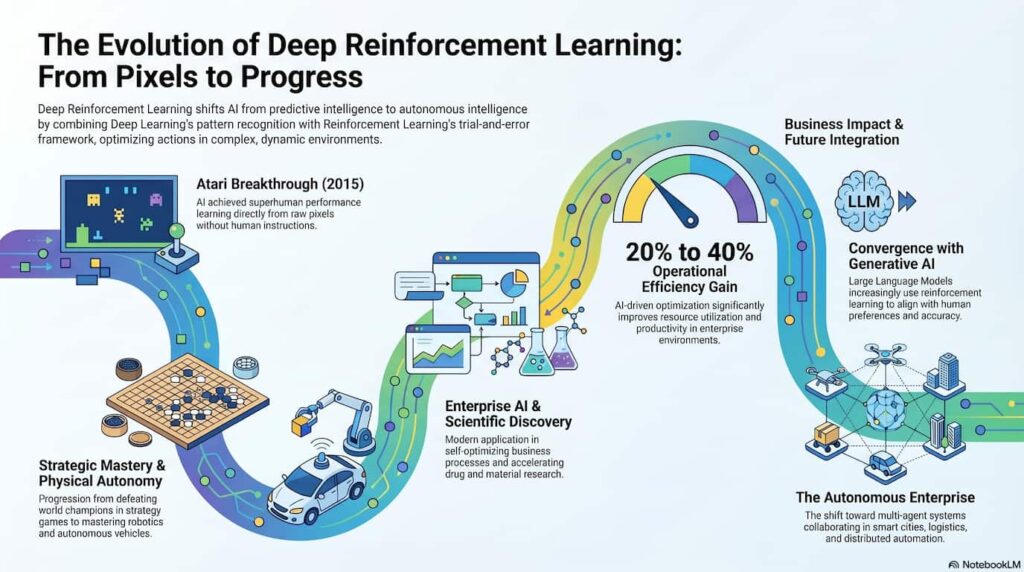
Atari Games → Strategic Games → Robotics → Autonomous Vehicles → Enterprise AI → Scientific Discovery
Real World Applications of Deep Reinforcement Learning
Autonomous Vehicles
Self driving vehicles operate in constantly changing environments.
DRL helps systems:
- Navigate traffic
- Predict vehicle behavior
- Optimize routes
- Improve safety decisions
Leading automotive companies continue investing heavily in reinforcement learning research.
Robotics
Modern robots increasingly learn through experience.
Applications include:
- Warehouse automation
- Industrial assembly
- Agricultural robots
- Medical robots
Rather than programming every movement manually, robots learn optimal actions through interaction.
Supply Chain Optimization
Global supply chains involve thousands of variables.
Deep Reinforcement Learning can optimize:
- Inventory management
- Warehouse operations
- Transportation routes
- Demand forecasting decisions
Even small efficiency improvements can generate millions in annual savings.
Personalized Recommendations
Streaming platforms, ecommerce providers, and social media companies increasingly use reinforcement learning.
Benefits include:
- Better content recommendations
- Improved customer engagement
- Increased retention
- Higher conversion rates
The system continuously learns from user interactions.
Healthcare
Healthcare is emerging as a promising DRL application area.
Potential use cases include:
- Treatment optimization
- Personalized medicine
- Resource allocation
- Drug discovery
While still developing, the potential impact is enormous.
Energy Management
Energy providers use reinforcement learning to optimize:
- Power distribution
- Renewable energy integration
- Smart grid management
- Energy consumption forecasting
As sustainability becomes a global priority, DRL adoption continues growing.
Deep Reinforcement Learning and Generative AI
One of the biggest technology trends today is the convergence of Generative AI and Reinforcement Learning.
Large Language Models increasingly benefit from reinforcement learning techniques.
Many modern AI assistants improve through human feedback mechanisms.
This allows models to:
- Generate higher quality responses
- Improve accuracy
- Align with human preferences
- Deliver better user experiences
The future will likely see deeper integration between foundation models and reinforcement learning architectures.
The Business Value of Deep Reinforcement Learning
Executives often ask a simple question:
What business value does Deep Reinforcement Learning provide?
The answer lies in autonomous optimization.
Organizations can use DRL to:
- Reduce operational costs
- Increase productivity
- Improve customer experience
- Enhance automation
- Accelerate innovation
- Improve resource utilization
Research from multiple industry studies suggests that AI driven optimization initiatives can improve operational efficiency by 20 to 40 percent in suitable environments.
For large enterprises, this translates into significant financial impact.
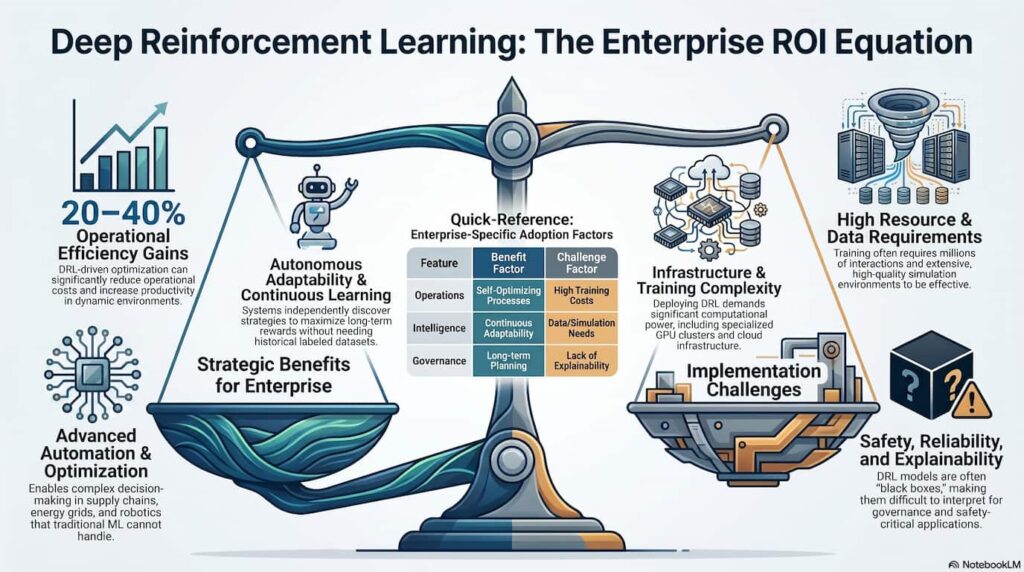
Key Challenges of Deep Reinforcement Learning
Despite its promise, Deep Reinforcement Learning is not without challenges.
Data Efficiency
- DRL often requires extensive training.
- Agents may need millions of interactions before achieving strong performance.
Computational Cost
- Training sophisticated models requires significant computing resources.
- GPU clusters and cloud infrastructure are often necessary.
Safety and Reliability
- In critical applications such as healthcare and autonomous vehicles, mistakes can have serious consequences.
- Safety mechanisms remain essential.
Explainability
- Business leaders increasingly demand transparent AI.
- Deep Reinforcement Learning models can be difficult to interpret.
- Organizations must balance performance with governance requirements.
Simulation Requirements
Many environments are expensive or dangerous for real world experimentation.
High quality simulations are often required.
Building these simulations can be challenging.
Benefits:
- Automation
- Optimization
- Adaptability
- Cost Reduction
- Continuous Learning
Challenges:
- High Training Cost
- Explainability
- Data Requirements
- Safety Concerns
- Infrastructure Complexity
The Future of Deep Reinforcement Learning
The next decade is expected to bring major advancements.
Several trends are emerging.
Autonomous Enterprises
- Organizations are moving toward self optimizing business processes.
- DRL will likely become a key enabling technology.
AI Powered Robotics
- Robots capable of learning continuously will become increasingly common.
Multi Agent Systems
Future AI systems will collaborate with other AI agents.
This creates opportunities for:
- Smart cities
- Traffic management
- Logistics optimization
- Distributed automation
Scientific Discovery
Researchers are already using reinforcement learning to accelerate:
- Material science
- Drug development
- Energy research
Future breakthroughs may occur faster than ever before.
Human AI Collaboration
Rather than replacing humans, many DRL systems will augment human decision making.
The strongest outcomes often emerge when human expertise and AI intelligence work together.
Why Technology Leaders Should Pay Attention
Deep Reinforcement Learning represents a shift from predictive intelligence to autonomous intelligence.
Predictive AI answers:
“What is likely to happen?”
Deep Reinforcement Learning answers:
“What should be done next?”
This distinction is critical.
As enterprises pursue intelligent automation, autonomous operations, and adaptive decision making, reinforcement learning will become increasingly important.
Organizations that understand and invest in these capabilities today will be better positioned for tomorrow’s AI driven economy.
Final Thoughts
Deep Reinforcement Learning is one of the most influential technologies shaping the future of Artificial Intelligence.
By combining deep neural networks with reward based learning, organizations can create systems that continuously improve, adapt, and optimize their decisions.
From autonomous vehicles and robotics to enterprise optimization and Generative AI, the impact of Deep Reinforcement Learning is already visible across industries.
The next wave of innovation will likely come from AI systems that not only understand data but also act intelligently based on what they learn.
For business leaders, architects, and technology professionals, now is the ideal time to understand this technology and explore how it can create measurable business value.
The future of AI will not simply be about prediction.
It will be about autonomous decision making.
Deep Reinforcement Learning is leading that transformation.
Call To Action
What are your thoughts on Deep Reinforcement Learning and autonomous AI systems?
Have you explored reinforcement learning use cases within your organization?
Share your experiences in the comments.
If you found this article valuable, share it with your network and subscribe for more insights on Artificial Intelligence, Generative AI, Machine Learning, Data Science, and Enterprise Architecture.