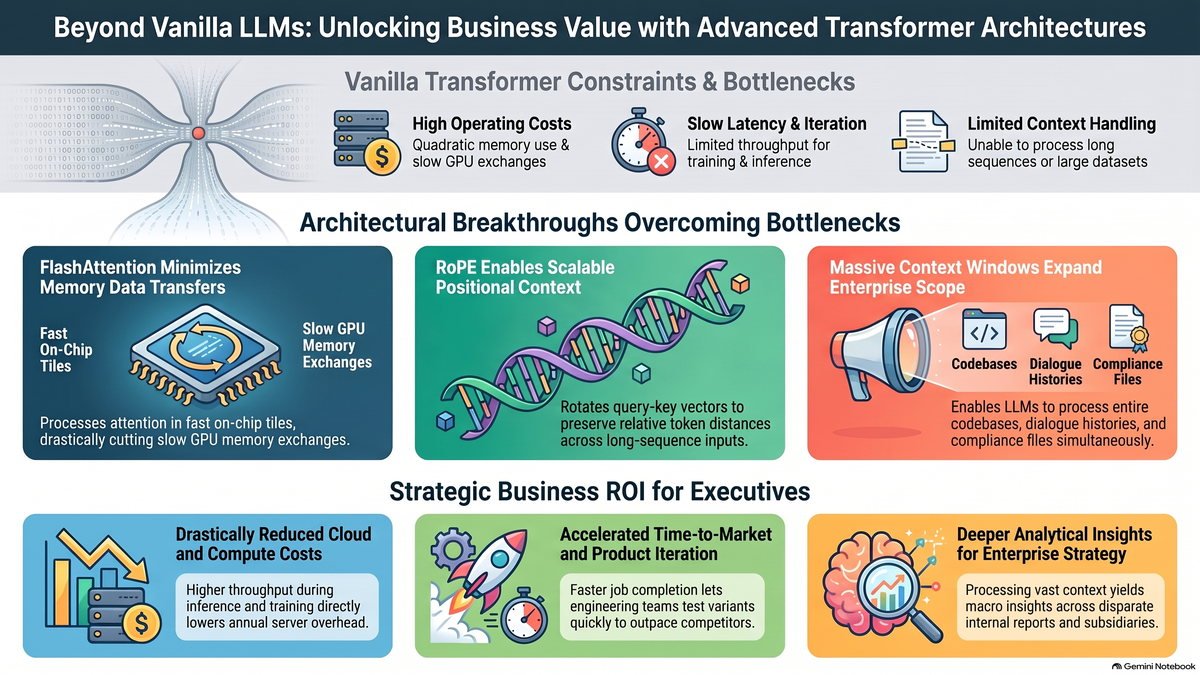
The rapid ascent of Large Language Models (LLMs) has redefined the landscape of business innovation. From automating complex workflows to revolutionizing customer engagement, LLMs are no longer a futuristic concept but a present-day strategic imperative. However, the foundational “vanilla” Transformer architecture, while groundbreaking, faces inherent limitations that constrain scalability, efficiency, and depth of understanding – challenges that can translate directly into soaring operational costs, slower innovation cycles, and missed opportunities.
For C-suite executives and senior decision-makers, navigating this evolving technological terrain requires more than a superficial understanding of AI. It demands insight into the underlying mechanics that are pushing the boundaries of what LLMs can achieve. The next wave of competitive advantage will not merely come from adopting LLMs, but from strategically leveraging advanced architectural innovations that address these core limitations, such as FlashAttention, Rotary Position Embeddings (RoPE), and the capability to handle truly massive context windows. These are not mere technical tweaks; they are foundational shifts with profound implications for your bottom line, your innovation pipeline, and your ability to gain a decisive edge in an AI-driven economy.
This article will demystify these advanced Transformer mechanics, translating their technical prowess into tangible business value, clear return on investment (ROI) propositions, critical risks, and actionable adoption strategies for the boardroom.
The Foundation: Understanding the Vanilla Transformer’s Power and Its Plateaus
To appreciate the innovations, start with self-attention: each token builds a representation by comparing itself with other tokens in the sequence. Unlike earlier recurrent models, a Transformer can process many positions in parallel during training, which helped make modern language models practical.
However, full attention has a significant scaling cost. Its core pairwise work grows roughly with the square of sequence length, while the attention matrix also creates substantial memory traffic. This distinction matters: FlashAttention slashes your GPU bill and speeds up response times by running hardware far more efficiently, but as your prompts get 10x longer, the underlying math workload still grows by 100x.
For a business, longer inputs can mean higher accelerator use, larger key-value caches during generation, more latency, and higher serving costs. The exact impact depends on the model, hardware, batching, and attention implementation; doubling context does not imply a fixed fourfold increase in every end-to-end bill.
The context window is the maximum input and generated text a model can handle in one request. Increasing that limit does not guarantee that a model will use every passage equally well: retrieval quality, training, position effects, and task design still matter. Long inputs can also increase cost and expose more sensitive data to a request.
These limitations, while manageable for certain applications, became bottlenecks as businesses demanded more sophisticated, comprehensive, and cost-effective AI solutions. This is precisely where advanced Transformer architectures step in.
Beyond Vanilla: Why Innovation is Imperative for Business Agility
The techniques below address different constraints: FlashAttention reduces attention’s memory traffic, RoPE supplies positional information, and long-context systems combine architectural, training, and serving choices. They are complementary, not interchangeable fixes.
Deep Dive 1: FlashAttention – Unleashing Speed and Efficiency
What it is (Conceptually):
FlashAttention is a revolutionary optimization for the self-attention mechanism within Transformers. At a high level, it re-engineers how the attention calculation interacts with computer memory. The core problem it addresses is that traditional attention computations require reading and writing vast amounts of data to and from slower external memory (like GPU memory) multiple times. These memory access operations, rather than the raw mathematical calculations, often become the bottleneck.
How it Works (Plain Terms):
Imagine you are doing a complex calculation that requires many intermediate steps. Traditionally, you might write down each intermediate result on a large whiteboard (slow memory), erase it, and write the next one. This takes a lot of time just moving the chalk. FlashAttention, by contrast, is like having a much smaller, faster notepad (on-chip memory) right in front of you. It intelligently breaks down the attention calculation into smaller “tiles” or blocks. Each block is processed entirely within this fast, on-chip memory, minimizing the need to constantly move data to and from the slower external memory. Only the final results of these blocks are written back to the slower memory. This “memory-aware” approach drastically reduces redundant data transfers.
Business Value and Implications:
The impact depends on workload and implementation, but the practical levers are clear:
- More useful accelerator time: Less intermediate data movement can improve throughput or reduce memory pressure for supported workloads. The measured benefit varies by hardware, sequence length, batch size, and software stack, so benchmark the actual production path.
- More room for long inputs: Lower memory overhead can make longer sequences or larger batches feasible on a given accelerator, subject to the model’s other limits.
- Faster experimentation: More efficient jobs may let teams test more variants within the same budget. This is an opportunity, not an automatic cost saving; utilization and workload volume determine the bill.
- Practical evaluation: Compare tokens per second, peak memory, end-to-end latency, and cost per completed task against the current baseline. A kernel-level speedup is not a guaranteed business outcome.
Deep Dive 2: Rotary Position Embeddings (RoPE) – Enhanced Positional Understanding
What it is (Conceptually):
Positional information lets a Transformer distinguish word order: “dog bites man” is not equivalent to “man bites dog.” RoPE encodes position by rotating the query and key representations used by attention. The resulting attention scores carry information about relative offsets, while the rotation also depends on absolute position.
How it Works (Plain Terms):
Imagine giving each position a phase on a rotating dial. Attention compares the position-adjusted query and key vectors, allowing the relationship between two tokens to reflect their distance and order. RoPE is part of a model’s design and training recipe, not a setting that can safely be added to an arbitrary model after training.
Business Value and Implications:
RoPE is widely used, but it should not be mistaken for a complete long-context solution:
- Position-aware attention: Relative-position information is useful in language, code, and document tasks where relationships between distant tokens matter.
- Model-family compatibility: Many open-weight Transformer families use RoPE, but implementations and supported context lengths differ. Extending a model beyond its trained range may require scaling methods, additional training, and evaluation; RoPE alone does not guarantee reliable extrapolation.
- A deployment check: Test retrieval of facts near the beginning, middle, and end of representative inputs. Measure accuracy and citation support, not merely whether the API accepts a long prompt.
Deep Dive 3: Handling Massive Context Windows – The Holy Grail of Comprehension
What it is (Conceptually):
A “massive context window” refers to an LLM’s capability to process and retain an extremely large amount of information – tens of thousands, hundreds of thousands, or even millions of “tokens” (words or sub-words) – within a single interaction or analytical task. This is the holy grail for many advanced AI applications, allowing an LLM to comprehend entire books, extensive dialogue histories, or entire codebases without losing track of the details.
Why it’s Challenging:
Long-context processing is challenging for several reasons. Full attention’s pairwise work grows quadratically with sequence length; the key-value cache grows with the number of tokens during generation; and the model may not retrieve or weigh every detail reliably. A 100,000-token input implies roughly 10 billion token pairs per attention head before accounting for the model’s layers and other operations, not simply 10 billion total operations.
Advanced Techniques Enabling Massive Context (Simplified):
Long-context capability usually combines model design, training, inference systems, and product choices:
- Efficient exact attention: FlashAttention reduces high-bandwidth-memory traffic and intermediate storage while retaining the standard attention result. It improves efficiency; it does not remove quadratic pairwise work.
- Position handling and training: RoPE and context-extension methods can support longer ranges, but successful extension depends on training and validation.
- Alternative attention patterns: Sparse, sliding-window, and linear-attention approaches reduce or restructure token interactions, each with quality and compatibility trade-offs.
- Retrieval and hierarchy: Search, chunking, summaries, and staged analysis can provide relevant evidence without placing an entire corpus into every prompt. These remain useful even when a model supports a large context window.
Business Value and Implications:
Long context can simplify some workflows and enable broader analysis, but is not automatically the best or cheapest design:
- Document review: A legal or compliance team can compare clauses across a complete matter file, while still requiring source-linked citations and reviewer approval.
- Software engineering: A model can consider more of a repository at once, but repository indexing, tests, and tools remain important for precise code changes.
- Customer operations: An assistant can use more interaction history, provided the system applies retention limits and only retrieves data the user is authorized to see.
- Model selection: Context limits vary by model and service and change over time. Compare current published limits, accepted input size, latency, pricing, and quality on your own workload rather than relying on headline token counts.
Strategic Business Value and ROI for C-Suite
The advancements in Transformer architectures are not abstract technical feats; they are direct enablers of significant business value and compelling returns on investment. For C-suite leaders, the strategic imperatives are clear:
- Reduced Operational Costs and Increased Efficiency:
- ROI: FlashAttention’s speed enhancements directly translate to lower compute costs for training and inference. This means your cloud bills shrink, or you can do more with the same budget. For companies training custom LLMs, this can save millions annually. For companies running inference at scale, faster response times reduce server load and improve throughput per dollar spent.
- Accelerated Innovation and Time to Market:
- ROI: Faster training and more robust models (thanks to RoPE and improved context handling) mean your AI teams can iterate more rapidly. This accelerates the development of new AI products, features, and internal applications, gaining a significant competitive advantage. Being first to market with superior AI capabilities can capture market share.
- Enhanced Decision Making and Strategic Insights:
- ROI: Massive context windows empower LLMs to analyze unprecedented volumes of data – from internal reports to external market intelligence – providing deeper, more comprehensive insights. This supports more informed strategic planning, risk assessment, and operational optimization. For example, a global enterprise can synthesize data from disparate subsidiaries to identify macro trends and allocate resources more effectively.
- Competitive Differentiation and New Revenue Streams:
- ROI: Offering AI-powered products or services that can understand longer, more complex inputs than competitors’ models is a powerful differentiator. This can lead to premium pricing, increased customer satisfaction, and the ability to unlock entirely new revenue streams through advanced AI services (e.g., specialized legal AI assistants, hyper-personalized financial advisors).
- Improved Customer Experience and Engagement:
- ROI: LLMs that “remember” entire customer histories and understand nuanced queries provide a superior, more personalized customer experience. This can lead to increased customer loyalty, reduced churn, and more efficient customer support operations.
Risks and Considerations for Adoption
While the promise is immense, C-suite executives must also weigh the risks and complexities associated with adopting these advanced LLM mechanics:
- Technical Complexity and Talent Gap: Implementing and fine-tuning models that leverage FlashAttention, RoPE, and massive context windows requires specialized machine learning engineering talent. These are not plug-and-play solutions in all cases. The difficulty in attracting and retaining this talent can be a significant bottleneck.
- Vendor Dependency and Lock-in: Relying heavily on specific cloud providers (e.g., AWS, Azure, Google Cloud) or hardware manufacturers (e.g., NVIDIA) for optimized execution of these advanced techniques can lead to vendor lock-in, impacting flexibility and bargaining power over time.
- Ethical Implications and Governance: Larger context windows mean LLMs process and potentially generate responses based on vast amounts of potentially sensitive data. This amplifies existing concerns around data privacy, algorithmic bias, transparency, and responsible AI usage. Robust governance frameworks and ethical guidelines become even more critical.
- Cost of Transition and Integration: Migrating existing LLM applications or developing new ones to leverage these advanced architectures may require significant upfront investment in re-architecting, data preparation, and testing.
- Security Risks of Massive Data Processing: Storing and processing massive amounts of proprietary or sensitive data within an LLM’s context window introduces heightened security risks. Ensuring robust data encryption, access controls, and compliance with data protection regulations (e.g., GDPR, CCPA) is paramount.
- Persistent Challenges of Hallucination and Accuracy: Even with improved context understanding, LLMs can still “hallucinate” or generate factually incorrect information. The challenge of grounding LLMs in truth and ensuring factual accuracy remains, and massive context can sometimes make these errors more subtle and harder to detect.
Strategic Adoption Choices and Roadmap for the C-Suite
For organizations looking to capitalize on these advanced LLM capabilities, a strategic, phased approach is essential:
- Pilot Programs with Clear KPIs:
- Action: Identify specific, high-impact business problems where increased LLM efficiency or contextual understanding can yield measurable benefits. Start with pilot projects that use readily available open-source models with these features (e.g., Llama 2 with RoPE) or leverage cloud-provider offerings.
- Focus: Quantify the ROI in terms of cost savings (compute, labor), speed improvements (time to market, response latency), or enhanced output quality (accuracy, deeper insights).
- Leverage Cloud Provider Ecosystems:
- Action: For many enterprises, the most practical path is to leverage hyperscale cloud providers (AWS, Azure, Google Cloud) that integrate FlashAttention and similar optimizations into their GPU instances and managed AI services. These providers also offer models with large context windows.
- Benefit: Reduces the need for in-house specialized hardware and deep technical expertise, allowing businesses to consume these advancements as a service. Explore services like Google Cloud’s Vertex AI, AWS’s SageMaker, or Azure Machine Learning with their optimized infrastructure.
- Strategic Partnerships and Open-Source Engagement:
- Action: Consider partnering with AI startups specializing in LLM optimization or consulting firms with deep expertise. Actively monitor and engage with the open-source community, which is often at the forefront of implementing these innovations.
- Benefit: Access to cutting-edge expertise and technologies without the full burden of internal development.
- Invest in Talent and Skill Development:
- Action: Develop a long-term strategy for attracting, retaining, and upskilling AI engineering and data science talent. Provide training in advanced LLM architectures and optimization techniques.
- Benefit: Build internal capability to customize, deploy, and maintain advanced LLM solutions, reducing reliance on external vendors.
- Phased Integration Based on Business Criticality:
- Action: Prioritize integration of these advancements into applications that offer the highest immediate business value or address critical bottlenecks. For example, a legal tech company might prioritize massive context for contract review, while a customer service firm might prioritize FlashAttention for real-time chatbot responsiveness.
- Benefit: Maximizes ROI and minimizes disruption by aligning technological adoption with strategic business goals.
- Robust Data Strategy and Governance:
- Action: Given the ability to process massive contexts, double down on data quality, security, and governance. Implement strict access controls, anonymization techniques where appropriate, and adhere to all relevant data privacy regulations.
- Benefit: Mitigates risks associated with handling large volumes of sensitive information, ensuring responsible and compliant AI deployment.
Conclusion
The evolution of Large Language Models is accelerating, and the advancements beyond vanilla Transformers – epitomized by innovations like FlashAttention, Rotary Position Embeddings, and the increasing capacity for massive context windows – are not merely incremental improvements. They represent fundamental shifts that are reshaping the capabilities, efficiency, and economic viability of enterprise AI.
For C-suite executives and senior leaders, understanding these mechanics is no longer an optional technical deep dive; it is a strategic imperative. These innovations offer tangible pathways to reduced operational costs, accelerated innovation, superior decision-making, and significant competitive differentiation. The organizations that strategically embrace and adopt these advanced architectural capabilities will be the ones best positioned to unlock the full transformative potential of AI, driving unprecedented value and securing their leadership in the digital economy. The time to move beyond vanilla is now.