In today’s rapidly evolving business landscape, Artificial Intelligence, particularly generative AI, is no longer a distant futuristic concept. It is a tangible force reshaping operational efficiencies, customer engagement, and competitive positioning. For C-suite executives and senior leaders, understanding the strategic levers that control AI’s output is not merely a technical curiosity; it is a critical competency for harnessing its full potential and mitigating associated risks.
At the heart of text-generating AI lies “autoregressive generation” – a sophisticated mechanism that allows these models to construct coherent, contextually relevant, and often remarkably human-like text. However, the raw ability to predict the next word is only one piece of the puzzle. The true power, and the strategic differentiation for businesses, comes from the decoding strategies employed during this generation process. These strategies are not mere technical footnotes; they are the dials and levers that allow leaders to fine-tune AI’s behavior, balancing creativity with factual accuracy, breadth with precision, and innovation with consistency.
This article aims to demystify autoregressive generation and the key decoding strategies – temperature, top-k sampling, top-p (nucleus) sampling, and beam search. We will explore ho
w these mechanisms work, their distinct business values, the risks they introduce or mitigate, and how decision-makers can make informed choices for their organization’s AI adoption journey. By understanding these fundamental controls, leaders can move beyond simply using AI to strategically commanding its output for clear business advantage.
Understanding Autoregressive Generation: The Foundation of AI Text
Imagine writing a sentence, but instead of planning the whole thing, you write one word, then think of the next based on what you just wrote, and so on. This sequential, dependent generation is precisely what “autoregressive generation” entails for AI models.
When you provide a prompt to a large language model (LLM) – be it a question, a command, or the start of a story – the model begins a step-by-step process. First, it processes your input to understand the context and intent. Then, for the very next word or “token” it needs to generate, it doesn’t just pick one at random. Instead, it calculates the probability of every single possible word or sub-word unit in its vast vocabulary appearing next, given the preceding text.
Think of it like this: if the model has just seen “The capital of France is”, it will assign high probabilities to “Paris”, “Marseille”, or “Lyon”, but very low probabilities to words like “banana” or “tree”. It creates a massive “probability distribution” across all its known tokens.
Once these probabilities are established, the model doesn’t simply choose the single most probable word. If it did, the output would be incredibly repetitive and predictable. Instead, a “sampling” process occurs. Based on the calculated probabilities and guided by specific decoding strategies (which we will discuss shortly), a token is “chosen” or “sampled” from this distribution.
This chosen token is then appended to the initial prompt, and the entire new sequence (original prompt plus the first generated token) becomes the input for the next step. The model then predicts the probabilities for the next token, samples one, adds it, and repeats the cycle. This iterative, token-by-token generation continues until a predefined stop condition is met, such as reaching a maximum number of tokens, or the model generating an “end of sequence” token indicating completion.
This token-by-token, dependent generation is the core engine. The quality, coherence, creativity, and factual accuracy of the output, however, are heavily influenced by how that sampling choice is made at each step – which brings us to decoding strategies.
The Strategic Levers: Decoding Strategies Explained
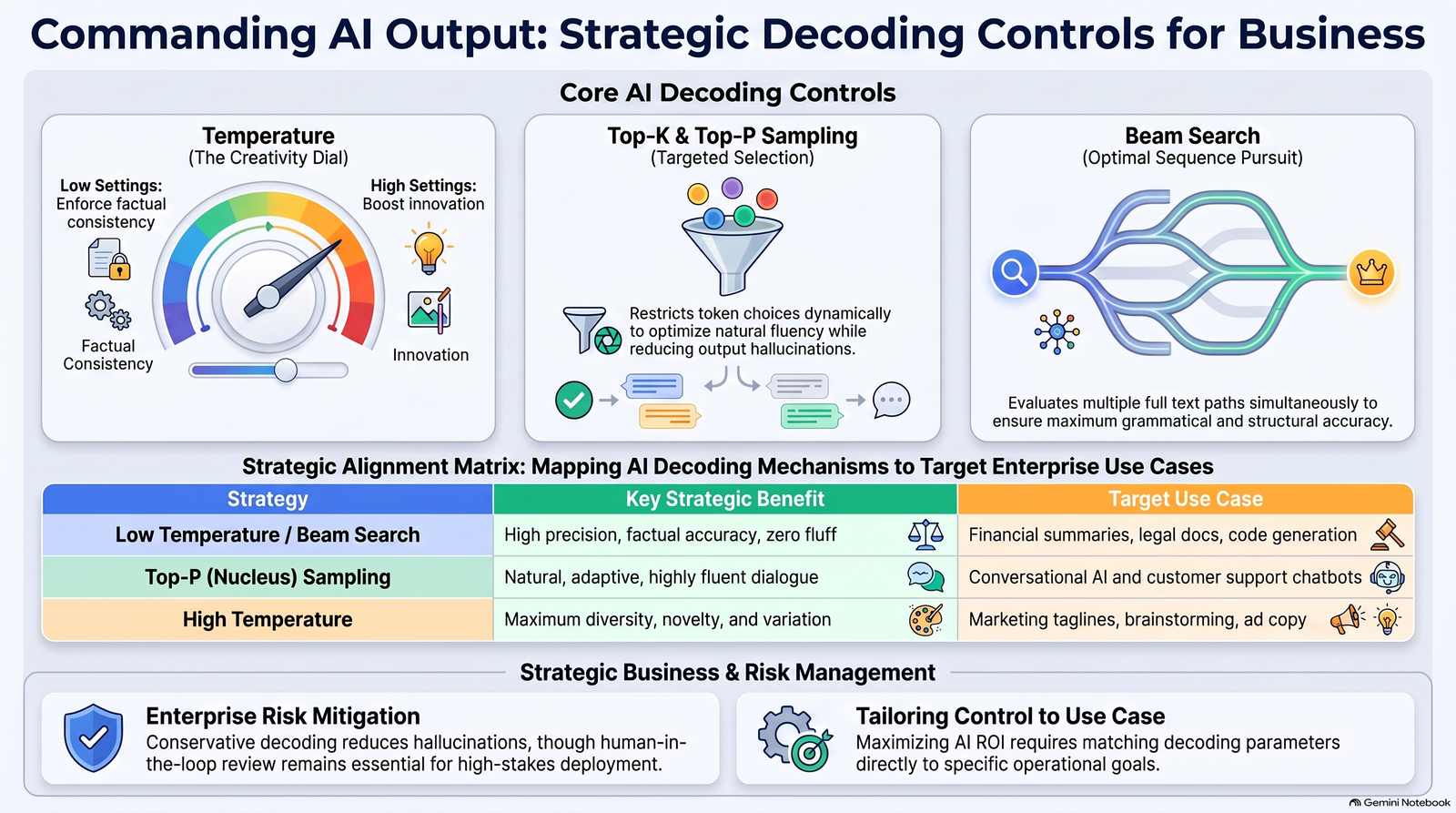
Decoding strategies are the crucial parameters that allow businesses to sculpt the AI’s output to fit specific use cases, ranging from highly creative brainstorming to strictly factual reporting. Each strategy offers a distinct approach to navigating the probability distribution of next tokens.
1. Temperature: The Creative Dial
Concept: Temperature is perhaps the most intuitive and widely used decoding parameter. It essentially controls the “randomness” or “creativity” of the AI’s output by adjusting the probability distribution of potential next tokens.
When the temperature is set to a low value (close to zero, e.g., 0.1 or 0.2), the model becomes more deterministic. It heavily favors the most probable tokens, making the output more focused, conservative, and predictable. If the temperature is high (e.g., 0.8 or 1.0), the probability distribution is “flattened,” meaning that less probable tokens have a higher chance of being selected. This encourages more diverse, surprising, and often creative or unique output. A temperature of 0 (zero) would mean the model always picks the absolute most probable token, leading to highly repetitive text.
Business Value:
- High Temperature (0.7-1.0): Ideal for tasks requiring novelty, brainstorming, generating marketing taglines, creative writing, unique content ideation, or exploring diverse perspectives. A marketing team might use a higher temperature to generate multiple distinct ad copy variations.
- Low Temperature (0.1-0.4): Crucial for applications where precision, factual accuracy, and consistency are paramount. Examples include summarizing financial reports, generating code snippets, drafting formal legal documents, or ensuring consistent brand voice in customer service responses. A financial institution would demand low temperature for generating reports.
Risks:
- Too High: Can lead to outputs that are nonsensical, irrelevant, factually incorrect (hallucinations), or simply too “off-the-wall” for practical use. The AI might deviate significantly from the prompt’s intent.
- Too Low: Results in text that can be overly generic, repetitive, bland, or lack originality. It might stick too closely to common phrases, failing to generate fresh insights.
Adoption Choices: Strategic leaders should guide teams to select temperature settings based on the primary goal of the AI interaction. For exploratory phases, higher temperatures are valuable. For production-grade content requiring strict adherence to facts or guidelines, lower temperatures are essential, often combined with other strategies.
2. Top-K Sampling: The Shortlist Approach
Concept: Top-K sampling refines the selection process by limiting the pool of potential next tokens. Instead of considering all possible tokens and their probabilities, the model first identifies the K most probable tokens at each step. The sampling then occurs only from this restricted shortlist of K candidates.
For example, if K=10, the model will only consider the top 10 most likely words to appear next, even if there are thousands of other words with non-zero probabilities. This approach prevents the model from generating extremely improbable or irrelevant words, providing a degree of control over the output’s quality.
Business Value:
- Controlled Creativity: Top-K sampling offers a balance between predictability and creativity. It prunes away truly outlandish options while still allowing for some variability within a sensible range. This is useful for generating variations of marketing content, product descriptions, or internal communications where a certain level of freshness is desired, but complete randomness is unacceptable.
- Reduced Hallucinations: By focusing on the most probable words, Top-K can help mitigate the risk of the model “hallucinating” or generating factually incorrect information that might arise from sampling a very low probability, out-of-context word.
Risks:
- Missing Opportunities: If
Kis set too small, the model might miss a genuinely creative or contextually relevant word that happens to fall just outside the topKmost probable options. This can lead to outputs that are still somewhat generic or predictable. - Bias Reinforcement: By always sticking to the most probable
Ktokens, the model might inadvertently reinforce biases present in its training data, as less common but perhaps more nuanced or inclusive options are consistently excluded.
Adoption Choices: Top-K is a robust choice when a certain level of output quality and coherence is critical, but some variation is still desired. Companies like Jasper.ai or Copy.ai, which focus on marketing content generation, might use Top-K to ensure generated copy remains on-brand and relevant while exploring different phrasings. It’s often paired with temperature to further fine-tune the output within the selected K tokens.
3. Top-P (Nucleus) Sampling: The Dynamic Threshold
Concept: Top-P sampling, also known as nucleus sampling, offers a more dynamic and adaptive alternative to Top-K. Instead of fixing the number of tokens (K), Top-P fixes a probability mass threshold P. The model identifies the smallest set of most probable tokens whose cumulative probability sums up to at least P. Sampling then occurs from this dynamically sized set of tokens.
For example, if P=0.9, the model will keep adding the most probable tokens to its “nucleus” until the sum of their probabilities reaches 90%. If the next word is highly predictable, the nucleus might be very small (e.g., only 2-3 tokens). If the next word is highly ambiguous, the nucleus might be much larger (e.g., 20-30 tokens) to reach the 90% threshold.
Business Value:
- Naturalness and Fluency: Top-P often produces more natural-sounding, less repetitive, and more human-like text compared to fixed K-sampling or pure greedy approaches. Its dynamic nature allows it to adapt to context: being more restrictive when the choice is clear and more exploratory when multiple good options exist.
- Optimal for Conversational AI: This strategy is highly effective for chatbots and conversational agents, where maintaining coherence while introducing natural variability is key. It allows for flexible responses without veering into complete nonsense. Companies employing AI for advanced customer service, like those used by major telecommunications providers or banks, often rely on Top-P to ensure fluid, context-aware interactions.
Risks:
- Tuning Complexity: Determining the optimal
Pvalue can require experimentation. IfPis too high, it might include less relevant or slightly off-topic tokens. If too low, it can become too restrictive, similar to a small K. - Potential for Deviation: While generally good at maintaining relevance, a high
Pvalue can still occasionally lead to outputs that drift slightly from the intended topic, especially in long generations.
Adoption Choices: Top-P is a widely favored strategy for general-purpose text generation, creative writing, and conversational AI. It is often the default or recommended setting for platforms like OpenAI’s ChatGPT and Google’s Bard/Gemini when balancing output quality with computational efficiency. Businesses seeking to generate engaging marketing content, personalized communications, or dynamic customer support interactions should explore Top-P sampling.
4. Beam Search: The Pursuit of the Optimal Sequence
Concept: Beam search is fundamentally different from sampling methods. Instead of sampling one token at a time, it’s a search algorithm designed to find the most probable sequence of tokens. It does this by exploring multiple potential sequences simultaneously.
Here’s how it works: At each step, instead of just picking one next token, Beam Search keeps track of the B (beam width) most probable partial sequences (or “beams”). For the next token, it extends each of these B sequences by considering all possible next tokens, and then again selects the top B new sequences overall. This process continues until an end-of-sequence token is generated for all beams, or a maximum length is reached. Finally, the algorithm outputs the single best sequence among the B candidates based on cumulative probability.
Business Value:
- High Accuracy and Coherence: Beam Search excels at producing highly coherent, grammatically correct, and logically structured outputs. Because it evaluates multiple paths, it is less prone to local errors that might occur with single-token sampling methods.
- Precision-Critical Applications: It is the go-to strategy for tasks where accuracy, fluency, and minimizing errors are paramount. This includes machine translation (e.g., DeepL, Google Translate), summarization, grammatical error correction, and code generation or completion (Microsoft’s Copilot often uses variants of Beam Search for this purpose).
Risks:
- Lack of Creativity and Diversity: Beam Search is inherently “greedy” and aims for the statistically most probable outcome. This often leads to generic, repetitive, or conservative text. It prioritizes fluency and correctness over originality and novelty.
- Computational Intensity: Exploring multiple beams simultaneously requires more computational resources compared to single-token sampling methods, potentially impacting generation speed and cost for very large beam widths.
- “Safe” but Uninspired Output: While excellent for factual tasks, Beam Search will rarely generate surprising insights or truly creative content. It tends to stick to established patterns.
Adoption Choices: For business applications where factual correctness, precise language, and eliminating errors are non-negotiable, Beam Search is the optimal choice. This applies to legal document generation, technical documentation, financial report summaries, and multilingual communication platforms. It is generally not recommended for creative content generation or conversational AI where diversity is valued.
Business Value and Strategic Implications for Decision-Makers
Understanding these decoding strategies moves AI from a black box to a controllable asset. For C-suite executives, this understanding translates directly into strategic advantages and informed risk management.
Quantifiable ROI through Strategic Decoding
- Increased Efficiency and Automation: By fine-tuning AI for specific tasks (e.g., low temperature for accurate data extraction, Top-P for quick draft generation), businesses can automate content creation, report generation, and customer service responses, leading to significant time and labor cost savings.
- Enhanced Customer Experience: Using Top-P with carefully chosen temperatures allows for personalized, context-aware, and natural-sounding customer interactions, improving satisfaction and reducing churn.
- Faster Time to Market: Accelerate content creation for marketing campaigns, product descriptions, or legal disclaimers, enabling quicker product launches and market responsiveness.
- Improved Decision-Making: AI-powered summarization (often using Beam Search or low temperature Top-P) can condense vast amounts of data, providing leaders with concise, accurate insights for strategic planning.
- Cost Reduction in Specialized Fields: For example, highly accurate machine translation powered by Beam Search can drastically reduce the cost and time associated with human translation services for international operations.
Navigating Risks with Informed Choices
Decoding strategies directly impact several critical AI risks:
- Hallucinations: The generation of false or misleading information. High temperature sampling increases this risk significantly. Beam Search and low temperature/Top-P strategies help mitigate it by sticking to more probable, and often more factual, tokens. However, no decoding strategy eliminates hallucinations entirely, underscoring the need for human oversight.
- Bias Reinforcement: AI models can inherit and perpetuate biases from their training data. While decoding strategies don’t remove underlying bias, they can influence its expression. Strategies like Beam Search, which prioritize the most probable sequences, might inadvertently amplify common stereotypes or exclude nuanced perspectives if those are underrepresented in the training data. Leaders must consider how chosen strategies interact with their ethical AI guidelines.
- Brand Voice and Consistency: Inconsistent AI output can damage brand reputation. Low temperature, Top-K, or Top-P strategies, carefully configured, are crucial for maintaining a consistent tone, style, and factual accuracy across all AI-generated content. Conversely, a poorly managed high temperature setting could lead to off-brand messaging.
- Repetitiveness and Lack of Innovation: Overly conservative decoding (e.g., pure Beam Search or very low temperature) can lead to generic, bland, or repetitive content, stifling creativity and potentially disengaging audiences. Balancing precision with appropriate levels of variability is a continuous management challenge.
Strategic Adoption Choices
- Match Strategy to Use Case: There is no universal “best” strategy. A financial services firm will prioritize Beam Search for compliance documents but might experiment with Top-P for internal communication drafts. A marketing agency will lean on Top-P and higher temperatures for creative campaigns.
- Iterative Experimentation: Effective AI deployment requires continuous experimentation with decoding parameters. What works for one task might be suboptimal for another. Establish internal frameworks for testing, evaluating, and refining these settings based on key performance indicators (KPIs) like accuracy, engagement, or user satisfaction.
- Human-in-the-Loop is Essential: Regardless of the sophistication of decoding, human oversight remains critical. Decision-makers must ensure processes are in place for human review, fact-checking, and refinement of AI-generated content, particularly in high-stakes domains. This is not about replacing humans but empowering them with AI tools.
- Vendor Selection Criteria: When evaluating AI platforms and vendors, inquire about the granularity of control they offer over decoding strategies. Platforms that provide flexible parameter tuning empower your teams to optimize AI output for specific business needs.
- Employee Training and Upskilling: Empower your teams – from marketers to developers to customer service agents – to understand and judiciously apply these decoding strategies. This knowledge transforms them from passive users to active shapers of AI capabilities.
Real-World Application and Company Examples
The principles of autoregressive generation and decoding strategies are at play across many leading AI applications:
- Google’s Bard/Gemini: For general conversational tasks, these models likely employ a combination of Top-P sampling with an adjustable temperature. This allows them to produce diverse, engaging, and relevant responses while maintaining coherence. For more factual queries, the temperature might be automatically lowered or internal mechanisms might mimic aspects of Beam Search to prioritize accuracy.
- Microsoft’s Copilot for Code: When generating or completing code, precision is paramount. Copilot likely utilizes a form of Beam Search or a very low temperature Top-P/Top-K to ensure the generated code is syntactically correct, logically sound, and adheres to common programming patterns. A creative, high-temperature approach would lead to non-functional code.
- DeepL Translate: Renowned for its high-quality machine translation, DeepL heavily relies on sophisticated Beam Search algorithms. Its goal is to find the most probable, grammatically correct, and semantically accurate translation sequence, rather than creative variations.
- Jasper and Copy.ai: These AI-powered copywriting platforms for marketers offer users adjustable “creativity” or “diversity” sliders. These directly map to the temperature parameter, and often incorporate Top-K or Top-P sampling to generate a range of marketing copy, blog post outlines, or social media content that is both engaging and on-brand.
- Internal Knowledge Base Generation (e.g., at large tech companies): For summarizing internal documents, extracting key information, or generating answers for an internal knowledge base, models would likely employ Top-P with a low to medium temperature to ensure accurate, concise, and helpful responses without being overly repetitive.
These examples underscore that the choice of decoding strategy is not arbitrary; it’s a deliberate decision driven by the specific task requirements and desired business outcomes.
Conclusion
Autoregressive generation is the intricate dance of predicting words one after another. Decoding strategies – temperature, Top-K, Top-P (nucleus) sampling, and Beam Search – are the choreographers of this dance, allowing business leaders to dictate the style, pace, and precision of AI’s performance.
For C-suite executives and senior leaders, moving beyond a superficial understanding of AI to grasp these strategic controls is paramount. It enables not just effective AI adoption but also competitive differentiation. It allows for the deliberate shaping of AI outputs to align with specific organizational goals – whether that is fostering unparalleled creativity, ensuring unwavering factual accuracy, streamlining operational workflows, or delivering personalized customer experiences.
The journey with generative AI is dynamic. As these technologies continue to evolve, so too will the decoding mechanisms and the strategic choices available. By investing in this understanding, continuously experimenting, and integrating human oversight, leaders can transform AI from a powerful tool into a precise instrument, unlocking unprecedented business value and navigating the future with confidence and control. The time to command AI’s output is now, defining a new era of strategic advantage.