Natural Language Processing has moved from experimental labs into the core of enterprise decision making. Among all NLP applications, sentiment analysis stands out as one of the most business critical capabilities. Every enterprise today is surrounded by unstructured text, customer reviews, social media conversations, support tickets, chat transcripts, survey responses, emails, internal feedback, and analyst reports. Inside this ocean of text lies customer intent, brand perception, product risk signals, and early warnings that traditional analytics cannot capture.
In my previous article on Deep Learning for Natural Language Processing, Text Classification at Enterprise Scale, I discussed how modern organizations classify text to automate decisions and drive operational efficiency. Sentiment analysis builds directly on that foundation. While text classification answers the question of what a piece of text is about, sentiment analysis answers how people feel about it. When combined, these two capabilities form the backbone of intelligent, language driven enterprises.
This article takes a deep dive into sentiment analysis powered by deep learning, written from the perspective of an AI architect designing systems that must scale, remain accurate, and deliver long term value.
What Is Sentiment Analysis in Simple Terms
Sentiment analysis is the task of identifying emotional tone in text. At a basic level, it classifies text as positive, negative, or neutral. At an advanced level, it detects nuanced emotions like frustration, excitement, sarcasm, urgency, trust, or disappointment.
For enterprises, sentiment analysis is not about labeling text for curiosity. It is about converting human emotion into structured signals that can be measured, tracked, and acted upon.
Examples include
- Understanding why customer satisfaction scores drop before churn happens
- Detecting negative sentiment spikes during a product launch
- Identifying frustrated customers in real time chat conversations
- Measuring employee morale from internal surveys and feedback platforms
Why Deep Learning Changed Sentiment Analysis Forever
Before deep learning, sentiment analysis relied heavily on rule based systems and traditional machine learning models. These approaches struggled with context, negation, sarcasm, and domain specific language.
Deep learning changed this by enabling models to learn meaning from data instead of relying on manually crafted rules.
Key breakthroughs include
- Word embeddings that capture semantic meaning
- Recurrent and attention based models that understand context
- Transformer architectures that process entire sentences holistically
Today, deep learning models can understand that
“This product is sick” can be positive in a consumer review
“I expected better” is often negative even without explicit negative words
Sentiment depends on context, not just vocabulary
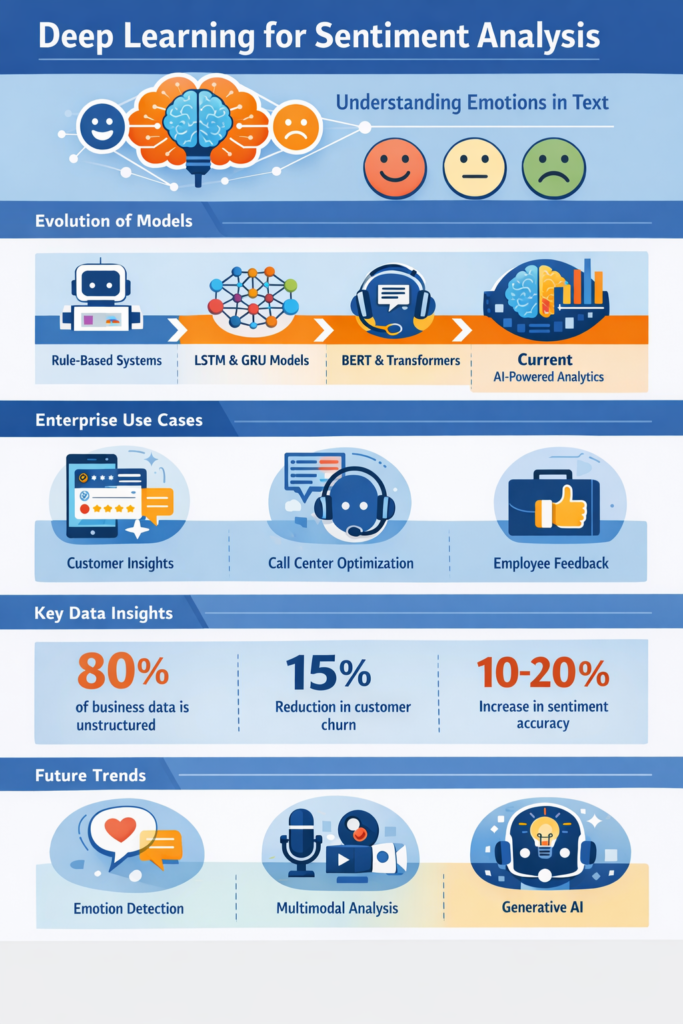
Evolution of Deep Learning Models for Sentiment Analysis
Early Neural Models
The first wave of deep learning sentiment systems used neural networks with word embeddings. These models improved accuracy compared to classical methods but still struggled with long text and complex dependencies.
LSTM and GRU Models
Recurrent neural networks brought context awareness. They processed text sequentially and captured relationships across words. For years, LSTM based sentiment classifiers were the enterprise standard.
Transformer Based Models
Transformers revolutionized NLP by using self attention mechanisms. Models like BERT, RoBERTa, DistilBERT, and domain specific transformers dominate sentiment analysis today.
Benefits include
- Better understanding of long and complex sentences
- Strong performance even with limited labeled data through fine tuning
- Consistency across languages and domains
According to industry benchmarks, transformer based models deliver 10 to 20 percent higher accuracy on sentiment tasks compared to traditional deep learning architectures.
Enterprise Use Cases of Sentiment Analysis
Customer Experience and Brand Intelligence
Sentiment analysis allows enterprises to continuously monitor brand perception across channels. Instead of waiting for quarterly surveys, leaders can see real time sentiment trends.
Examples include
- Analyzing app store reviews to prioritize feature improvements
- Monitoring social media sentiment during marketing campaigns
- Detecting emerging complaints before they escalate
A recent industry study shows that enterprises using AI driven sentiment analysis reduce customer churn by up to 15 percent by acting earlier on negative signals.
Contact Centers and Conversational AI
Modern contact centers generate massive volumes of conversational data. Sentiment analysis transforms this data into insights.
Use cases include
- Real time sentiment tracking during live chats and calls
- Escalating frustrated customers to human agents automatically
- Measuring agent empathy and conversation quality
Organizations adopting sentiment driven routing report higher first contact resolution and improved customer satisfaction scores.
Product and Market Intelligence
Sentiment analysis helps product teams understand how users feel about specific features, pricing, or competitors.
Applications include
- Comparing sentiment across competing products
- Tracking feature level sentiment over time
- Identifying unmet customer needs
This capability feeds directly into product roadmaps and innovation pipelines.
Employee Experience and Internal Analytics
Sentiment analysis is not limited to customers. Enterprises increasingly apply it to internal feedback.
Examples include
- Analyzing engagement surveys and open ended feedback
- Detecting burnout signals in internal communications
- Measuring sentiment after organizational changes
Organizations that actively monitor employee sentiment see improved retention and workplace satisfaction.
Data Requirements for Effective Sentiment Analysis
Data is the foundation of any deep learning system. Sentiment analysis is no exception.
Types of Data
Common data sources include
- Customer reviews and ratings
- Social media posts and comments
- Chat transcripts and call center logs
- Survey responses and feedback forms
- Emails and internal messages
Labeling and Annotation
High quality labeled data is critical. However, labeling sentiment is subjective. Enterprises often face challenges such as
- Inconsistent labels across annotators
- Domain specific language
- Cultural and regional differences
Many organizations address this by combining human annotation with weak supervision and active learning.
Multilingual and Cross Domain Data
Global enterprises require sentiment models that work across languages and regions. Transformer based multilingual models make this feasible but still require careful evaluation.
Architecture Patterns for Sentiment Analysis at Scale
From an AI architect perspective, sentiment analysis is not just a model. It is an end to end system.
Typical Architecture Flow
- Text ingestion from multiple sources
- Preprocessing and normalization
- Model inference using deep learning services
- Post processing and confidence scoring
- Integration with dashboards and business systems
Deployment Models
Common deployment approaches include
- Batch processing for large scale analytics
- Real time APIs for chatbots and monitoring systems
- Streaming pipelines for social media and event driven analysis
Cloud native architectures with containerized models are now the enterprise standard.
Measuring Performance Beyond Accuracy
Accuracy alone is not enough for enterprise sentiment systems.
Key evaluation metrics include
- Precision and recall for negative sentiment detection
- Latency for real time use cases
- Model stability across time and data drift
- Explainability and confidence scores
Enterprises increasingly demand explainable AI. Attention visualization and token level importance scoring help stakeholders trust model outputs.
Challenges Enterprises Face and How to Solve Them
- Sarcasm and Implicit Sentiment
- Even advanced models struggle with sarcasm. Continuous fine tuning using domain specific data improves performance over time.
- Bias and Fairness
- Sentiment models can inherit bias from training data. Regular audits and balanced datasets are essential.
- Data Drift
- Language evolves quickly. Slang, product names, and cultural references change. Monitoring drift and retraining models is critical.
- Cost and Scalability
- Large models can be expensive. Distilled models and hybrid approaches balance cost and performance.
How Sentiment Analysis Connects with Text Classification
In my earlier article on enterprise text classification, I explained how organizations categorize text to drive automation. Sentiment analysis is a natural extension of that strategy.
Together, they enable
- Routing support tickets by topic and urgency
- Prioritizing negative sentiment cases automatically
- Building intelligent dashboards that show both what customers talk about and how they feel
This integrated approach transforms raw text into actionable intelligence.
Future Trends in Sentiment Analysis
- Aspect Based Sentiment Analysis
- Instead of overall sentiment, models analyze sentiment toward specific aspects like price, performance, or support.
- Emotion and Intent Detection
- Beyond positive or negative, future systems detect emotions and intent, enabling deeper personalization.
- Multimodal Sentiment Analysis
- Combining text with voice tone, facial expressions, and video signals will redefine customer experience analytics.
- Generative AI Integration
- Large language models enhance sentiment analysis by explaining sentiment and suggesting next best actions.
Industry forecasts indicate that sentiment aware AI systems will be embedded into most enterprise applications within the next five years.
Why Sentiment Analysis Is a Strategic Capability
Sentiment analysis is no longer a nice to have feature. It is a strategic capability that influences revenue, retention, brand trust, and employee engagement.
Enterprises that invest in robust, scalable sentiment analysis systems gain a competitive edge by listening to customers and employees at scale.
If you are building or planning enterprise NLP systems, sentiment analysis should be a core component of your AI roadmap. I encourage you to explore how sentiment signals can integrate with your existing analytics and decision systems.
Share your thoughts in the comments, discuss your real world challenges, and subscribe to the newsletter for more deep dives on enterprise AI architecture and NLP trends.