Deep Learning, a subset of AI that mimics the human brain’s neural networks and deep learning fundamentals, has powered some of the most breathtaking technological leaps of our era. From recognizing faces on your phone to enabling self-driving cars, discovering new drugs, and generating shockingly realistic art, its impact is undeniable. It’s a force that promises to solve some of humanity’s most intractable problems, streamlining industries, and personalizing experiences to an unprecedented degree.
But here’s the rub: with immense power comes immense responsibility. As these intelligent systems become more pervasive, more autonomous, and more intertwined with the fabric of our daily lives, their ethical implications grow proportionally. We are not just talking about bugs in the code; we’re talking about biases etched into algorithms, privacy breaches on a global scale, and the fundamental question of accountability when a machine makes a life-altering decision.
This isn’t just an academic debate for white-coated researchers in labs. This is about your future. It’s about the justice system that decides a person’s fate, the healthcare system that determines diagnoses, the financial institutions that approve your loans, and the very information landscape that shapes your understanding of the world. Ignoring these ethical shadows isn’t an option; it’s a recipe for disaster, undermining public trust, perpetuating injustice, and ultimately hampering the very innovation we champion.
So, buckle up. We’re about to dive deep into the ethical maze of Deep Learning, exploring why it matters, what specific issues we face, real-world, practical examples that hit close to home, and how we can practically navigate this intricate path toward a more responsible, equitable, and human-centric technological future.
Related Reading: If you haven’t already, check out Fairness and Bias in Deep Learning, where we explored the foundations of algorithmic fairness (discussed in our previous post on fairness and bias). This week’s post builds on those concepts to examine the broader ethical landscape.
Why This Matters: The Elephant in the Room
Deep Learning models are incredibly powerful because they learn patterns from vast amounts of data. The more data, the more complex the patterns they can identify, leading to astonishing accuracy in tasks like image recognition, natural language processing, and predictive analytics. This data-driven nature is both its greatest strength and its most significant ethical Achilles’ heel.
Unlike traditional software, where every rule is explicitly coded by a human, deep neural networks learn these rules implicitly. They build complex internal representations that are often opaque, making it incredibly challenging to understand why they made a particular decision. This “black box” problem is at the heart of many ethical dilemmas. When an AI system denies someone a loan, flags a patient as high-risk, or contributes to a biased legal judgment, we need to know the rationale. Without it, we cannot address fairness, prevent discrimination, or assign responsibility.
The stakes are higher than ever. We’re not just optimizing ad clicks anymore; we’re influencing healthcare outcomes, determining criminal sentences, filtering job applicants, and even shaping public discourse through content moderation and recommendation algorithms. These are decisions with real-world consequences, impacting individuals’ livelihoods, freedoms, and well-being.
Moreover, the sheer scale at which these applications operate means that even subtle biases or errors can be amplified millions of times over, affecting entire demographics or societies. An algorithm trained on unrepresentative data isn’t just imperfect; it can become a systemic engine of discrimination, reflecting and reinforcing societal inequities at an unprecedented speed and scale.
The imperative, therefore, is not to halt innovation, but to infuse it with ethical foresight. We must demand transparency, champion fairness, safeguard privacy, and establish clear lines of accountability. It’s about building trust, fostering public acceptance, and ensuring that AI serves humanity’s best interests, not just technological advancement for its own sake.
Core Ethical Concepts in Deep Learning Explained
Before we get to the gritty examples, let’s break down the fundamental ethical concepts that frequently emerge in the context of Deep Learning:
1. Algorithmic Bias and Fairness
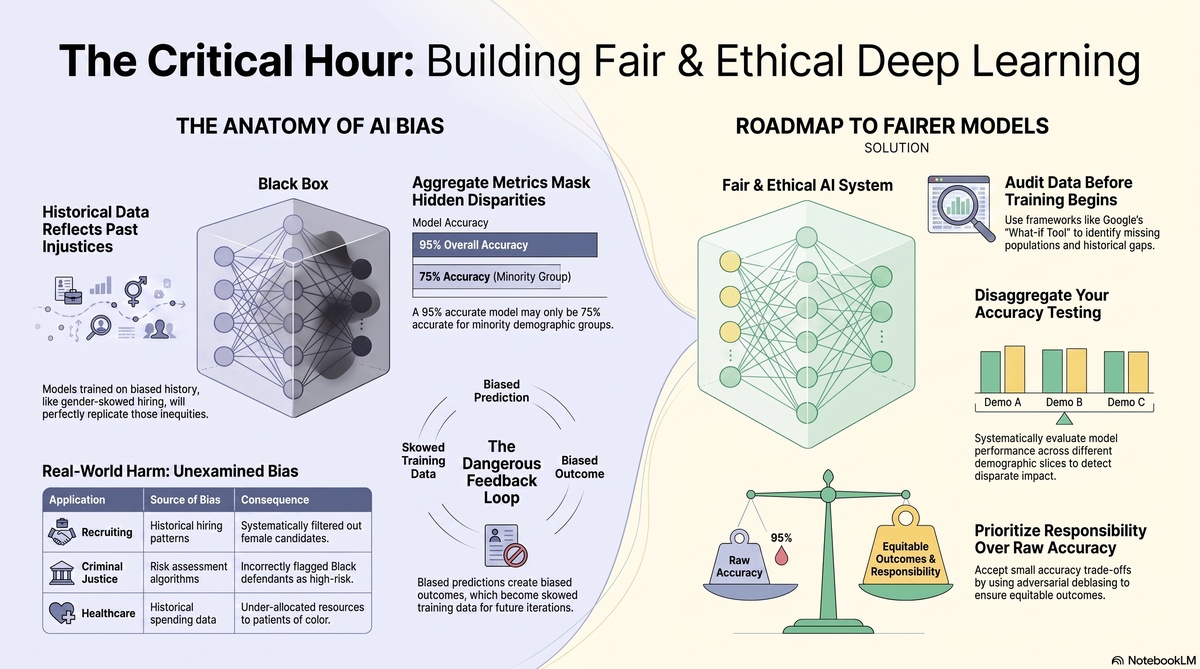
At its core, deep learning is about pattern recognition. If the data used to train these models reflects historical or societal biases, the model will not only learn but amplify those biases. For instance, if a dataset contains fewer images of certain demographic groups or if historical data shows discriminatory outcomes, the AI will learn to perpetuate those same inequities.
- Bias: This refers to systematic and unfair prejudice for or against a person or group, often unconsciously. In AI, it can stem from skewed training data (data bias), how features are selected (selection bias), or even the way the model is designed.
- Fairness: This is the ideal we strive for – ensuring that AI systems treat individuals and groups equitably, without undue disadvantage. Defining “fairness” is complex, as different mathematical definitions exist (e.g., equal accuracy across groups, equal false positive rates). It’s often a societal and philosophical challenge as much as a technical one.
2. Transparency and Explainability (XAI)
As mentioned, many deep learning models, especially complex ones, are “black boxes.” We can see the input and the output, but the internal reasoning process is obscure.
- Transparency: The ability to understand how an AI system works, from its data sources to its algorithms and decision-making logic.
- Explainability: The ability to explain a specific decision made by an AI in a way that humans can understand. This is crucial for building trust, debugging errors, and ensuring accountability, especially in high-stakes domains like healthcare or criminal justice. Without it, appealing an AI’s decision is like arguing with a brick wall.
3. Data Privacy and Security
Deep learning thrives on data – often personal, sensitive data. The collection, storage, processing, and use of this data raise significant privacy concerns.
- Privacy: Protecting individuals’ personal information from unauthorized access, use, or disclosure. Deep learning models can inadvertently leak private information (membership inference attacks) or be vulnerable to data poisoning, where malicious data is introduced to manipulate the model.
- Security: Ensuring the integrity and confidentiality of the data and the model itself against attacks. This includes protecting against adversarial attacks where tiny, imperceptible changes to input data can cause a model to misclassify entirely (e.g., making a stop sign look like a yield sign to a self-driving car).
4. Accountability and Responsibility
When an AI system makes an error, who is responsible? The developer? The deploying organization? The data provider? The user? This question becomes incredibly complex, especially with autonomous systems.
- Accountability: Establishing clear lines of responsibility for the actions and consequences of AI systems. This is particularly challenging when AI models are self-learning and their behavior can evolve unpredictably.
- Responsibility: The ethical obligation to ensure that AI systems are developed, deployed, and used in a way that is beneficial and minimizes harm.
5. Malicious Use and Misinformation
The power of deep learning can be harnessed for nefarious purposes, from generating hyper-realistic fake images and videos (deepfakes) to crafting sophisticated disinformation campaigns.
- Misinformation/Disinformation: AI can accelerate the creation and spread of convincing but false content, making it harder for individuals to discern truth from fiction. Deepfakes, synthetic voices, and AI-generated text can be weaponized to manipulate public opinion, commit fraud, or damage reputations.
- Ethical Use: The imperative to ensure AI is developed and deployed for beneficial purposes, with safeguards against its misuse.
Deep Dive into Real-World Ethical Dilemmas
Let’s ground these concepts with some concrete examples across various industries:
1. Justice and Law Enforcement: The Scales of AI
Deep learning is increasingly being deployed in the justice system, from predictive policing to algorithms assessing recidivism risk (the likelihood of a defendant re-offending) for bail and sentencing decisions.
- The COMPAS Algorithm: Perhaps the most famous (or infamous) example is the Correctional Offender Management Profiling for Alternative Sanctions (COMPAS) tool. This proprietary algorithm was used in U.S. courts to assess a defendant’s risk of future crime. ProPublica’s investigation in 2016 revealed that COMPAS was significantly biased against Black defendants. It wrongly flagged Black defendants as future criminals at twice the rate of white defendants, and conversely, it wrongly flagged white defendants as low-risk more often than Black defendants. The algorithm was a black box, and its developers offered no transparency into its inner workings, making it impossible for defendants or their lawyers to challenge its findings effectively.
Facial Recognition Technology (FRT): Deep learning powers highly accurate facial recognition systems, used by law enforcement for identification. However, numerous studies have shown FRT systems exhibit significant racial and gender bias, performing less accurately on darker-skinned individuals, women, and non-binary individuals. This can lead to wrongful arrests or misidentifications, disproportionately affecting minority communities. The ethical concerns here extend to mass surveillance, erosion of privacy, and potential for authoritarian control.
Ethical Stakes: Bias directly impacts freedom and due process. Lack of transparency makes it impossible to challenge potentially flawed decisions. Surveillance technologies raise profound privacy and civil liberty concerns.
2. Healthcare: Diagnosing Disease, Dispensing Disparity
Deep learning holds incredible promise in healthcare, from accelerating drug discovery to improving disease diagnosis and personalizing treatment plans. However, the data-intensive nature of medical AI brings its own set of ethical challenges.
- Algorithmic Bias in Diagnosis: Imagine an AI system designed to diagnose skin cancer from images. If the training data predominantly features images of lighter skin tones, the AI might perform poorly on darker skin tones, leading to missed diagnoses or incorrect treatments for certain populations. This isn’t theoretical; studies have shown such biases in medical imaging AI. Similarly, algorithms used for patient risk assessment might perpetuate existing health disparities if trained on data reflecting historical inequities in healthcare access or quality for specific demographic groups.
- Data Privacy and Security: Medical data is among the most sensitive personal information. Training deep learning models often requires vast datasets of patient records, images, and genetic information. Ensuring the anonymization of this data is a complex technical and ethical challenge, as even “anonymized” data can sometimes be re-identified. Moreover, the security of these large datasets against breaches or cyberattacks is paramount, as a compromise could have devastating consequences for individuals’ privacy and well-being.
Accountability in Errors: If an AI assists in a diagnosis that turns out to be wrong, leading to adverse patient outcomes, who is accountable? The doctor? The AI developer? The hospital? This question is still largely unresolved in regulatory frameworks globally from organizations like WIPO, hindering the widespread adoption of AI in critical medical decision-making.
Ethical Stakes: Life and death decisions, health equity, patient confidentiality, and trust in medical systems.
3. Finance and Hiring: Economic Gatekeepers
Deep learning algorithms are increasingly used to make high-stakes economic decisions, from approving loans and credit cards to screening job applicants and assessing creditworthiness.
- Amazon’s Biased Hiring Tool: In 2018, Reuters reported that Amazon had to scrap an experimental AI recruiting tool because it was biased against women. The AI was trained on a decade of past résumés submitted to the company, which were predominantly from men. Consequently, the AI learned to penalize résumés that included the word “women’s” (as in “women’s chess club captain”) and down-ranked graduates from all-women’s colleges. This is a classic example of historical data bias perpetuating and amplifying existing inequalities.
Credit Scoring and Loan Approvals: Many financial institutions use AI to assess credit risk and approve loans. If these systems are trained on historical data that reflects past discriminatory lending practices (e.g., redlining or systemic denial of credit to minority groups), the AI will learn to perpetuate these biases. This can lead to a “poverty trap,” where individuals or communities are unfairly denied access to financial resources based on algorithmic discrimination, not true creditworthiness.
Ethical Stakes: Economic opportunity, social mobility, and fairness in access to essential services.
4. Autonomous Systems: The Trolley Problem on Wheels
Self-driving cars and other autonomous vehicles represent perhaps the most visible and immediate ethical battleground for deep learning. These systems are designed to make real-time decisions in complex, unpredictable environments.
- The “Trolley Problem”: This classic ethical dilemma takes on a new dimension with autonomous vehicles. In a no-win accident scenario (e.g., needing to choose between swerving to hit a pedestrian or staying course and hitting the car’s occupant), how should the AI be programmed to decide? Should it prioritize the occupants, pedestrians, or minimize overall harm, even if it means sacrificing its own passenger? These moral algorithms need to be explicitly designed, and the values embedded in them reflect societal ethics, not just engineering choices. Different cultures might even have different preferences, making a universal solution elusive.
Accountability in Accidents: When a self-driving car causes an accident, who is legally and ethically responsible? The car manufacturer? The software developer? The owner? The regulatory bodies are still grappling with these complex questions, highlighting the gap between technological advancement and ethical-legal frameworks.
Ethical Stakes: Human life, legal accountability, and public trust in life-critical autonomous technology.
5. Generative AI and Misinformation: The Erosion of Reality
The rise of generative deep learning models (like large language models and image generators) has opened a Pandora’s Box of ethical concerns related to truth, authenticity, and intellectual property.
- Deepfakes and Disinformation: AI can now create highly convincing synthetic media – videos, audio, and images – that are virtually indistinguishable from real ones. This technology can be used for harmless entertainment but also for malicious purposes: spreading misinformation, creating revenge porn, manipulating elections, or committing sophisticated fraud. The ability to easily generate fabricated reality erodes trust in media and makes it increasingly difficult to discern truth.
Intellectual Property and Artist Rights: Generative AI models are often trained on vast datasets scraped from the internet, which include copyrighted images, texts, and artistic works. This raises significant questions about intellectual property rights, fair use, and how artists whose work contributed to the training data should be compensated or credited. The ethical implications extend to the very definition of creativity and authorship in the age of AI.
Ethical Stakes: The fabric of truth, intellectual property rights, public discourse, and democratic processes.
Common Mistakes to Avoid in Developing and Deploying Deep Learning
Building responsible AI practically isn’t just about good intentions; it requires a structured approach to avoid common pitfalls. Here are some critical mistakes to steer clear of:
Ignoring Dataset Bias: This is perhaps the most frequent and impactful error. Developers often assume their data is neutral, but historical, collection, or measurement biases are almost always present.
- Avoid: Don’t just grab the biggest dataset you can find without thoroughly scrutinizing its provenance, composition, and potential biases.
- Do: Actively seek out diverse and representative datasets. Perform rigorous data audits for demographic imbalances, historical inequities, and missing information. Consider techniques like re-weighting or synthetic data generation to balance skewed datasets.
Lack of Transparency and Explainability: Treating deep learning models as impenetrable black boxes, especially in high-stakes applications, is irresponsible.
- Avoid: Deploying models without any mechanism to understand why they made a particular decision or without documenting their decision logic.
- Do: Prioritize Explainable AI (XAI) techniques. Implement tools for feature importance, counterfactual explanations, and local interpretable model-agnostic explanations (LIME). Document model architecture, training data, evaluation metrics, and decision thresholds thoroughly.
Insufficient Adversarial Testing and Robustness Checks: Assuming your model is secure once trained can lead to vulnerabilities.
- Avoid: Only testing models on ‘clean’ data or against expected inputs. Neglecting potential malicious attacks.
- Do: Conduct adversarial testing to evaluate model robustness against subtle input perturbations. Develop strategies to detect and mitigate adversarial attacks. Regularly audit models for unintended behaviors and vulnerabilities.
Failing to Involve Diverse Stakeholders: AI development often happens in silos, neglecting the perspectives of those most affected by the technology.
- Avoid: Developing AI solely with engineers and data scientists, without input from ethicists, social scientists, legal experts, and representatives from affected communities.
- Do: Establish interdisciplinary teams. Conduct user research and feedback loops with diverse groups. Engage community leaders and advocacy groups to understand potential societal impacts.
Prioritizing Speed and Profit Over Ethical Review: The pressure to deploy quickly can overshadow the imperative for ethical diligence.
- Avoid: Rushing AI deployment without adequate ethical impact assessments, risk analysis, or independent review.
- Do: Integrate ethical considerations into every stage of the AI lifecycle – from conceptualization to deployment and monitoring. Establish clear ethical guidelines, review boards, and “stop-go” points based on ethical impact.
Assuming Technology is Neutral: The belief that “technology itself is neither good nor bad” can lead to neglecting its societal context and impact.
- Avoid: Treating AI as a purely technical artifact divorced from its human users, developers, and the socio-economic systems it operates within.
- Do: Understand that AI systems reflect the values and biases of their creators and the data they consume. Consciously design AI to promote positive societal values and mitigate negative ones.
Ignoring Long-Term Societal Impacts: Focusing only on immediate performance metrics without considering broader, systemic consequences.
- Avoid: Deploying AI without considering its cumulative effect on employment, social structures, mental health, or the information ecosystem.
- Do: Conduct foresight analysis. Engage in ongoing monitoring of deployed AI systems for emergent ethical issues. Participate in policy discussions and contribute to the development of ethical AI standards and regulations.
Key Takeaways for Building a Responsible Future
The ethical challenges in deep learning are formidable, but not insurmountable. They demand a multi-faceted approach involving technologists, policymakers, ethicists, and the public. Here are some key takeaways:
- Data is Destiny: The quality, representativeness, and ethical sourcing of your training data are paramount. Biased data leads to biased AI. Invest heavily in data auditing, cleaning, and augmentation to ensure fairness.
- Prioritize Transparency: Strive for explainable AI (XAI). In high-stakes applications, if you can’t explain why the AI made a decision, it shouldn’t be making that decision autonomously.
- Embed Ethics from Day One: Don’t treat ethics as an afterthought or a compliance checkbox. Integrate ethical considerations into every stage of the AI lifecycle, from design and development to deployment and ongoing monitoring.
- Embrace Interdisciplinary Collaboration: AI ethics isn’t just a technical problem; it’s a societal one. Involve diverse perspectives – ethicists, social scientists, legal experts, and community stakeholders – in the development process.
- Champion Human Oversight: While AI offers automation, critical decisions, especially those impacting human rights and well-being, should always involve human review and override capabilities. AI should augment human intelligence, not replace human judgment entirely.
- Stay Vigilant and Adaptive: The ethical landscape of AI is constantly evolving. Continuous monitoring of deployed systems, regular ethical audits, and a commitment to adapting to new challenges are crucial.
- Advocate for Responsible Regulation: While over-regulation can stifle innovation, thoughtful, human-centric regulation is essential to establish baselines for fairness, privacy, and accountability in AI development and deployment.
Deep learning is one of humanity’s most powerful inventions. It has the potential to elevate our lives, solve complex problems, and usher in an era of unprecedented progress. But like any powerful tool, its impact depends on how we choose to wield it. By confronting its ethical shadows head-on, by embracing responsibility, and by prioritizing human values, we can ensure that deep learning truly serves as a force for good in the world.
What are your thoughts on these ethical dilemmas? Have you encountered any AI applications that raised red flags for you? Share your insights, challenges, and solutions in the comments below!
If you found this deep dive valuable, don’t keep it to yourself. Share this article with your colleagues, friends, and anyone interested in the future of technology.
Let’s build a better, more ethical AI future, together.