You’ve already mastered the foundation in our previous post on data preparation and preprocessing. You know how to clean data, handle missing values, and prepare datasets for training.
But here’s the reality: building a neural network is easy. Making it truly excellent is hard.
The difference between a mediocre model and one that delivers real business value? That’s not usually the architecture.
It’s almost always the hyperparameters and how rigorously you evaluate what you’ve built.
The Problem Nobody Talks About
Consider a colleague built a deep learning model for fraud detection. The lab performance looked fantastic 93% accuracy.
Everyone was excited. The budget was approved. The deployment happened.
Six months into production, disaster. The model was catching only 71% of actual fraud while generating false positives that frustrated legitimate customers. The gap between lab performance and production reality was devastating.
What went wrong?
- The model was tuned on one dataset
- Evaluated on another dataset
- Deployed into a completely different data distribution
- Accuracy alone never told the real story—precision and recall metrics diverged wildly across different fraud types
This is the story of countless AI projects. We excel at building models. We’re terrible at tuning them properly.
The truth: Research shows meticulous hyperparameter tuning delivers 10-30% performance improvements.
In fraud detection, that’s millions of dollars. In medical diagnosis, that’s lives saved.
Understanding What We’re Tuning
Before going further, let’s clarify something fundamental that confuses many practitioners.
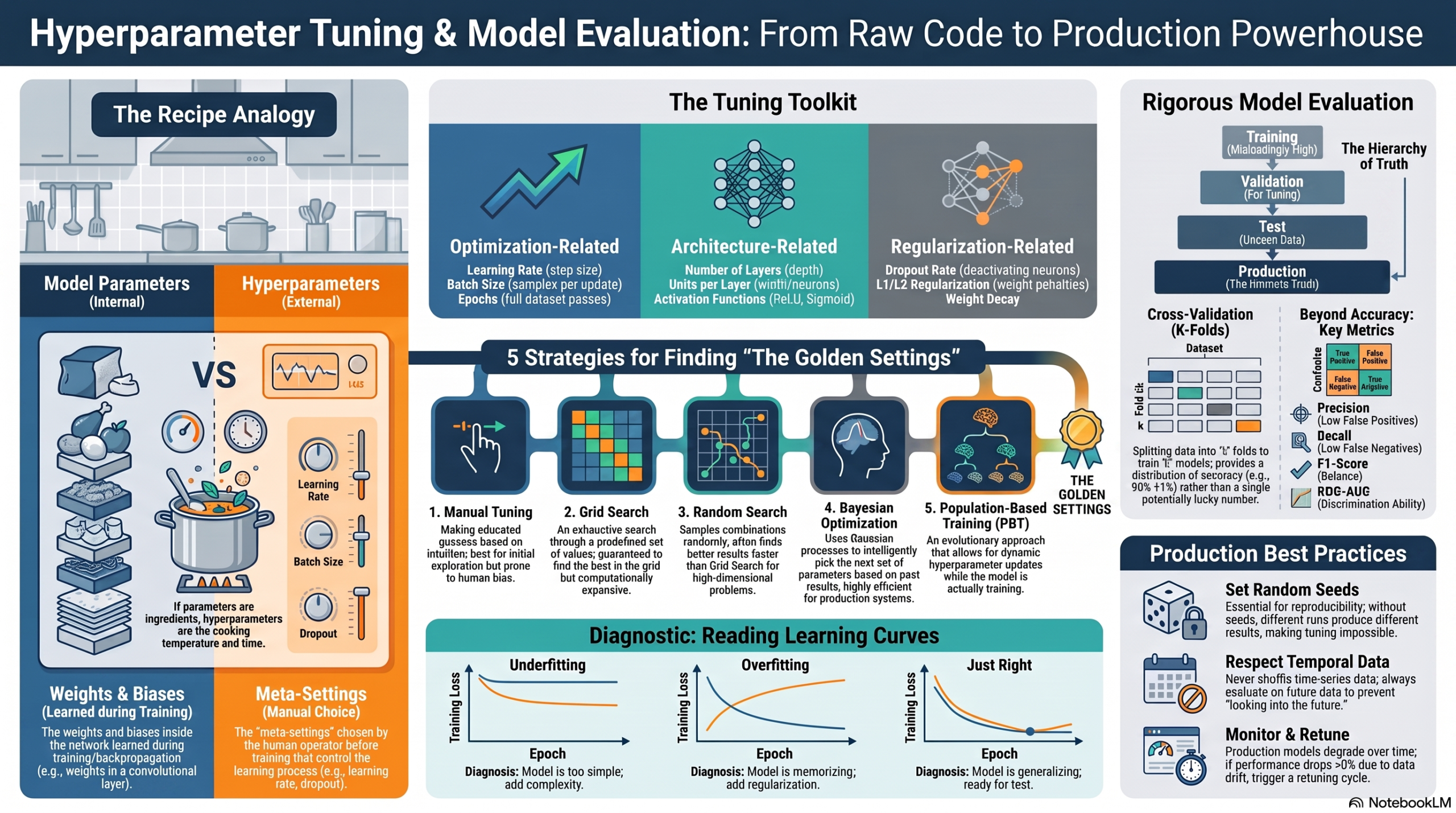
There are two completely different types of parameters in a neural network.
Model Parameters (Learned Automatically)
These are the weights and biases inside your network. Thousands, millions, even billions of internal numbers that your neural network learns automatically during training through backpropagation.
You never set these manually. The training process adjusts them based on your data.
Hyperparameters (Set Before Training)
These are the configuration settings you choose as a human before training begins. They control how your model learns:
- Learning rate (step size in gradient descent)
- Batch size (how many samples before updating weights)
- Number of layers (network depth)
- Dropout rate (regularization strength)
- Activation functions (ReLU, Tanh, Sigmoid)
Think of it like baking:
The ingredients (flour, eggs, sugar) are like model parameters, what the final cake is made of. The temperature and baking time are like hyperparameters, they control how the ingredients transform. You don’t adjust ingredients while baking, but you absolutely must get temperature and time right.
Why This Gets Complicated
Deep learning hyperparameter tuning is tricky because:
1. The space is enormous – You might have 15-30 critical hyperparameters
2. They interact in non-obvious ways – A learning rate that works with one batch size might fail with another
3. There’s no universal answer – Only context-dependent tradeoffs
This is why random guessing fails so badly. This is why you need strategy.
Strategy 1: Manual Tuning (Start Here)
Manual tuning teaches you intuition. Train a model, observe results, make educated changes, repeat.
This phase shows you what actually matters for your problem. Does your model converge? Is it overfitting or underfitting? Which parameters are most sensitive?
Good for: Exploration phase, building mental models
Bad for: Finding optimal combinations, wasting computational resources, confirmation bias
Verdict: Start here, but don’t stop here.
Strategy 2: Grid Search (Exhaustive)
Define specific values for each hyperparameter, then train a model for every combination.
Example:
- Learning rates: [0.001, 0.01, 0.1]
- Batch sizes: [32, 64, 128]
- Total combinations: 3 × 3 = 9 models
The problem: Computational cost explodes exponentially. Four hyperparameters with ten values each? That’s 10,000 models.
Good for: Small spaces (2-3 parameters), abundant computational resources
Bad for: High-dimensional spaces, practical work
Verdict: Use for small initial exploration, but it doesn’t scale.
Strategy 3: Random Search (Sweet Spot)
Here’s something counter-intuitive: research consistently shows random search often outperforms grid search.
Instead of systematic testing, random search samples randomly from your parameter ranges. You decide how many trials (“run 50 trials”) and each trial uses random hyperparameters.
Why it works better: You’re exploring a bigger region of the parameter space. With five hyperparameters, grid search with 10 values each needs 100,000 combinations. Random search with 50 trials explores 50 different regions more efficiently.
Good for: High-dimensional spaces, practical work, most practitioners
Bad for: Guaranteed optimal solutions
Verdict: This is where most teams should be. It’s the practical sweet spot.
Strategy 4: Bayesian Optimization (Advanced)
This stops treating tuning as blind search and treats it as an informed learning process.
The insight: After each trial, you know something. Bayesian optimization builds a statistical model of the landscape and asks: “Which unexplored region is most promising?”
It balances:
- Exploration (checking uncertain regions)
- Exploitation (focusing on promising regions)
Result: Remarkable efficiency. Where random search needed 50 trials, Bayesian optimization often finds something better in 20-30 trials.
Libraries like Optuna make this accessible.
Good for: Serious production work, limited computational budget, high-dimensional spaces
Bad for: Simple problems, over-engineering
Verdict: Worth it when computation is precious.
The Real Challenge: Evaluation Done Right
You’ve found good hyperparameters. Now, how do you know if your model is actually good?
Checking accuracy on a test set is dangerously incomplete. Many practitioners stop there and deploy models that fail spectacularly in production.
The Evaluation Hierarchy
Training Accuracy → tells if model memorized data (usually not useful)
Validation Accuracy → tells if hyperparameter tuning is working
Test Accuracy → performance on held-out data it never saw
Production Accuracy → the truth, how it performs when real users rely on it
Each level can hide problems:
- A model with 99% accuracy might only achieve 70% on a specific demographic
- A stable test model might experience catastrophic drift in production
- A model perfect on your laptop might be too slow when deployed
Use Cross-Validation, Not Just Train/Test Split
Split data into five folds. Train five different models. Get five accuracy estimates.
The mean tells you expected performance. The standard deviation tells you stability.
- Model scoring 92±1% = trustworthy (consistent)
- Model scoring 92±15% = fragile (unstable)
Which would you deploy?
Beyond Accuracy: Choose the Right Metrics
In medical diagnosis: False negatives (missed cases) might be worse than false positives
In fraud detection: Precision and recall need careful balancing
In recommendations: You care about diversity, not just accuracy
Use precision, recall, F1-score, and ROC-AUC. Not just accuracy.
Learning Curves Show You Everything
Plot training vs validation loss over epochs:
- Divergence = overfitting
- Both decreasing together = healthy learning
- Both stuck high = underrating
These curves tell you if your problem is solved.
Common Mistakes That Tank Production Models
Tuning on your test set: If you adjust hyperparameters based on test performance, your reported performance is an illusion.
Solution: Maintain separate validation set for tuning, completely held-out test set for final evaluation.
Ignoring class imbalance: If 99% of data is class A and 1% is class B, a model that “always predicts A” gets 99% accuracy and is useless.
Solution: Report precision, recall, F1-score disaggregated by class.
Only checking aggregate metrics: A model might be 95% accurate overall but 70% for a specific demographic.
Solution: Disaggregate evaluation by meaningful subgroups.
Assuming validation performance matches production: It rarely does. Production data is messier and shifts over time.
Solution: Monitor continuously. Set up alerts for performance degradation.
Best Practices for Production Models
1. Always set random seeds
Deep learning has multiple randomness sources. Without fixed seeds, you get different results every run.
2. Use appropriate metrics
Accuracy is rarely the full story. Use precision, recall, F1-score, ROC-AUC.
3. Embrace cross-validation
It costs more computation but the insights are worth it.
4. Test hyperparameter sensitivity
Perturb good hyperparameters slightly. Robust solutions are better than brittle ones.
5. Monitor continuously in production
Set up dashboards. Define alert thresholds. Investigate degradation immediately.
A Real-World Example
Building a movie recommendation engine:
Phase 1 – Manual exploration:
- Simple 3-layer network (128-64-32 units)
- Default hyperparameters = 78% accuracy
- Through experimentation, discover smaller learning rate and moderate dropout help
Phase 2 – Random search:
- 50 random combinations
- Learning rates: 0.0001 to 0.1
- Batch sizes: 16 to 256
- Dropout: 0.1 to 0.5
- Best result: 87% accuracy (9% improvement)
Phase 3 – Bayesian optimization:
- Use Optuna around promising region
- After 30 more trials: 89.2% accuracy (another 2% improvement)
Phase 4 – Rigorous evaluation:
- 5-fold cross-validation: 89.2% ± 0.8% (stable!)
- Precision: 0.91, Recall: 0.87, AUC-ROC: 0.94
- Learning curves show healthy convergence, no overfitting
- Sensitivity analysis shows robustness
Phase 5 – Production:
- Monitor daily for 6 months
- Accuracy stays at 89.1%
- No drift, no problems
- Investment in proper tuning paid off
Key Takeaways
Hyperparameter tuning isn’t magic, it’s systematic exploration + rigorous evaluation.
1. Start with manual tuning (build intuition)
2. Graduate to random search (practical sweet spot)
3. Use Bayesian optimization (when compute is precious)
4. Evaluate with cross-validation, disaggregated metrics, learning curves
5. Monitor continuously in production
The difference between models that work and models that excel lives in these details.
Most organizations have the tools now. What matters is the discipline to actually do it.
Have you encountered the gap between lab performance and production reality? What hyperparameter tuning strategies have worked for you? What’s gone wrong?
I’d genuinely love to hear about your challenges and victories. Drop them in the comments below.
If you’re building production deep learning systems, share this with your team. These practices might feel like overhead, but they’re what separate systems that work from systems that fail silently.