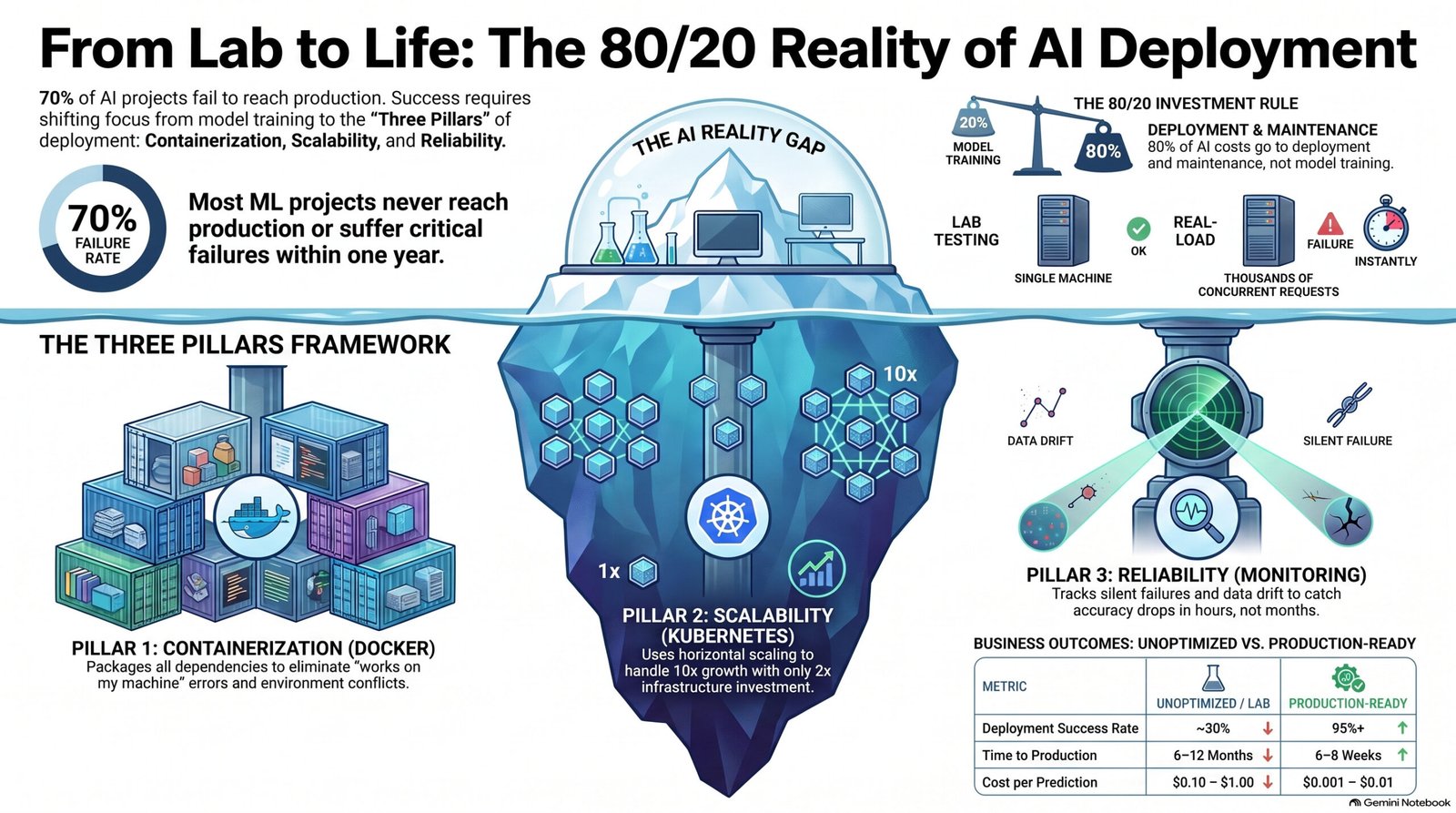
Why most AI projects fail after the model is trained
Training a deep learning model is often the most celebrated part of an AI project. It is where teams celebrate accuracy, impressive benchmarks, and promising prototype results. But the real challenge begins later: deployment.
Businesses do not win with a model that works in a notebook. They win when the model works reliably in production, scales under real traffic, and continues delivering value over time. This is where many AI initiatives stall or fail.
According to industry research, a large share of machine learning projects never make it to full production, and many of those that do struggle within the first year. The reason is rarely poor model design alone. It is usually a combination of weak deployment strategy, poor infrastructure planning, and little operational discipline.
The uncomfortable truth is simple: model performance is not the same as business readiness.
The real bottleneck is not training. It is deployment.
In a lab environment, a model is isolated. The data is stable, the environment is controlled, and the system is built for experimentation. In production, everything changes.
Now the system has to handle real users, real traffic spikes, inconsistent input quality, and evolving business demands. It must run inside a production environment with limited resources, tighter latency expectations, and no luxury of manual intervention.
That is why a model that performs beautifully in a testing environment can still fail in the real world. It might be too slow, too expensive, too fragile, or too difficult to scale. In many organizations, this gap between experimental success and operational reliability is the actual reason AI does not create value.
What usually breaks in production
AI teams often run into a predictable set of issues after deployment:
- Environment mismatch: The model works locally but breaks in the target environment because of dependency, library, or runtime conflicts.
- Latency problems: The model makes predictions quickly in testing but becomes too slow under real user demand.
- Cost explosion: Inference becomes expensive as traffic grows, and infrastructure costs rise faster than expected.
- Scaling bottlenecks: A single instance may work for a small user base, but it cannot handle real-world concurrency.
- Silent performance drift: Over time, the model quality degrades as input data changes, and teams do not notice until business outcomes worsen.
These problems are not signs of weak machine learning. They are signs that the production system was not designed with operational reality in mind.
The three pillars of successful AI deployment
High-performing teams usually focus on three core priorities.
1. Consistency
A production model must run the same way in every environment. If it behaves differently between development, staging, and production, it is not ready for serious deployment.
Consistency requires standardization across dependencies, runtime versions, model artifacts, infrastructure configuration, and deployment pipelines. It reduces the risk of the classic “works on my machine” problem that destroys credibility.
When teams control the environment properly, debugging becomes faster, deployment becomes predictable, and confidence in the system improves.
2. Scalability
Scalability is not just a technical nice-to-have. It is a business requirement. A model that works for a small demo may fail when the business grows.
Real production systems need strategies for concurrency, load balancing, resource management, and elastic capacity. That means planning for growth early instead of reacting only after outage or latency problems appear.
Without scalability, AI systems become brittle. They work for a few tests and then collapse under demand.
3. Reliability and monitoring
A model that is deployed once is not truly deployed. It must be monitored continuously.
Data drift, model degradation, infrastructure issues, and workload spikes can slowly erode quality. If teams are not watching the system closely, they may not notice until after the business is already affected.
Reliability means more than uptime. It means measurable performance, anomaly detection, alerting, rollback planning, and continuous improvement.
Why most organizations underestimate deployment complexity
AI efforts often get over-optimized around model experimentation and underfunded around operations. This creates a dangerous imbalance.
Leadership sees a promising model and expects business impact. Engineering teams see a system that was never designed for real-world traffic, resilience, and ongoing care. The result is a gap between vision and execution.
That gap usually appears in several common forms:
- Model-first thinking: teams optimize for model quality while underinvesting in serving infrastructure.
- Weak ownership: nobody clearly owns the runtime operation, reliability checks, and model health.
- Poor monitoring: the system is running, but no one knows when quality begins to degrade.
- No capacity plan: the model works in a test environment but collapses under real demand.
- Insufficient maintenance budget: teams spend heavily on building the AI system and far too little on keeping it healthy after launch.
This is why many organizations struggle to convert AI investments into durable business value.
What leaders should focus on
Executives do not need to become machine learning engineers, but they should ask the right business questions before they celebrate a model launch.
Questions like these matter:
- What does successful production deployment look like for this model?
- How will we measure quality in real-world use, not just on validation data?
- Are we investing enough in monitoring, maintenance, and retraining?
- Do we have a clear cost and scaling model as usage grows?
- Who owns the operational health of the AI system?
If those questions are not answered, the initiative may look impressive on paper but remain strategically fragile in practice.
Production AI is a system, not a single model
The winning approach is to treat deployment as an operational capability, not an afterthought.
Teams that succeed often build a production workflow that includes:
- clear deployment standards
- versioned model artifacts and environment controls
- performance and cost tracking
- reliable scaling strategies
- continuous monitoring and model evaluation
- rollback and retraining plans
This turns AI from a one-time experiment into a repeatable business system.
The real takeaway
The most valuable AI systems are not the ones with the highest demo scores. They are the ones that can be trusted in production.
Deployment, scalability, and reliability are not separate technical chores. They are the foundation of AI business value.
If a model cannot be deployed consistently, scaled efficiently, and monitored responsibly, it does not create sustainable business value. It simply creates risk.
That is the real difference between an AI experiment and an AI advantage.