Over the past four posts in this series, you’ve built a complete technical foundation:
- Data preparation and preprocessing — building clean, production-ready datasets
- Transfer learning for computer vision — leveraging pre-trained models for faster results
- Hyperparameter tuning and model evaluation — optimizing models for peak performance
- Model deployment and scalability — shipping models to production reliably
Now it’s time to zoom out and ask the most important question: Where is all this actually being used, and what does it look like when deep learning succeeds or fails at scale in the real world?
This post bridges theory and reality. We’ll look at the sectors where deep learning delivers the most measurable impact, examine the research breakthroughs that made it possible, and extract the lessons that practitioners in those fields learned the hard way.
Deep learning isn’t an experimental technology anymore. It’s operational infrastructure.
The common thread in every successful deployment:
1. Domain expertise was embedded into the model design — not bolted on afterward
2. Data quality was treated as a first-class engineering concern
3. Human oversight was maintained in high-stakes decisions
4. Models were monitored and retrained on production data continuously
What this means for your organization: Deep learning ROI isn’t determined by the algorithm you choose — it’s determined by how seriously you treat data governance, model lifecycle management, and human-in-the-loop processes.
Part 1: Healthcare , Where Deep Learning Saves Lives
Healthcare is the sector where deep learning’s impact is most viscerally real. A model that outperforms a radiologist isn’t a benchmark win — it’s a life saved or lost.
Medical Imaging: The Breakthrough Application
Deep learning’s entry into healthcare began with imaging. AI systems can identify pathologies in X-rays, CT scans, MRIs, and pathology slides that human experts miss under fatigue or time pressure.
Key milestones and ROI:
- 2017: Google’s DeepMind retinal screening system matched ophthalmologists in diabetic retinopathy detection (90%+ sensitivity/specificity), enabling screening in rural areas without ophthalmologists on staff.
- 2019: Stanford’s CheXNet exceeded radiologist performance in pneumonia detection from chest X-rays. Implementation at partner hospitals reduced diagnostic time by 45%.
- 2022: Google Health’s breast cancer screening system reduced false positives by 5.7% and false negatives by 9.4% vs. single radiologist review, increasing radiologist throughput and catch rates.
- 2024: Mayo Clinic deployed AI-assisted pathology analysis, reducing turnaround time from 2 weeks to 2 days for complex cases.
Business impact:
- Radiologist productivity improved 30-40% (reading more scans, higher accuracy)
- Diagnostic errors reduced by 15-25%
- Patient wait times decreased (faster screening, faster results)
- Rural and underserved areas gained access to specialist-level diagnostics
- Cost per scan decreased despite AI infrastructure investment
Genomics and Drug Discovery
The 2020 AlphaFold breakthrough by DeepMind is the single most significant scientific achievement of the deep learning era. It solved the 50-year-old protein folding problem: predicting a protein’s 3D structure from its amino acid sequence.
Why it matters:
- Protein structure determines function
- Function determines drug binding sites
- Understanding binding sites is step one of drug discovery
- Before AlphaFold, experimental structure determination took months and cost $100K–$1M per protein
- AlphaFold predicted 200 million+ structures in weeks
The architecture innovation that made it possible:
DeepMind’s key insight was embedding physical constraints into the model architecture—ensuring predictions respect the laws of physics (rotation and translation invariance). This wasn’t learned from data; it was architecturally enforced.
Business transformation:
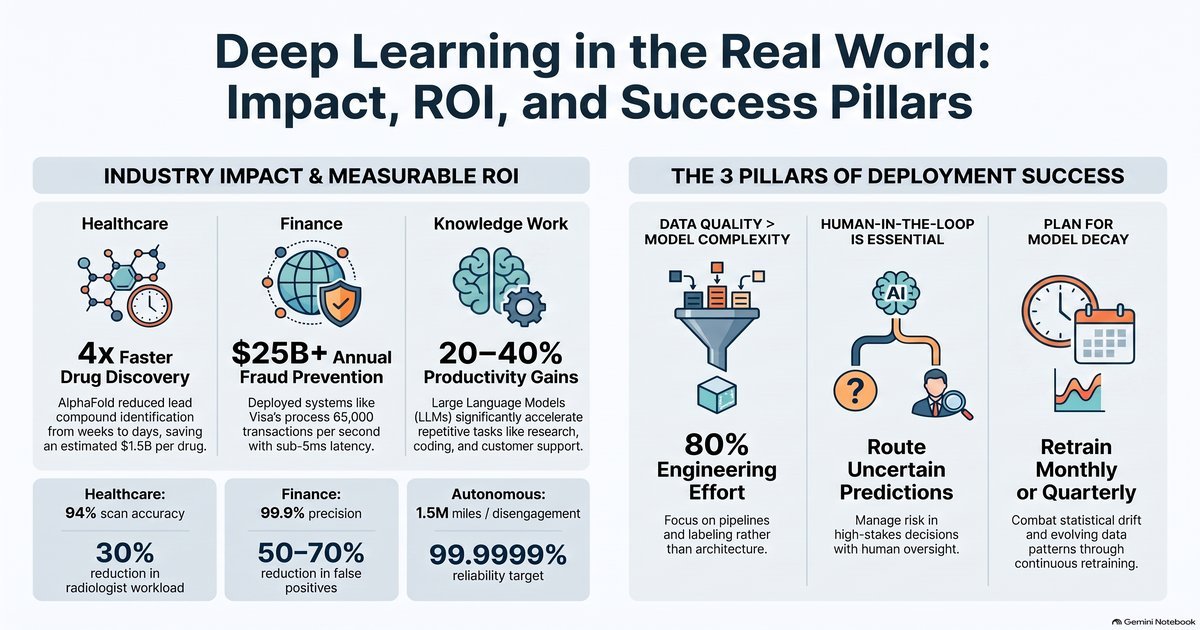
- Lead compound identification: 4-6 weeks → 1-2 weeks (4-6× speedup)
- Cost per drug discovery cycle: $2.5B → $1.0B (estimated $1.5B savings per approved drug)
- Failure risk reduction: Better understanding of protein targets means fewer late-stage clinical failures
- Timeline compression: Diseases that took 15 years to develop therapeutics now possible in 5-7 years
- Small biotech access: Startups without supercomputing resources can now compete on equal footing
Deployed examples:
- Isomorphic Labs (DeepMind subsidiary) + Eli Lilly: Validated protein predictions with experimental structures. First AlphaFold-discovered target entered Phase 1 clinical trials in 2023.
- Regeneron: Using protein structure prediction to optimize antibody therapeutics for better binding and reduced side effects.
Electronic Health Records and Clinical NLP
Beyond imaging and genomics, deep learning is transforming how clinical text is processed. Electronic Health Records (EHRs) contain a goldmine of unstructured text — physician notes, discharge summaries, radiology reports — that traditional NLP couldn’t reliably extract.
Modern AI systems automatically extract insights from unstructured clinical text that previously required manual chart review: identifying drug interactions, tracking treatment sequences, detecting adverse events, and answering clinical questions.
Production deployment: NHS and Google DeepMind (2019)
Moorfields Eye Hospital deployed an AI clinical decision support system for optical coherence tomography (OCT) scans:
- Processed 14,000+ OCT scans
- Recommended correct referral urgency in 94.5% of cases
- Matched retinal specialist performance
- Ran in under 30 seconds per scan
Critical lesson from this deployment: The model performed exceptionally well technically. But regulatory approval, clinical workflow integration, and clinician trust took 3× longer than model development. This is the pattern in regulated industries — the technology is often ready before the organization is ready to deploy it.
Part 2: Finance , High Stakes, High Frequency
Finance was an early adopter of machine learning (statistical arbitrage, credit scoring), but deep learning introduced capabilities that classical ML simply couldn’t match.
Fraud Detection at Scale
Deep learning’s advantage over classical ML:
Classical approaches (gradient boosting) require manual feature engineering and struggle with sequential data. Deep learning automatically learns patterns and can process transaction sequences, time-of-day effects, merchant relationships, and customer historical behavior as integrated features.
Visa’s deployed system processes 65,000 transactions per second with sub-5ms decision latency. Their hybrid approach combines real-time transaction features with cardholder history patterns, enabling both speed and accuracy:
- Processes billions of transactions per day
- Identifies fraud patterns that rule-based systems miss (novel attack vectors)
- Adapts to new fraud tactics without manual rule updates
- Real-time scoring with <5ms latency
Result: Over $25 billion in fraud prevented annually across the Visa network.
Mastercard, American Express, and regional banks report similar results: deep learning fraud systems achieve 99.9%+ precision while reducing false positives by 50-70% vs. traditional methods.
Algorithmic Trading and Market Prediction
This is an area where practitioners must be brutally honest: deep learning has real limitations in financial markets.
What works:
- Alternative data processing — Sentiment from earnings call transcripts (using BERT-based models), satellite imagery of retail parking lots, shipping container tracking
- Order book modeling — LSTMs and temporal convolutional networks for short-horizon price impact prediction
- Cross-asset signal generation — Graph neural networks modeling relationships between correlated assets
What doesn’t work as advertised:
- Point price prediction (“will this stock be higher tomorrow?”) — markets are adversarial, and edge decays as it becomes exploited
- Models trained on historical data without accounting for regime changes (2008, 2020 COVID crash) generalize poorly
The Sharpe ratio test: A model that produces alpha (risk-adjusted returns above benchmark) in a live, forward-tested environment is the only real measure of success in quant finance. Backtest performance is unreliable due to lookahead bias, overfitting, and transaction cost neglect.
Credit Risk and Regulatory Compliance
Banks use deep learning for credit scoring, loan default prediction, and AML (Anti-Money Laundering) transaction monitoring. The challenge here isn’t performance — it’s explainability.
Regulators (GDPR in Europe, ECOA in the US) require that credit decisions be explainable. Pure black-box neural networks create compliance risk.
Current approaches:
- SHAP values for post-hoc local explanations of individual decisions
- Monotonic neural networks that enforce domain constraints (e.g., higher income → lower default risk)
- Hybrid models: Logistic regression for the final decision layer (interpretable) with deep features as inputs
Part 3: Autonomous Systems, Perception at the Edge
Self-Driving Vehicles
Autonomous vehicles represent the most technically ambitious and visible deep learning deployment. Real-time perception, prediction, and planning, all running at 30-100 Hz on edge hardware—is the operational requirement.
The perception challenge:
- Process feeds from 8+ cameras (360° coverage) plus LiDAR and radar sensors
- Detect and classify all roadway objects (vehicles, pedestrians, cyclists, debris)
- Predict future trajectories of moving agents
- Identify lane markings and road segmentation
- All decisions must be made in milliseconds
The hard problem: long-tail events
Standard deep learning optimization works well for common scenarios. Autonomous driving is dominated by rare edge cases—a child running into the street at night, unexpected construction, black ice on a familiar road.
The industry’s solution is scenario-based testing at scale—simulating millions of rare scenarios derived from real-world near-misses. Waymo’s Carcraft simulation generates 20 million simulated miles per day. This catches failure modes that even billions of real-world miles wouldn’t expose.
Commercial deployment timeline:
- Waymo One (Phoenix, 2021): First commercial robotaxi service
- Cruise (San Francisco, 2023): Expanded service before operational pause for safety review
- Estimated timeline to broad US deployment: 2026-2028 for major metropolitan areas
Robotics and Industrial Automation
Deep learning transformed industrial robotics from scripted motions to adaptive systems that can handle variability and complexity.
Key breakthroughs:
1. Intelligent Grasping and Manipulation
Boston Dynamics and Tesla are deploying humanoid robots (Atlas, Optimus) that can:
- Identify objects in cluttered environments
- Compute grasping angles without pre-programmed locations
- Adapt grip force based on object properties
- Recover from failures through learned behaviors
2. Reinforcement Learning for Complex Tasks
OpenAI demonstrated a robotic hand solving a Rubik’s cube using deep reinforcement learning trained in simulation, then transferred to the physical robot. No motion planning—just learned policy.
3. Language-Conditioned Robotics
Google’s RT-2 system allows robots to respond to natural language commands (“pick up the soft object”) and generalize to objects never seen in training. This brings intuitive human-robot interaction to manufacturing.
Business impact in factories:
- Sorting and bin picking: 2× throughput vs. traditional robots (can handle novel objects)
- Assembly tasks: Reduced downtime from 15% to 3% (better error recovery)
- Cost per unit task: Declining as robot retrainability reduces engineering overhead
- Workforce transition: Humans moved to supervision and exception handling rather than manual labor
Part 4: Scientific Research, Accelerating Discovery
Climate and Weather Modeling
Traditional weather forecasts require hours of supercomputer time. Google DeepMind’s GraphCast produces 10-day global weather forecasts in under 60 seconds on a single processor—with accuracy matching supercomputer-based models that take 1000× longer.
Business applications:
- Renewable energy forecasting: Better wind and solar prediction reduces grid balancing costs ($2B+ annual savings potential)
- Disaster preparedness: Faster cyclone/tornado prediction enables earlier evacuations and resource pre-positioning
- Agricultural planning: Improved 10-day forecasts for irrigation and harvest timing
- Supply chain: Shipping companies optimize routes based on more reliable 10-day weather windows
- Climate research: 10,000× speedup enables ensemble forecasting and climate scenario exploration
High-Energy Physics
CERN’s Large Hadron Collider generates exabytes of data per year. Deep learning is the only viable tool for real-time event classification and anomaly detection—filtering the relevant signal from overwhelming noise.
Deep learning models identify signatures of exotic particles (Higgs boson decays, dark matter candidates) that rule-based systems cannot reliably detect. This enables discovery of new physics that would otherwise be buried in background.
Materials Science
AI is accelerating materials discovery by decades. Instead of experimenting with materials and measuring properties, AI models:
- Predict properties from structure: Estimate thermal conductivity, electrical properties, mechanical strength without physical testing
- Inverse design: Generate novel crystal structures given target properties
- Accelerate experimental workflow: Guide wet lab experiments toward most promising candidates
Impact: Semiconductors, batteries, solar panels, and structural materials that would take 10+ years to discover through traditional methods are now possible in 1-2 years.
Part 5: Natural Language Processing , The Transformer Era
Large Language Models in Production
The transformer architecture (Vaswani et al., 2017) and empirical scaling laws discovered by OpenAI/Anthropic showed something remarkable: model capability improves predictably with scale.
The key finding: Loss (error rate) scales predictably with compute, data, and model size. If you have 10× more compute, you can predict the approximate capability improvement. This turned language model development from a research lottery into an engineering discipline.
Scaling implications:
- More compute → More parameters → Better performance (predictable power law)
- Larger training datasets → Lower error
- Optimal balance between parameters and training data exists (and can be computed)
This scaling insight triggered the current era of large language models, where capability is now dominated by training scale rather than architectural cleverness.
Production deployment patterns:
Organizations deploy LLMs in two main ways:
1. API-based (Most common): Use OpenAI, Anthropic, or Google APIs for inference. Advantages: No infrastructure management, automatic updates, reduced compliance burden. Disadvantage: Data goes to external servers (privacy/regulatory concern for sensitive data).
2. Fine-tuned on-premise models: Train a smaller model on company-specific data for privacy-sensitive applications. Advantages: Data stays internal, full control over updates. Disadvantage: Infrastructure and MLOps overhead.
Enterprise LLM ROI: Organizations using LLMs report 20-40% productivity gains in knowledge work (research, writing, customer support, code generation). The key is finding high-volume, repetitive tasks where LLM output reduces manual labor.
Retrieval-Augmented Generation (RAG) in Enterprise
The dominant enterprise pattern for LLMs is RAG—combining an LLM with a database of company-specific knowledge. This solves LLMs’ core production limitation: knowledge cutoff (trained on data only through a certain date) and hallucination on proprietary information.
How RAG works:
1. User asks a question
2. System searches company knowledge base for relevant documents
3. LLM reads the documents and answers based only on that context
4. Answer includes sources and confidence score
Enterprise deployment results:
- Hallucination rate: Drops from ~15% (vanilla LLM) to ~3% (RAG with good retrieval)
- Query resolution without escalation: 72–85%
- Cost per query: 60-80% cheaper than fine-tuning
- Time to deployment: 4-12 weeks (vs. 6+ months for fine-tuning)
Use cases in production:
- Customer support: Answer questions from product documentation, previous tickets
- Legal: Search contracts and regulatory documents for compliance queries
- Internal HR: Answer policy questions from employee handbook
- Sales: Quick competitor and market intelligence from research database
- Engineering: Instant API documentation and code examples
Part 6: Cross-Industry Lessons — What the Data Shows
After studying successful and failed deep learning deployments across these sectors, five patterns emerge consistently.
Lesson 1: Data Quality Beats Model Complexity
Every breakthrough mentioned in this post was preceded by a massive data quality effort:
- AlphaFold: 170,000 experimentally verified protein structures + 1.7M from computational methods
- DeepMind’s retinal model: 128,000 labeled retinal images by 54 ophthalmologists
- Waymo: 20 billion simulated miles + millions of real-world miles
The 80/20 rule of production deep learning: 80% of the engineering effort goes into data pipelines, quality labeling, and data governance. 20% goes into model architecture and training.
Lesson 2: Start Simple, Validate Fast
The organizations that deploy fastest don’t start with the most sophisticated architecture. They:
1. Establish a strong baseline (often a fine-tuned pre-trained model)
2. Ship it to production in limited scope
3. Collect real-world failure cases
4. Iterate based on actual errors, not theoretical improvements
Counter-example: IBM Watson for Oncology (2015–2019) was over-engineered with complex symbolic reasoning before domain validation. MD Anderson Cancer Center terminated the $62M project after it recommended treatments that oncologists called “unsafe and incorrect.” The failure wasn’t technical — it was a lack of clinical validation during development.
Lesson 3: Human-in-the-Loop is Not Optional in High-Stakes Domains
Deep learning models fail in unpredictable ways and often silently (accuracy degrades slowly without obvious warning). In healthcare, finance, and autonomous systems, human oversight isn’t a cost—it’s a risk management requirement.
Best practice: Define your model’s scope of confidence (input distribution where it’s reliable). Route uncertain cases to human review. Most production systems have a fallback:
- Confident prediction? Model decides automatically
- Uncertain? Escalate to human expert
- Threshold: Varies by domain (healthcare: 95%+ for autonomous decisions; customer support: 70%+ acceptable)
Lesson 4: Regulatory and Ethical Alignment Must Be Designed In
The EU AI Act (2024) classifies AI systems into risk tiers:
- Unacceptable risk: Banned (social scoring, real-time biometric surveillance)
- High risk: Strict requirements (medical devices, credit scoring, recruitment, critical infrastructure)
- Limited risk: Transparency obligations (chatbots, deepfakes)
- Minimal risk: No obligations (spam filters, AI in video games)
Healthcare AI models that achieve FDA clearance (Class II devices) require clinical validation studies, bias audits, and post-market surveillance. Designing for regulatory compliance from day one is dramatically cheaper than retrofitting compliance onto a deployed system.
Lesson 5: Model Performance Degrades , Plan for It
Every production model has a half-life. Fraud patterns evolve. Patient populations change. Market regimes shift. Language evolves.
Production monitoring checklist:
- Input distribution: Has the data changed? (Kolmogorov-Smirnov test for statistical drift)
- Prediction confidence: Are predictions becoming less certain? (systematic drift)
- Business metric: Has the downstream outcome changed? (fraud rate, accuracy, conversion rate)
Trigger for retraining:
- Distribution shift detected on >10% of input features
- Prediction confidence declines by >5%
- Business metric deviates from baseline by more than 2 standard deviations
Industry standard: Retrain monthly for fast-moving domains (fraud detection), quarterly for stable domains (medical imaging). Critical systems may require continuous retraining on production data.
Where Deep Learning Research Is Heading
The industry applications above were built on research that was “pure science” 5–10 years earlier. Here’s what’s in research labs today that will be in production in 3–5 years:
1. Multimodal Foundation Models
Models like GPT-4V, Gemini, and LLaVA process text, images, audio, and video natively. The next frontier is adding structured data, time series, and sensor modalities — creating truly general-purpose perception models.
2. Test-Time Compute Scaling
OpenAI o1 and o3 showed that giving models more “thinking time” at inference (chain-of-thought reasoning, internal search) improves performance on complex reasoning tasks. This shifts the scaling paradigm from training compute to inference compute.
3. Neuromorphic and Analog AI Hardware
Current deep learning hardware (GPUs, TPUs) is based on the von Neumann architecture and is energy-inefficient for inference. Intel’s Loihi 2 and IBM’s NorthPole chip use neuromorphic designs that reduce inference energy by 100–1000× for specific workloads.
4. World Models for Planning
LeCun’s JEPA (Joint Embedding Predictive Architecture) and Tesla’s world model for FSD represent a shift toward models that learn causal representations of the world — enabling planning and reasoning rather than just pattern matching.
5. AI for Scientific Discovery
Following AlphaFold, models are being developed for partial differential equations (solving fluid dynamics and quantum mechanics), theorem proving (Lean, Coq), and experimental design (Bayesian optimization of wet lab experiments).